Documents
Document Fraud Detection: AI-Generated and Altered Files
How to spot a fake utility bill, pay stub or bank statement, then confirm with the issuer. Choose fraud detection software by what each tool proves.
Published · Updated · 19 min read
On this page
Choose document verification and fraud detection tools by the evidence your team needs: how prose was drafted, whether a page was generated, whether a material field changed, or whether an issuer confirms a claim. These are different review tasks, even when they concern the same PDF.
Text-origin analysis can help direct a drafting-policy review. File comparison can reveal an altered payment field. Issuer confirmation can establish whether a new account was authorized. Matching each tool to its task gives reviewers a useful next action and keeps the procurement scope clear.
Four cases that require different evidence
The FBI's December 2024 alert describes criminals using generated text and images, including identification documents, to make fraud more believable. FinCEN's November 2024 alert describes suspicious activity reports involving suspected deepfake media and fraudulent identity documents targeting financial institutions. Neither alert estimates fraud prevalence across ordinary business documents. FBI alert, FinCEN alert, pages 1–3.
Document fraud covers falsified documents, whether generated from scratch or altered from a genuine original, and genuine documents presented in a false context. For practical review, separate four cases. They can overlap within one submission.
| Review task | Tool or check to evaluate | Evidence the reviewer still needs |
|---|---|---|
| AI-assisted writing | Text-origin analysis on sufficient prose in a supported language | The applicable disclosure rule, drafting account and supporting records |
| A generated page or document image | Image analysis evaluated for the relevant document images | An independently obtained issuer copy or issuance record |
| Local changes to an existing document | Field and version comparison; image or file analysis suited to the input | A reliable reference and whether the change was authorized |
| An authentic file in a false context | Party, date and transaction matching; independent source confirmation | Evidence that this document supports this particular decision |
The last case is easy to miss. An unmodified bank statement from a previous period may be authentic but insufficient to establish a present balance. A genuine supplier invoice does not establish that an email directing payment elsewhere was authorized. Image and file checks can find nothing unusual while the business claim remains unsupported.
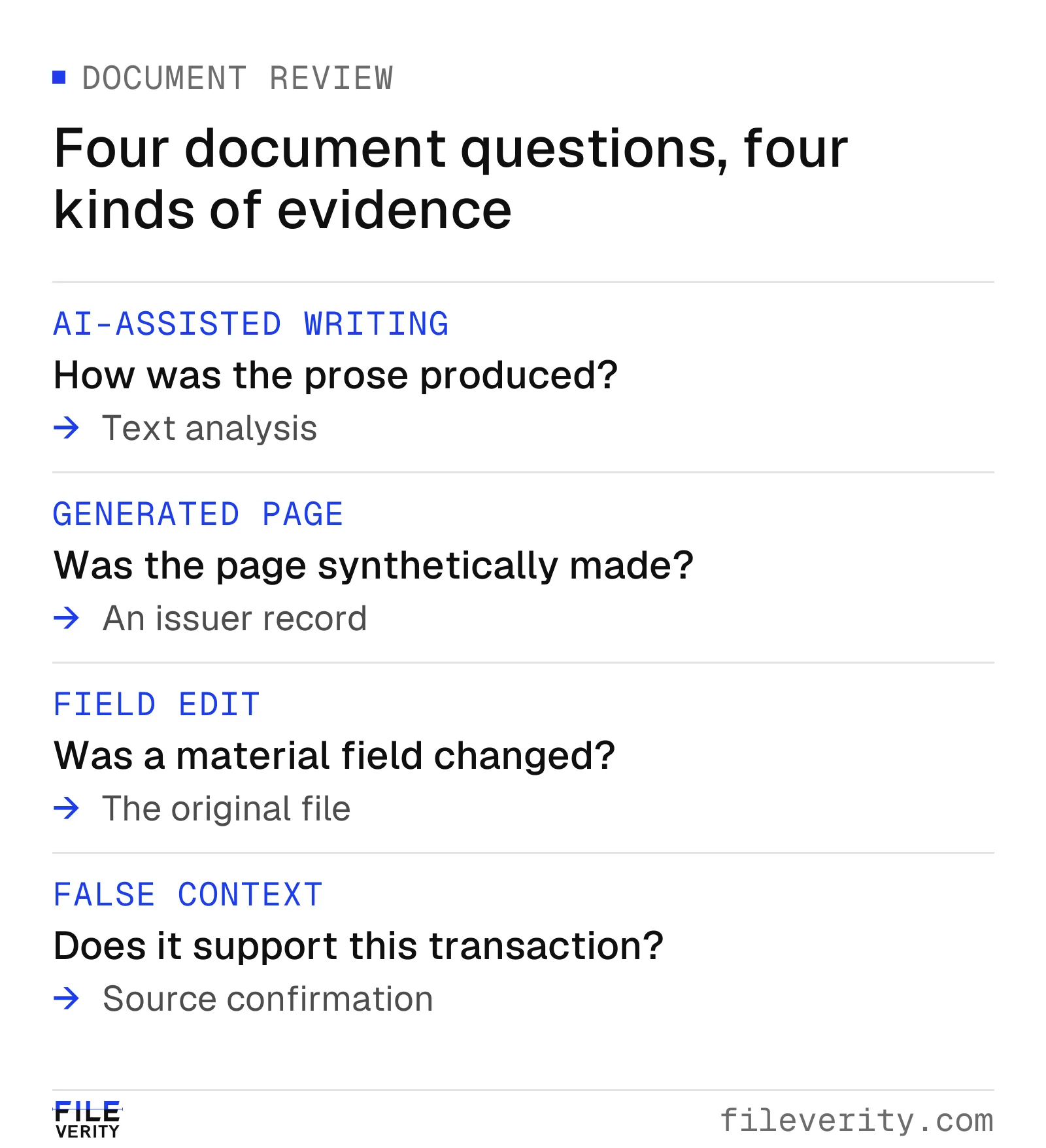
Match the evidence to the question: writing origin, page generation, field alteration or transaction context.
How to spot a fake bank statement, pay stub or utility bill
Bank statements, pay stubs and utility bills are routinely requested as proof of funds, income and address in lending, leasing, onboarding and claims. Each is easy to download as a PDF and easy to edit, and each has an issuer who can confirm it. Checks on the document nominate the fields to question; the issuer settles them. Receipts and supplier invoices have their own guides: detecting fake receipts and verifying an invoice before payment.
| Document | Fields to verify | Checks on the document | What settles it |
|---|---|---|---|
| Bank statement | Account holder, balances, individual deposits, statement period | Running balances reconcile; transactions fall inside the period; no pages missing | The bank, through a route the applicant does not control, or consented account-data access |
| Pay stub | Employer, gross and net pay, year-to-date totals, pay dates | Year-to-date figures fit the pay rate and periods elapsed; deductions move with gross pay | The employer, through contact details you look up; IRS wage records |
| Utility bill | Name, service address, issue date | Service and mailing addresses consistent; account number and billing period agree across pages | The utility, through a number from its official website, or a second, unrelated proof of address |
Bank statements
An altered bank statement can keep a genuine layout while changing the holder's name, a balance or individual deposits. Start with arithmetic: the opening balance plus deposits minus withdrawals should produce each running balance and the closing balance, and every transaction date should fall inside the stated period. A break in that chain identifies the field to confirm. A reconciling statement clears nothing on its own, because a careful forgery can be internally consistent.
Mortgage underwriting shows what a complete statement contains and what direct verification looks like. Fannie Mae's Selling Guide requires statements that identify the institution and the account holder and show at least the last four digits of the account number, the period covered, all deposits and withdrawals and the ending balance. Its direct verification form must be sent from the depository institution itself. The same guide also accepts statements the borrower downloads, which is why a downloaded PDF alone should not settle a balance that decides the outcome. Fannie Mae Selling Guide, Verification of Deposits and Assets.
For a PDF statement, the file's own record can show whether it was saved again after the bank produced it: editing software named in the metadata, a modification date later than the creation date, or incremental saves. Those observations point to pages to confirm. They do not prove the content changed, because legitimate tools also re-save PDFs. The PDF edit-checking guide covers how to read them.
Pay stubs and proof of income
A fake pay stub can come from an online template or from editing a genuine one. Check its internal consistency: year-to-date gross pay should fit the current-period gross and the number of pay periods elapsed, allowing for raises, overtime and bonuses; taxes and deductions should move with gross pay; pay dates should match the stated pay frequency; and the employer's name and address should match a listing you find independently. For the full issuer-first workflow for lenders, landlords and HR teams in the United States and Canada, see how to spot a fake pay stub.
Fannie Mae's documentation standards illustrate what makes a stub checkable: the most recent paystub must be dated no earlier than 30 days before the loan application and include all year-to-date earnings, and W-2s must clearly identify the borrower as the employee. Fannie Mae Selling Guide, Standards for Employment and Income Documentation.
Proof of income verification works best through records the applicant did not produce. Contact the employer's payroll or HR department using contact details you look up rather than those printed on the stub. For tax records, the IRS Income Verification Express Service lets a taxpayer authorize a participating lender to obtain a transcript, and the IRS releases records to a third party only with the taxpayer's consent. The request form, Form 4506-C, covers return transcripts and wage and income transcripts that include Form W-2 data. IRS Income Verification Express Service, Form 4506-C. Transcripts reflect returns and information returns already filed, so they confirm earlier years' wages rather than the current pay period.
How to spot a fake utility bill and check proof of address
To spot a fake utility bill, test the name, service address and issue date, because a forgery may need to change only one of them. Check that the service and mailing addresses are used consistently, that the account number and billing period agree across pages, and that the issue date fits the billing cycle. A genuine bill shows that an account exists at an address; it does not by itself show that the applicant lives there. Confirm the account with the utility through a number from its official website, or request a second proof of address from an unrelated source, following the same rule as for any independent source confirmation.
For all three documents, Fileverity's document report records what the PDF says about itself: creating and saving software, created and modified dates, incremental saves and whether a digital signature is present. It does not compare amounts, fonts or layout with the issuer's original and does not decide whether a balance, wage or address is genuine. That confirmation comes from the bank, employer, IRS or utility.
When writing-origin analysis earns its place
Use text-origin analysis when your organization has an explicit drafting or disclosure requirement and the document contains enough prose for the selected method. The result can direct a reviewer to passages that need a drafting explanation. Factual claims in those passages still require their own checks.
Fileverity document verification assesses AI-writing signals in the running prose of PDF, Word and text files in English, French, German, Spanish and Chinese, and flags the passages that read as AI-written, with page or paragraph references. It is built for teams reviewing narrative documents under a defined drafting policy. The report also records what the file says about itself: creating software, dates, saved versions, AI labels and whether a digital signature is present. Document analysis checks supported PDF signatures against configured trust material and distinguishes valid, invalid and indeterminate results. Keep issuer confirmation and any additional signature validation with the case record. Forms, tables and very short text are outside the writing assessment. Document analysis extends the same report to the photos inside a document, scanned pages and the PDF's saved versions and signatures, with a risk level from L0 to L5 and supporting findings.
Independent benchmarks such as RAID (ACL 2024) show that text detectors behave differently across domains and generation conditions. That is why Fileverity publishes its error rates by language, document type and condition on the document accuracy page; evaluate any provider on your own document types and writing conditions. RAID paper and abstract.
Example: reviewing an AI-use disclosure in a supplier narrative
Suppose a procurement team requests a detailed security-control narrative from a supplier. Its stated policy allows AI drafting assistance when disclosed and requires an accountable reviewer to confirm the technical claims. The supplier submits several pages of running prose and declares that no AI drafting assistance was used.
If a supported text-origin check flags passages, the reviewer can ask a targeted question: “Please explain how these sections were prepared and provide the available draft history, source notes or reviewer record.” The team checks the control claims separately through its established assessment. It does not reject the supplier on the text signal alone.
| Follow-up evidence | Review action | What closes the drafting question |
|---|---|---|
| Supplier confirms permitted AI assistance | Correct the disclosure and verify the required human review | Updated declaration and accountable review record |
| Supplier provides a supported human-drafting account | Reconcile the account with the original concern | Reviewer records why the concern is cleared or what remains open |
| Available records do not resolve the concern | Request the specific missing material and assign an owner | Evidence arrives or the policy's exception process determines disposition |
A negative or inconclusive text result does not establish that the disclosure is correct. Apply the same disclosure requirements consistently. If the organization permits drafting assistance without disclosure and only needs to verify the technical claims, spend the review effort on those claims instead.
The value to test is concrete: can reviewers use the analysis to ask better drafting questions, interpret benign assistance correctly and close the review with an accountable explanation? Measure that in an authorized evaluation before adding it to routine intake.
Examine each evidence layer for a specific purpose
Preserve the submission and its context
Retain the file as received, its filename, receipt time and channel, along with the message or submission identifier. Keep analysis copies separate. A cryptographic hash can identify the exact bytes examined later; it does not establish that those bytes came from a legitimate issuer.
Record whether the input is a native PDF, a scan, a phone photograph or a screenshot. A screenshot may be sufficient to read an amount but inadequate to inspect the original file structure. Request the original export through the approved channel when that distinction matters. Record any conversion, OCR or cropping performed during review so that artifacts introduced by your own process are not attributed to the submitter.
Reconcile extracted text with the visible page
Text extraction helps locate names, dates, amounts and references. Optical character recognition, or OCR, estimates text from page pixels. Neither should silently replace the visible source for a consequential field.
Compare the extracted value with the page location. If OCR reads an account digit differently from what a reviewer sees, label it an extraction discrepancy and resolve it using a better copy or issuer record. Do not describe the mismatch as an alteration finding. Check page coverage too: missing extracted text can mean a skipped page rather than missing content.
OCRmyPDF's official documentation explains that its OCR sidecar may omit pages that already contain text or were skipped, and that the wrong language setting can reduce OCR quality. A text output is therefore not automatically a complete transcription of the document. OCRmyPDF cookbook.
The technical principle: contextual text representations, not a list of “AI words”
A word does not carry a fixed authorship label. “Therefore” can occur in a human analysis, a generated answer or a quoted passage. A contextual text model represents a token using its surrounding text, allowing a classifier to learn patterns across expressions and passages rather than merely count suspicious vocabulary. Tokens are model input units and may be parts of words.
Fileverity's writing-origin assessment works on suitable extracted prose and reports its findings by passage, with page or paragraph references. Signals drawn from neighboring text describe the same writing; they are not independent votes.
Why retain local information as well as a broader impression? Consider a constructed sequence of ten passage-level scores: nine are 0.1 and one is 0.9. Their simple average is (9 × 0.1 + 0.9) / 10 = 0.18. The average conceals the concentrated difference. These illustrative scores show why a whole-document average can lose useful local information; Fileverity uses its own assessment and aggregation methods. A local peak also does not prove generation: quotations, templates and a change of author or subject can require explanation.
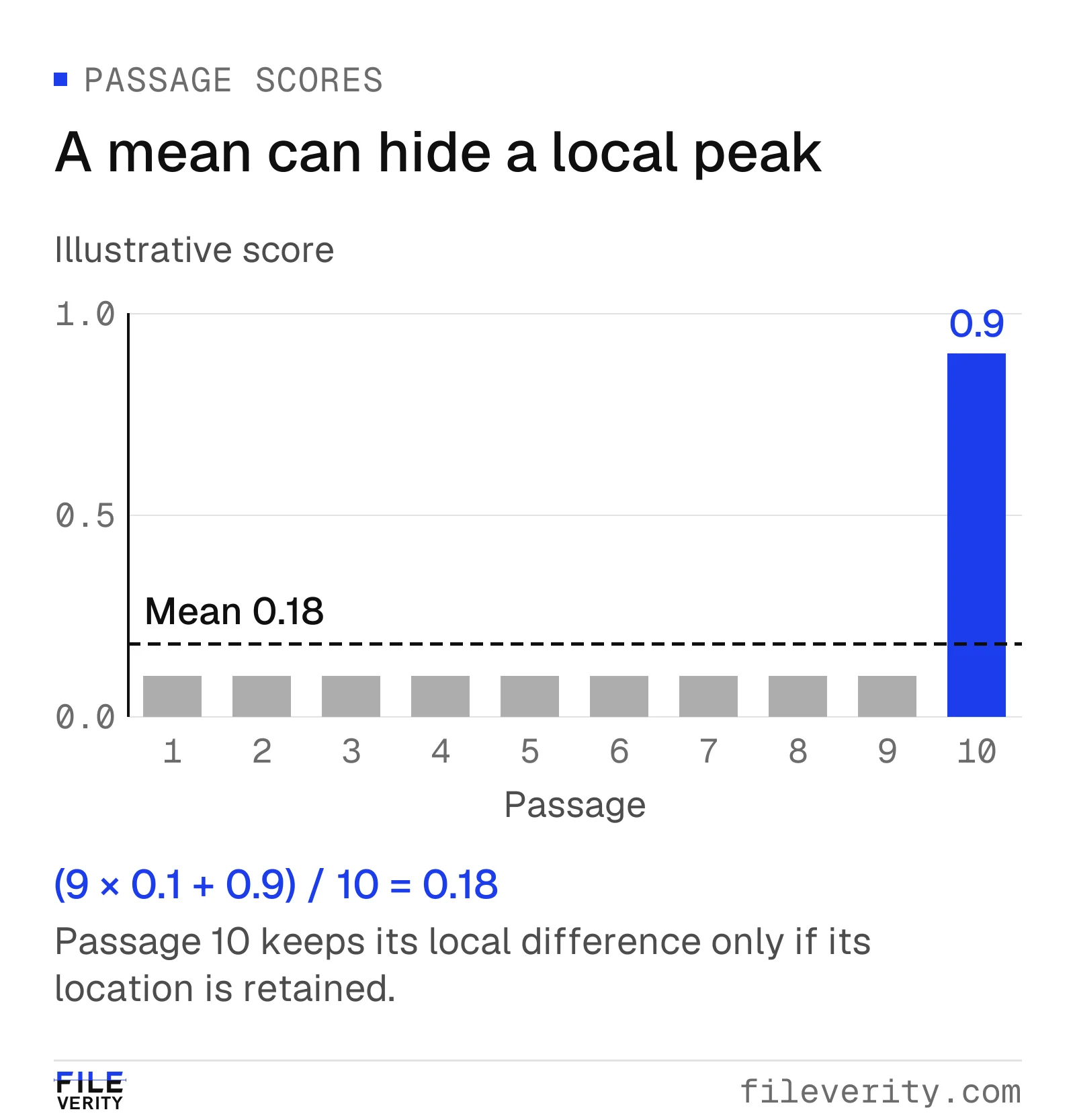
Illustrative passage scores: a mean of 0.18 obscures the single passage at 0.9. Retaining its location makes a targeted drafting question possible.
This mechanism also explains why a table of account labels is not interchangeable with a narrative of the same byte length. Repeated labels and numbers provide little connected linguistic context. A scan with no extracted text provides none to a text classifier. A short passage supplies fewer contextual observations; adding copies of the same line does not create independent evidence. Fileverity therefore limits writing assessment to suitable prose and distinguishes inputs that cannot support it.
For a supplier security narrative, a passage-level concern can direct a drafting question to the relevant explanation rather than casting suspicion on attached certificates or every claim in the document. Confirm authorship context and factual assertions separately.
In a Fileverity report, that concern appears as numbered passages with page or paragraph references, next to the file's recorded creating software, dates and any AI labels, so the drafting question can cite the exact passage rather than the document as a whole.
Inspect the file and rendered image separately
File examination can identify the presence of text layers, embedded images, metadata and signatures. Record what was inspected and which questions those observations can answer. A producer field naming an editor is a clue about software processing, not proof that a payment field was maliciously replaced. Routine export and processing also change files.
At the page level, inspect material fields in context. Differences in alignment, character appearance or local image quality can justify closer comparison. They do not identify the author or intent on their own. A mixed scan assembled from legitimate sources may have uneven quality; a false claim may appear perfectly consistent. Use visual observations to nominate a field for verification, rather than treating a whole page as condemned by one unusual patch.
If a signature is material, use a capable validator and record its actual findings, including the signed revision and trust outcome. A visible signature picture is not that validation. Keep the narrower question of document integrity separate from whether the signer had authority to approve the transaction.
A historical balance sheet: one changed line breaks the total
This comparison uses a real scan of Wachovia National Bank's 1906 financial statement. It is the bank's own balance sheet, not a customer's account statement. Transcribed in decimal-dollar notation, the source lists “Cash and Due from Banks” as 268,231.30 and total resources as 839,320.91. The figures here normalize the scan's typographically separated cents into decimal notation. Fileverity used AI to change that cash line to 368,231.30 in a derivative; the printed total remains 839,320.91.
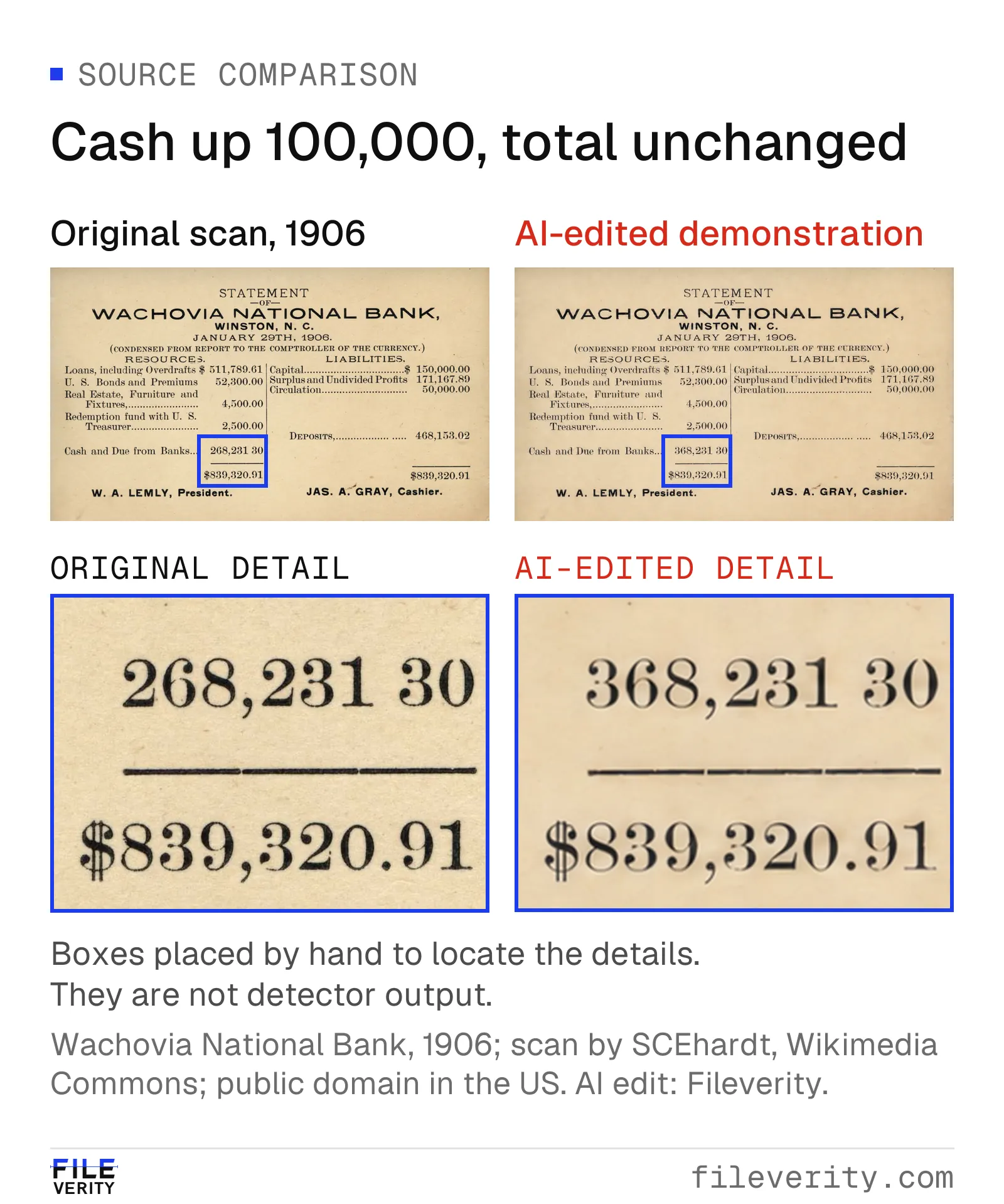
AI-editing demonstration using a real bank balance sheet: increasing the cash line by $100,000 leaves the resource entries out of balance with the printed total.
Source: Wachovia National Bank, 1906; scan by SCEhardt, Wikimedia Commons; public domain in the United States. AI alteration and comparison layout: Fileverity. The original scan is retained separately.


Start by checking the extracted amount against the visible line. Then add the resource entries in the edited copy: the unchanged source total of 839,320.91 plus the added 100,000 produces 939,320.91, which is 100,000 above the printed total.
In a live review, confirm that all relevant rows, adjustments and pages are present before concluding that a total fails to reconcile. Then verify the needed financial facts through an approved independent source. Correct arithmetic alone would not authenticate the issuer. The arithmetic check is a numerical document-review task; for a scan like this one, Fileverity image verification examines the page image for AI generation, local manipulation and provenance, marks the region a finding concerns and records the examined file's SHA-256 fingerprint and timestamp validation status.
Obtain independent source confirmation
Independence concerns how the contact route was obtained. A phone number printed on the disputed invoice, a link in its email or a second attachment from the same sender does not establish a separate source. Use previously verified supplier contact details or another approved route established outside the disputed submission.
Ask the issuer to confirm the relevant fields, not merely whether the layout looks familiar. For a changed payment instruction, confirm the invoice reference, beneficiary, destination and authority for the change through the organization's supplier process. Keep sensitive details in the controlled record and disclose only what is necessary for verification.
The FBI advises independently looking up company contact details and verifying changes in account numbers or payment procedures. This supports checking the instruction through an established route rather than replying within the same suspicious exchange. FBI business email compromise guidance.
Worked example: a supplier invoice with a new payee
Consider a different hypothetical task. Invoice 1042 requests $18,400, matching the purchase order and delivery record, but its payment details and accompanying email direct payment to a new account. Verify the authority for that account change through the supplier's established contact route.
Preserve the attachment and message, confirm that the displayed account differs from the approved vendor record, and hold the new-account payment under the payee-change process. Contact an authorized supplier representative through the route recorded during onboarding. A formatting difference may guide examination, but the independent confirmation determines the next business action:
- Confirmed: complete the required payee verification and approval controls before releasing payment.
- Contradicted: keep the disputed instruction blocked and route the case to fraud or security response, retaining the supplier's confirmation and independently obtained invoice.
- Unresolved: assign an owner and deadline for the missing confirmation; use the established exception process if it cannot be obtained.
The resulting record states which instruction was confirmed or denied and by whom. The team can resolve the payment question without attributing the attachment to AI or a particular editor.
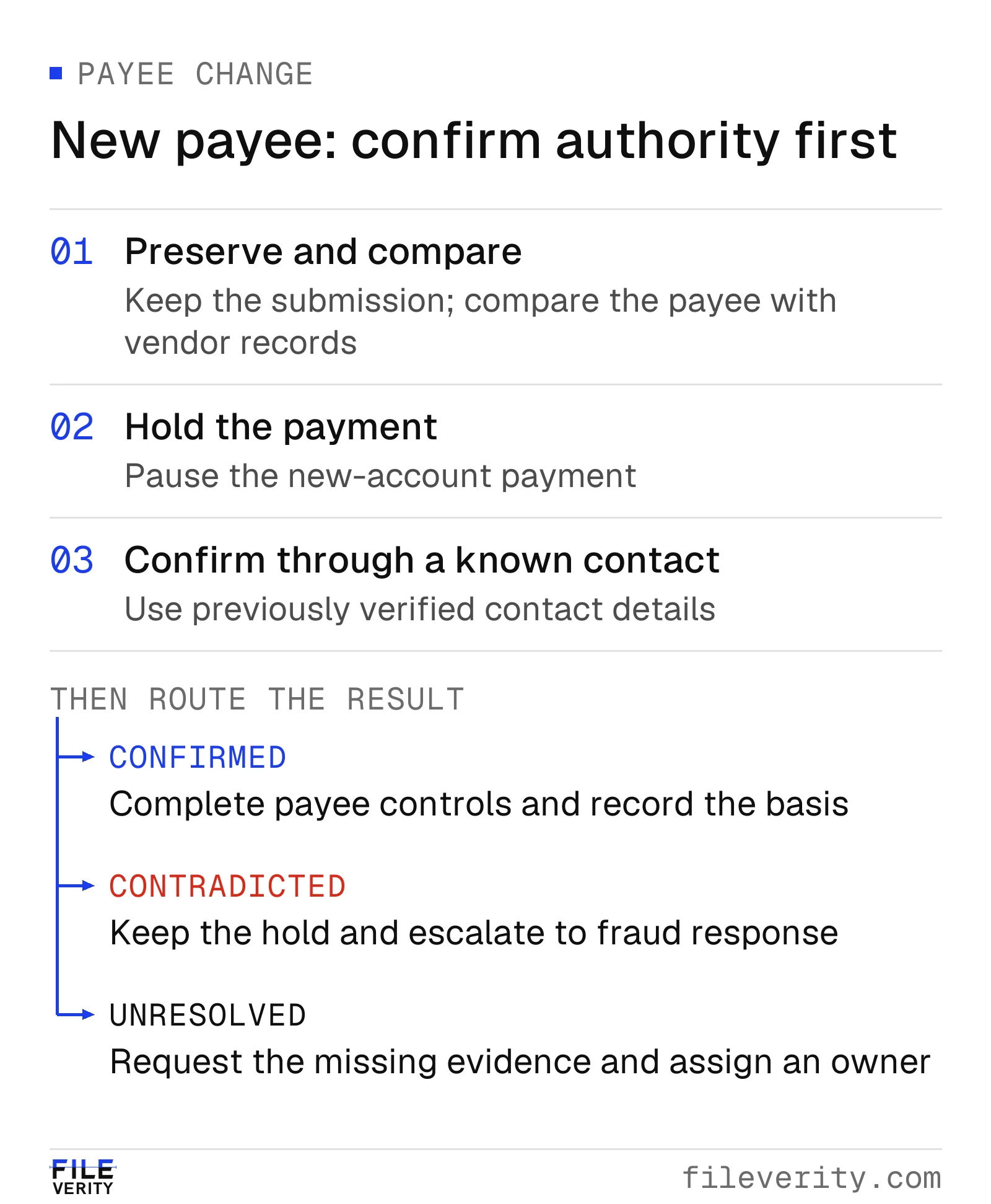
Route a changed payment instruction by the supplier's response: confirm and complete controls, hold and escalate, or request the missing evidence.
Route the case by the unresolved risk
Use evidence states that tell the next reviewer what to do. A single “suspicious” bucket mixes technical limitations, factual contradictions and ordinary administrative exceptions.
| Evidence state | Appropriate route | Exit condition |
|---|---|---|
| Input cannot support the check | Request original or better-quality material | Suitable input received, or documented incomplete-submission decision |
| Extraction and page disagree | Manual field reconciliation | Value resolved and source recorded |
| Appearance is unusual; material facts untested | Targeted comparison or specialist review | Relevant field confirmed, contradicted or explicitly unresolved |
| Material claim independently confirmed | Complete remaining business controls | Authorized approver records basis for action |
| Material claim independently contradicted | Hold affected action and escalate | Responsible team determines response and permitted next steps |
| Required confirmation unavailable | Pending review with owner and deadline | Required evidence arrives or established exception process decides disposition |
Apply the stronger route when consequences demand it, even if a detector reports no anomaly. Conversely, an unexplained visual difference should not erase reliable corroboration without a reasoned account of what remains in dispute. Document exceptions so that similar cases are handled consistently.
A reusable document review record
This template keeps observation, inference, corroboration and action distinct. Populate it with references to controlled evidence rather than duplicating full identity or banking information in free-text notes.
| Record field | What to enter |
|---|---|
| Decision and ownership | Case ID, proposed action, applicable policy, reviewer and approver |
| Submission and scope | Stored original, receipt details, pages or passages examined, input limitations |
| Observation and interpretation | Exact result or discrepancy, its location, supported inference and remaining alternatives |
| Checks and corroboration | Tool/version, retained result, drafting records or independent source confirmation |
| Resolution | Confirmed, contradicted or unresolved for each question; action and approving person |
| Follow-up | Missing evidence, owner, deadline and controlled record location |
The separation helps another reviewer reconstruct why a decision was made. “Font mismatch” is an observation. “Possibly replaced payment block” is an inference. “Supplier denied the change through the verified contact” is corroboration. “Payment held and referred” is an action. Combining them into “AI fraud detected” discards the most useful evidence.
Document fraud detection software: what each type verifies
Products sold as document fraud detection software or document verification software do different jobs. Map each to the evidence it produces before comparing prices.
| Software category | What it examines | What it can establish | What it cannot establish |
|---|---|---|---|
| Document forensics and tamper detection | File structure, metadata, page images, fonts and layout | Signs that a file was edited or assembled, and where | That the original content was true, or who made a change |
| Source-data verification | Records obtained from a bank, employer, payroll provider or tax authority with consent | Whether a stated balance, income or employment matches the source | Anything about the file the applicant uploaded |
| Identity document verification | An ID document image, often with a live capture of the holder | Whether the ID appears genuine and matches the person presenting it | Funds, income or address claims made in other documents |
| Text-origin analysis | Running prose in letters, reports and narratives | Whether passages show AI-writing signals, for a drafting-policy review | Whether figures, fields or the issuer are genuine |
| Digital signature validation | Signatures and certificates embedded in a PDF | Whether a signed revision is intact and the signer is trusted | Whether later unsigned content, or the business claim, is valid |
Where an issuer exists, source-data verification is the layer that settles a field, because it bypasses the submitted file. Forensic and text checks earn their place where no source is available, where volume means source checks must be targeted, or where the file itself is part of the evidence. Ask each vendor which document types, formats and languages are covered; what the output states and what a reviewer can retain; how scans, screenshots and short text are reported; what error rates it publishes for your document types; how long files are kept; and how consent is handled for source data.
Turn the task into an evaluation request
Before preparing a large test collection, ask each provider to map its product to the four tasks at the top of this guide. Obtain supported formats and languages, input requirements, inconclusive-result handling and the evidence a reviewer can retain. Include data handling and the proposed plan's price in this first comparison. A product name containing “document authenticity” is not a coverage specification.
Next, use a small authorized collection to identify obvious mismatches. For writing-origin analysis, include sufficiently long human-drafted narratives, documented AI drafts and permitted assisted writing representative of your policy. Keep short forms and scanned-only inputs visible as coverage tests rather than silently treating them as cleared documents. For image or field-change tools, use a separate collection with known page changes and reliable reference versions. This initial fit check does not establish an error rate; use a planned, separate evaluation before adoption.
Record whether reviewers understand the output, what follow-up they request and how long resolution takes. Compare the complete workflow cost, including analyst time and repeat submissions, alongside software charges. Keep policy decisions with the responsible reviewer.
For file checks and detection of AI-written passages, start with Fileverity document verification. Your first document check is free, with a result summary: you see the risk level and the recommended action, and a document credit unlocks the full document report with the flagged passages, the photos and the edit history. For claim packages with photos, or PDFs whose edit history matters, that document report is the one to use. For volume pricing or claims-system integration, talk to sales with the following brief:
We review [document types] in [languages], at approximately [volume]. Our drafting or disclosure policy requires [specific requirement]. The inputs are [formats, available text layer and typical prose length]. Please confirm the supported scope, data-handling terms, evaluation options and pricing for this workflow.
If your immediate concern is a changed amount or signature, follow the PDF edit-checking guide. Keep issuer confirmation in the business process wherever authorization or factual claims determine the outcome. Fileverity analyzes files on servers operated by Entogo in Toronto, Canada and deletes them once the analysis is complete. The Trust & security page sets out data handling, including private deployment for Enterprise on request.
By Yang Zheng · Reviewed by Bill Liu