Claims and refunds
AI Insurance Fraud: A Practical Claim Photo Review Workflow
Review insurance claim photos with a practical evidence workflow, worked example and checklist. Separate AI image findings from decisions about fraud.
Published · Updated · 14 min read
On this page
An insurance photograph supports a proposition: this vehicle was damaged, this room flooded, or this possession existed before a loss. Reviewing the photograph means testing that proposition, not simply deciding whether its pixels look artificial. A generated scene, an altered damage area, a photograph from an earlier incident and an incomplete genuine image each require a different follow-up.
The practical goal is a targeted next step: obtain a clearer view, reconcile an earlier photograph, ask a specialist about a local alteration, or close a concern that the evidence explains. A finding about AI-generated or altered image content can help select that step. The claim decision still belongs to the insurer’s responsible reviewer, using the full evidence.
For a handler reviewing a case now, start with the four review routes below and the door-damage example, which includes a copyable evidence request. For a team designing a process, use the handoff table and the separate photo/case measures to define responsibilities and evaluate a limited pilot.
What the evidence says about AI insurance fraud
In June 2026, Aviva reported an increasing number of claims supported by AI-generated images and manipulated documents, particularly in motor insurance. It described analytics and AI-enabled tools operating with human oversight. This is one insurer’s account of its experience. Its headline fraud totals cover wider suspected fraud, not a measured total of AI-generated claim photographs. They should not be reused as an industry AI-fraud prevalence estimate. Aviva’s announcement
Teams need to distinguish different image problems and connect findings to the facts under review. Introducing a detector without that connection can produce more alerts while leaving investigators unclear about what evidence to request.
Start with the proposition, then classify the uncertainty
Write a one-sentence purpose for the image before reviewing it: “This photograph is offered to show damage to the left rear door associated with the reported collision.” That makes the relevant region, object and event explicit. It also prevents a peripheral anomaly from acquiring more significance than it deserves.
| Review route | Question to resolve | Useful next evidence | What the finding does not establish |
|---|---|---|---|
| Generated scene | Does the depicted scene correspond to the claimed loss? | Independent inspection or records linked to the event | Who made the image or whether the whole claim is false |
| Local alteration | Was a claim-relevant feature changed? | Source file, overlapping views and specialist examination | Whether an unrelated edit affected the loss |
| Reused photograph | Does this image belong to this event? | Earlier submission history and event-specific corroboration | That an identical-looking object is necessarily the same object |
| Insufficient visibility | Is the relevant feature actually assessable? | A clearer view or an approved alternative | That poor quality indicates dishonesty |
These routes can overlap. A real photograph may show real damage from a previous event; a generated illustration may have been clearly supplied as an illustration rather than evidence. Record the submission’s stated purpose and any accompanying explanation before interpreting how it was produced.
1. Specify a reasonable submission requirement
Ask for evidence that answers the claim question. For vehicle damage, an overview connects the affected panel to the vehicle, a closer view shows the damage and another angle helps assess its extent. For a damaged appliance, a model label may establish identity while a wider view shows the condition. Avoid asking for additional personal surroundings merely because they might be interesting.
Explain how to provide the source photograph when available, rather than only asking for an “original.” A claimant may interpret that word as the first screenshot they received. Clarify whether a forwarded attachment, exported image or camera file is being requested, and retain the explanation of where the submitted file came from.
Set an alternative route for inaccessible devices, missing source files, repaired property or unsafe locations. A claimant should not repeatedly photograph an unsafe roof or re-enter a damaged building to satisfy a template. The handler can choose an appropriate inspection or existing independent record. The aim is an answer to the evidence question, not unlimited resubmissions.
2. Preserve the received file and its relationships
Give each received file a stable reference tied to the claim, receipt time, submitting party and channel. Preserve the received bytes and link crops, annotations and thumbnails to that file. A filename alone may identify several different submissions; a cryptographic hash can distinguish exact bytes, without proving the scene’s truth.
Record known intake transformations. A portal’s compressed preview and its retained upload are different inputs. Label screenshots and forwarded copies as such so the next reviewer knows which version produced the finding.
3. Check context and provenance separately
First compare visible details with the claim: object identity, damaged area, stated sequence and other submitted views. Ask which observations have independent support. Three photographs forwarded by the same intermediary may add useful viewpoints, but they do not become three independent witnesses merely because they are separate files.
Then inspect available metadata or provenance using appropriate tools. Treat a recorded capture date as a field to assess, not a guaranteed event date. Distinguish ordinary metadata from cryptographically validated provenance, and distinguish an absent record from a failed validation.
Content Credentials can record signed information about creation and editing. The Content Authenticity Initiative explains that successful validation provides evidence about integrity and, under a trust policy, the signature’s source; it does not prove that every assertion or the depicted scene is true. Missing credentials alone do not show that content is false. CAI technical introduction
In practice, a provenance record can help answer “what processing is recorded?” It does not remove the need to establish “is this the insured object and the relevant event?” Preserve the validation result and tool version alongside the file reference so another reviewer can understand what was actually checked.
4. Use analysis that matches the question
Whole-image generation, local modification and image reuse are different tasks. Ask a tool supplier what its output measures and which inputs it supports before treating a result as evidence about a small damage region. A label for the entire scene is not automatically an assessment of every panel, stain or serial number within it.
NIST’s November 2024 overview distinguishes provenance approaches from detection based on content characteristics and discusses their evaluation. It also warns that technically legitimate content can be misleading when used out of context. This supports combining methods without treating any one as a complete account of the event. NIST AI 100-4
Record the actual input, tool version, supported task and returned result, keeping any score in its documented terms. An image-classification score is not a probability of fraud. For evaluation details, use the guide to detector accuracy and false positives.
For a regional concern, describe the observation in ordinary language and retain an unannotated reference. “The lower door contour differs between A01 and A02” is reviewable. “The heatmap proves fraud” skips both interpretation and corroboration. If the input is too small, obscured or otherwise unsuitable, record it as unassessable rather than forcing a binary answer.
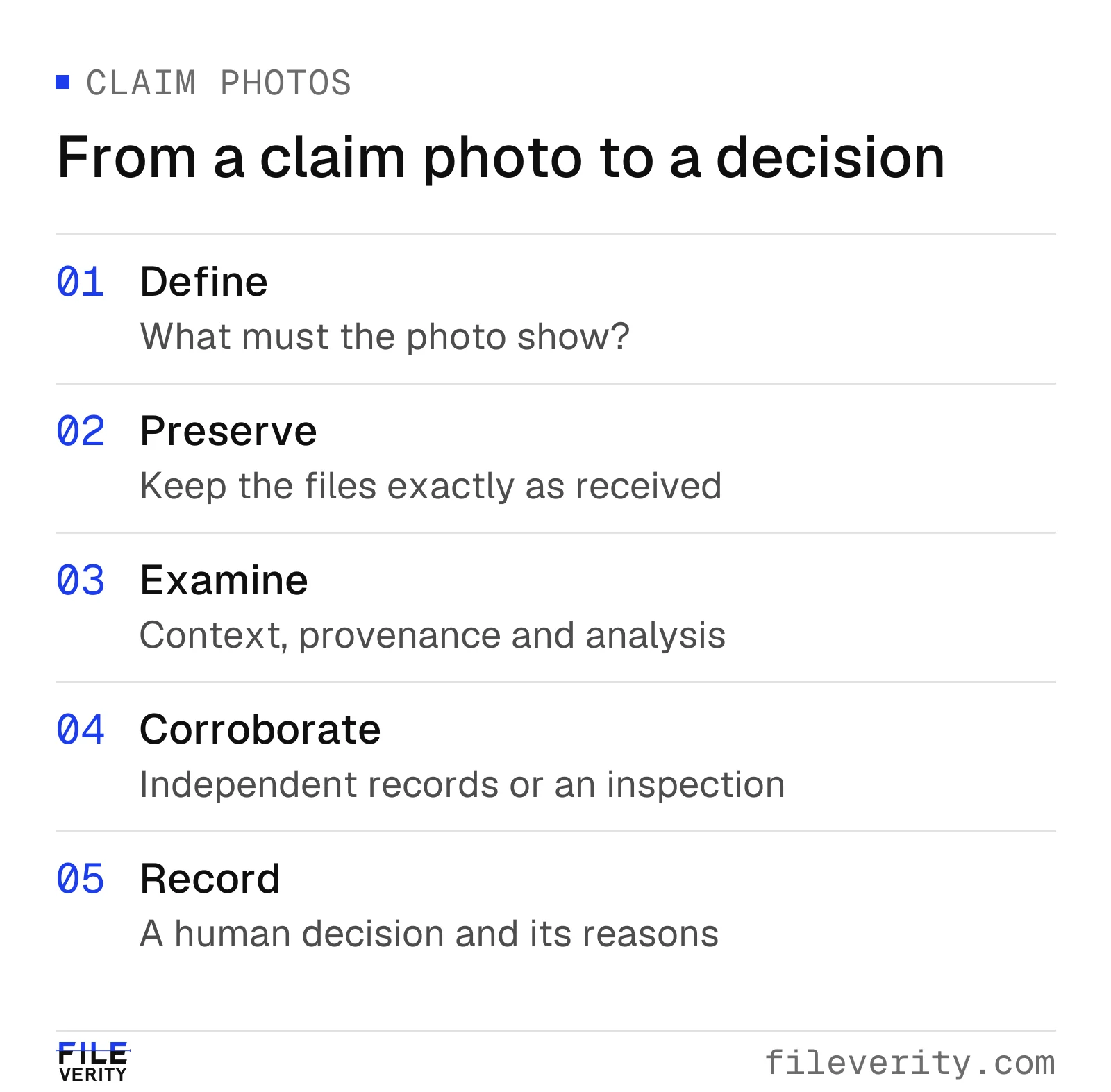
Technical analysis identifies a question; corroborating evidence connects the finding to the claimed loss.
The technical principle: why local noise can carry evidence of image processing
Two wall regions can have similar colors but different fine-scale fluctuations. An image contains scene structure together with sensor and processing effects; a local replacement or retouch can disturb that relationship. Noise-based forensics asks whether an area's fluctuation pattern is consistent with comparable surroundings. It does not assume that all authentic photographs have uniform noise.
One established approach examines high-frequency wavelet coefficients, which emphasize fine detail, then estimates local variation robustly. For coefficients c, the median absolute deviation is MAD(c) = median(|c − median(c)|). Using a median reduces the influence of a few extreme coefficients compared with squaring every deviation. Under an ideal Gaussian-noise model, a fixed mathematical scaling converts this measure into an estimate of noise standard deviation. Real camera processing can violate that model, so the estimate needs interpretation. Mahdian and Saic, “Using noise inconsistencies for blind image forensics,” 2009
A small constructed example makes the distinction visible. Residual values −2, −1, 0, 1, 2 have median zero and MAD 1. Values −6, −3, 0, 3, 6 also have median zero but MAD 3. The centers match while the fluctuation scales differ.
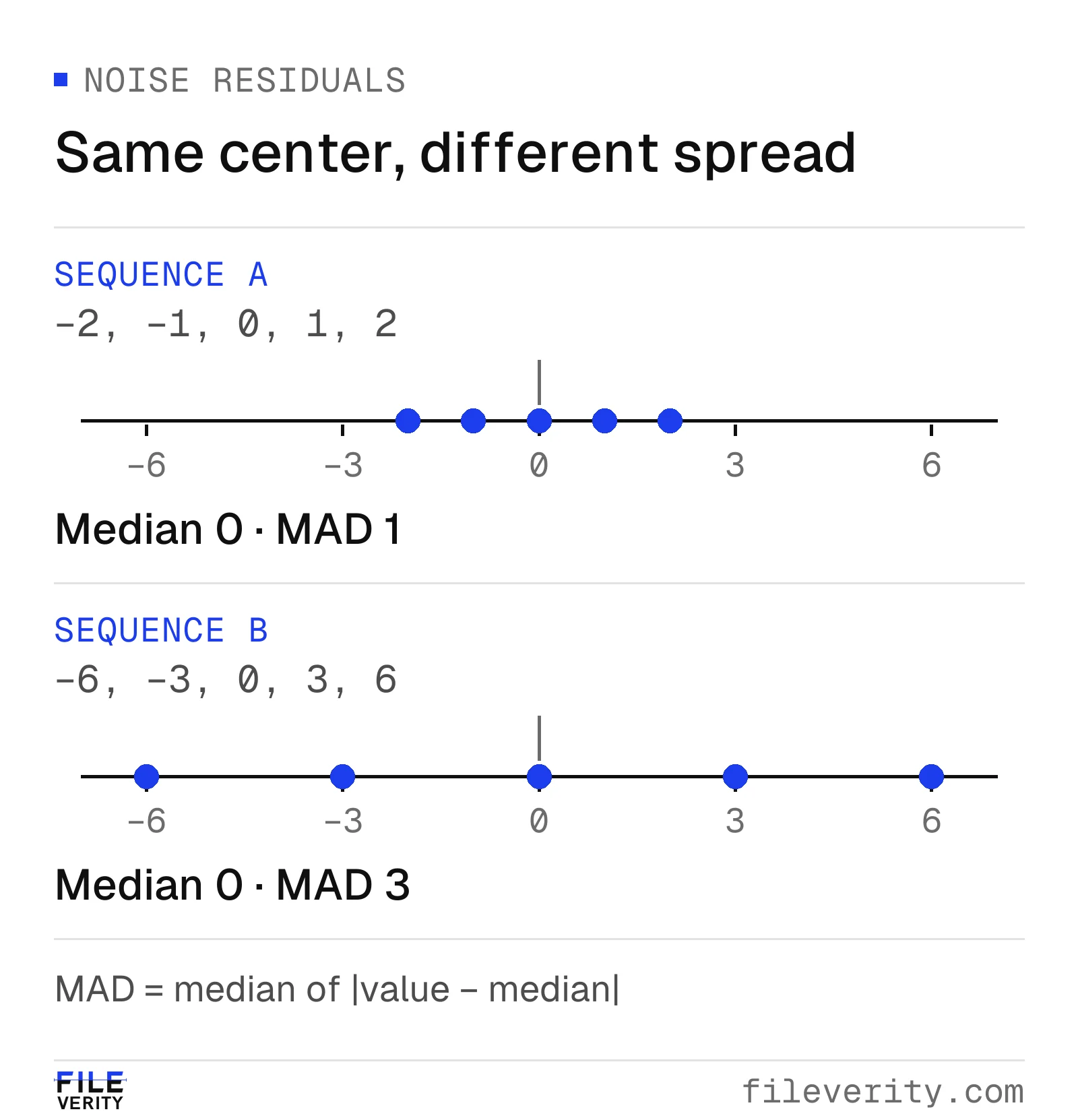
Illustrative residuals: both sequences center on zero, but their MAD values differ threefold. The statistic measures fluctuation scale rather than average brightness.
Local noise analysis is one of the forensic methods Fileverity applies to suitable inputs. It considers local noise variation and the confounding effect of texture. A patterned curtain, a flat painted wall and a dark shadow naturally produce different high-frequency content. Treating every difference as manipulation would confuse the scene with the processing being investigated.
For an insurance photograph, a local noise concern overlapping the claimed water stain can justify examining that area alongside other manipulation evidence and another view. It cannot establish when a leak occurred or calculate its extent. Denoising, sharpening and compression can change or obscure the signal, and a technically consistent image can still depict the wrong event. Compare the region with the source file and other views before deciding whether the difference concerns the claimed damage.
5. Escalate according to the unresolved question
A useful escalation has a defined destination and stopping condition. Route a poor-quality file to an evidence-quality request. Route a specific unexplained alteration concern to an appropriately qualified reviewer. Route a contradiction between images and independent records to the claim investigation process. These routes can converge, but their starting reasons should remain visible.
| Unresolved question | Suggested owner and handoff | Stop or move on when |
|---|---|---|
| Can the relevant damage be seen and connected to the object? | Handler requests a linking view or an approved inspection alternative | The feature and object are assessable, or the evidence limitation is recorded |
| Does the technical signal support a local-change concern? | Qualified reviewer receives the source file, relevant region, output definition and other views | The concern is explained, bounded for further investigation, or cannot be resolved technically |
| Does the image agree with the event and repair evidence? | Handler or investigation team reconciles the specific contradiction | The evidence supports a recorded finding under the insurer’s process |
Fileverity image verification handles the technical review step. It checks each photograph for AI generation, local manipulation and provenance, and shows which region a finding concerns, so your handler knows what to request from the claimant next. Your claim system and responsible staff still connect the result to the vehicle, event and decision, and retain the handoff record.
The stopping condition might be “obtain a view that connects the damage to the identified vehicle,” not “keep requesting photos until the detector stops flagging them.” A new submission should be evaluated on whether it answers the question. Multiple similar outputs from the same detector are not necessarily independent corroboration.
Keep the technical finding separate from the claim decision. In the United States, the NAIC’s December 2023 model bulletin addresses governance of AI used to make or support consumer decisions and reminds insurers of applicable insurance requirements. The NAIC explicitly describes the bulletin as a guiding document, not a model law or regulation. Jurisdiction-specific obligations still need assessment through the insurer’s established process. NAIC adoption announcement
A worked example: a questionable door-damage photograph
This hypothetical case shows how a technical concern changes an evidence request.
A policyholder submits three photographs for a reported side collision. A01 is a close view of a rear door, A02 is a wider side view and A03 shows the vehicle identifier. A01 appears to show a deeper crease than A02. A technical tool also returns a local-modification concern for A01. The repair estimate includes replacement of that door.
Observation: the crease appears different across the two views, and the tool returned a concern for one supplied file. Inference: modification is one possible explanation. Lighting, viewing angle, file processing and photographs taken at different stages are other possibilities that have not yet been resolved. Neither the observation nor the tool result establishes intent.
The local concern makes the rear door the focus of the follow-up; it does not justify asking for more photographs of unrelated areas. The handler requests the available source file for A01 and a view linking that door to the identified vehicle. A practical request is:
Please attach the available source photograph for A01, rather than a screenshot of it. The rear-door crease appears different in A01 and A02. If safe and practical, provide an overlapping view showing that door and enough of the vehicle to connect it to the identifier already supplied. Tell us whether the photographs were taken before or after any repair. If another photograph is unavailable or unsafe, contact the handler so an inspection or existing repair record can be considered.
The handler owns the response and checks whether the repair estimate independently describes that exact panel and when its assessment occurred. A technical reviewer receives the original file references and the specific panel question, rather than an unexplained “AI fraud” label.
| Evidence item | Established in the hypothetical file | Still unresolved | Next action |
|---|---|---|---|
| A01 close view | Shows an apparent crease; tool concern recorded | Relationship to the source file and event | Obtain available source and explanation |
| A02 wider view | Shows vehicle side and panel position | Whether angle explains the apparent difference | Compare overlapping details |
| A03 identifier view | Contains a vehicle identifier | Connection between identifier and damaged panel | Obtain linking view or inspection |
| Repair estimate | Lists door replacement | Basis and timing of the repair assessment | Check the underlying assessment record |
The review can end in three states. If an independent inspection confirms the described damage and a source comparison explains the discrepancy, close the photo concern with that reasoning. Further detector runs are unnecessary for that resolved question. If the inspection contradicts the submitted damage and the discrepancy remains unexplained, hand the specific contradiction to the investigation team under the insurer’s process. If no suitable evidence can be obtained, retain an unresolved state with a named owner and review point; do not turn a missing response into a technical finding.
A suitable interim note would be: “A01’s apparent crease differs from A02. The tool result is a technical review signal. The relationship between the views remains unresolved. Request the source file and linking view; handler to compare with the repair assessment before deciding further action.” That note identifies the evidence, uncertainty, owner and next step without prematurely assigning blame.
In Fileverity, the A01 step is an image analysis of that photograph: the report marks the region of the door that a finding concerns, separates a regenerated area from whole-image generation, reads any Content Credentials and metadata, and records the file's SHA-256 fingerprint and timestamp validation status, so the handler's request names the exact panel and file.
Keep a review record another person can use
A concise record is preferable to a folder of unexplained outputs. Use the following template as a starting point, adapting it to existing case systems and retention rules.
| Field | What to capture |
|---|---|
| Proposition | The specific fact the photograph is offered to support |
| Evidence references | Received file IDs, receipt details and related working copies |
| Observation | What is visible or what a tool actually returned |
| Method and limits | Tool/version, input suitability and scope of analysis |
| Alternative explanations | Plausible explanations still open at this stage |
| Corroboration | Evidence source, independence and connection to the event |
| Action | The question to resolve, responsible person and review point |
| Resolution | Supported finding, remaining uncertainty and decision owner |
Include cleared concerns as well as escalations. Otherwise, the retained record gradually becomes a catalogue of suspicion, making it harder to learn which alerts caused unnecessary work. When a reviewer changes a conclusion, retain the earlier assessment and explain the new evidence instead of silently replacing the history.
Measure cases and files without confusing them
The number of flagged photographs is a workload measure. It is not a count of fraudulent claims: several photographs may belong to one claim, an alert may concern benign processing, and some reviewed cases remain unresolved.
Consider a second, purely hypothetical monthly batch. There are 1,000 submitted photographs across 200 claims. The workflow flags 60 photographs belonging to 25 claims, and those 25 claims enter image review. At the reporting cutoff, eight have a substantiated image-related concern, twelve have the concern cleared and five remain unresolved.
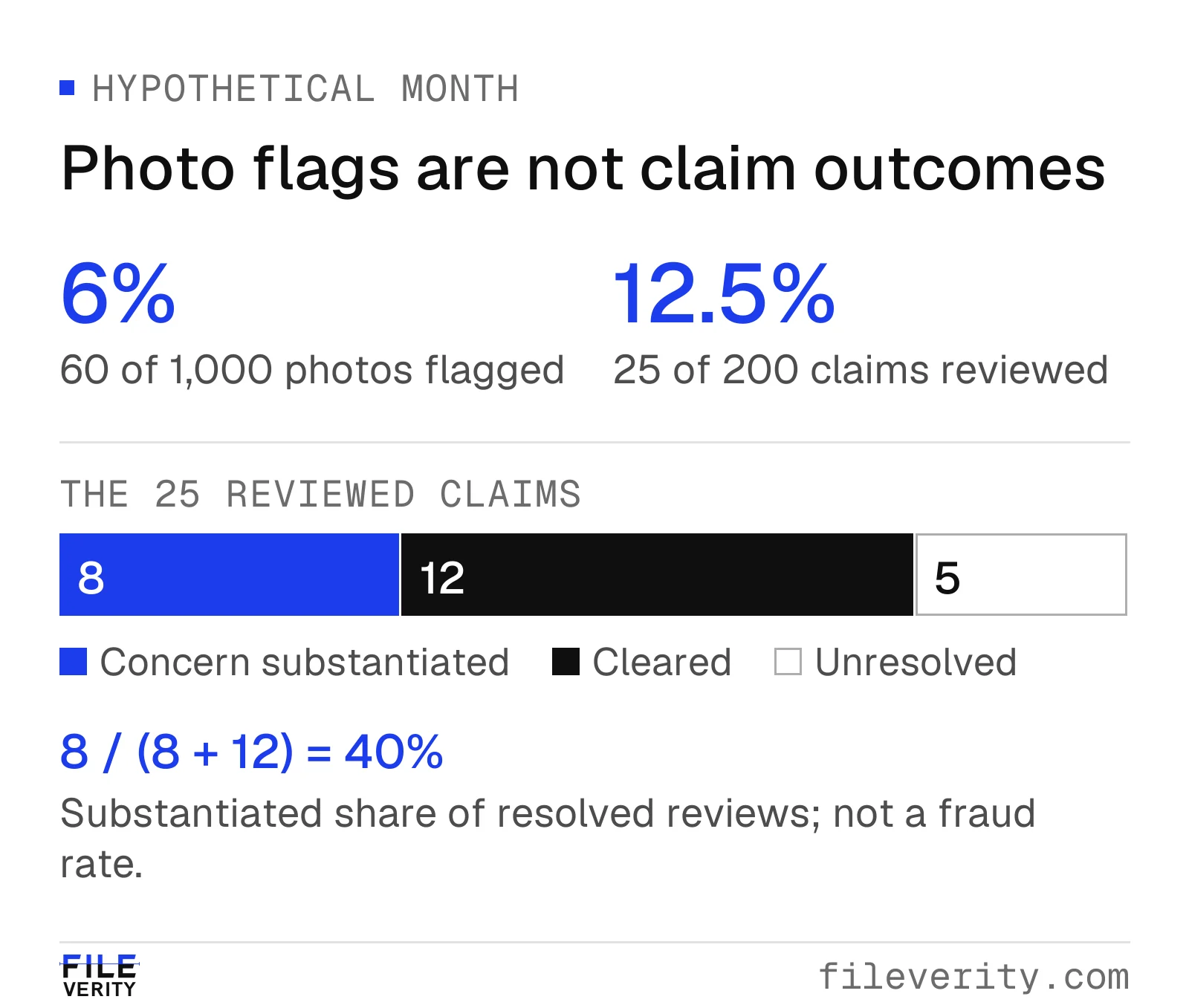
Illustrative monthly review: 60 flagged photos lead to 25 claim reviews. Eight image concerns are substantiated, twelve cleared and five remain unresolved.
The image flag rate is 60 / 1,000 = 6%. The share of claims entering this image-review workflow is 25 / 200 = 12.5%. Among the twenty reviewed claims with a resolved image concern, eight have the concern substantiated: 8 / 20 = 40%. That 40% describes resolved image concerns within the reviewed group. It measures neither fraud prevalence nor missed concerns across all claims.
Track resolution time and repeat evidence requests alongside these counts. Review an appropriately designed sample of unflagged cases through an independent process to learn about missed issues. Keep unresolved cases separate, and report changes in input channels or case mix that could explain a shift. A higher flag rate alone cannot tell you whether detection improved or inputs became harder to assess.
Start a pilot at one review step
Ask suppliers to demonstrate how their system handles representative, lawfully obtained inputs from the intended intake process. Include source files, ordinary processed copies and images that cannot support a reliable conclusion. Establish the reference labels independently; do not define an image as altered simply because the candidate tool flags it.
Compare performance for the task you need, the evidence reviewers receive and the time required to resolve concerns. Confirm sensitive-file handling, retention, access controls and permitted secondary uses before uploading claim material. Ask whether the system can retain input references and analysis versions, or whether that traceability must be supplied by your case system.
Start with a defined part of the workflow, such as technical review of disputed vehicle-damage photographs. Agree who receives the output, which evidence requests they may make and when they should stop or escalate. Measure whether the output helps them choose a justified next step, including time to close cleared concerns and repeat requests to claimants. Keep broader claims about loss prevention outside the pilot conclusion unless the evaluation actually supports them.
Fileverity image verification fits that step. Run authorized claim photographs through the detector for AI-generated images and review the full evidence report against your own review question. Send us your submission channels, formats, typical photographs per claim and reviewer capacity, and we will walk your team through real cases; talk to sales. Fileverity analyzes files on servers operated by Entogo in Toronto, Canada and deletes them once the analysis is complete. The Trust & security page sets out data handling, including private deployment for Enterprise on request.
For the technical distinction between generated scenes and local alterations, see how to detect AI edits in a photo.
By Yang Zheng · Reviewed by Bill Liu