Images
C2PA, AI Watermarks and Image Detectors: Which Check Do You Need?
Compare C2PA Content Credentials, AI watermarks and image detectors. Build a review workflow for mixed sources and resolve conflicting results.
Published · 12 min read
On this page
An enterprise receiving images from customers, agencies and suppliers rarely controls how every file was created. Some arrive with signed history. Some contain a detectable AI watermark. Others are screenshots with neither. A useful verification process must handle all three without treating missing information as a clean bill of health.
Choose C2PA verification when the question is what recorded history can be validated. Choose a supported watermark verifier when the question is whether a particular embedded signal is present. Choose learned image analysis when the question is whether the received content shows patterns associated with the detector's target. Then connect those findings to the decision you actually need to make.
These methods can coexist in one review. None establishes, on its own, that a photographed event happened as described. This guide focuses on assembling the evidence and resolving disagreements, rather than spotting visual AI mistakes. For an initial file review, see how to tell if an image is AI-generated.
If you already have conflicting outputs, start with the conflict workflow. For tool selection, use the comparison matrix first.
Start with the claim, not the authenticity label
“Is this image authentic?” is too broad for a purchasing requirement. A marketing team may need to identify undisclosed generative edits. A supplier-quality team may need evidence that a particular production run was inspected. A newsroom may need to verify where and when an image was captured. Those are different decisions, even when all three teams receive the same JPEG.
Write the acceptance condition first: “This image must document the identified production unit before shipment.” Now distinguish the file-history question from the scene question. Evidence that AI was used may affect whether the photograph is acceptable, but evidence that AI was not detected does not identify the production unit. An untouched photograph of a different unit would still fail the requirement.
For mixed sources, maintain two parallel records: what is known about the file, and what supports its use in this case. Their intersection determines whether the submission is sufficient.
What each method contributes
Content Credentials carry signed provenance assertions using C2PA standards. A verifier checks their integrity and relationship to the asset; the history may describe capture, editing or generation. Participation is optional, histories can be incomplete, and provenance is not a guarantee of the truth of a scene or caption. C2PA explainer
An invisible AI watermark is a signal embedded into content by a participating system. A compatible verifier searches for that signal. Learned detection instead analyzes characteristics of the content without requiring a participating creator to have attached provenance. NIST describes these as complementary approaches and cautions that no individual approach supplies a comprehensive solution. NIST AI 100-4, sections 3.1–3.2
| Requirement | C2PA / Content Credentials | Supported AI watermark verification | Learned image detection |
|---|---|---|---|
| Primary use | Validate recorded assertions and their connection to the asset | Look for the supported embedded signal | Assess patterns associated with generation or manipulation |
| Cooperation needed upstream | A participating signing workflow | A participating watermarking system | No prior watermark or credential required |
| Best evidence to retain | Validation diagnostics, signer and relevant history | Exact verifier, scope and returned status | Input, output definition, version and review threshold |
| Coverage boundary | Available history, formats, trust configuration and verifier support | Supported watermark families and products | Evaluated image types, transformations and target tasks |
| Absent or negative result | Separate absent, invalid/unsupported and validated history with no relevant assertion | Supported signal not detected; coverage and input limits still apply | Target not flagged under this analysis |
| Useful next action | Inspect relevant actions or obtain an earlier file | Confirm ecosystem scope and input suitability | Investigate the disputed feature or request corroboration |
| Cannot settle alone | Truth of the depicted claim | Full editing history or which account made the image | Complete provenance, author identity or intent |
A visible logo or AI badge belongs in a different category: it is something a reviewer can observe. Record it, but do not assume it is a successful cryptographic or watermark verification.
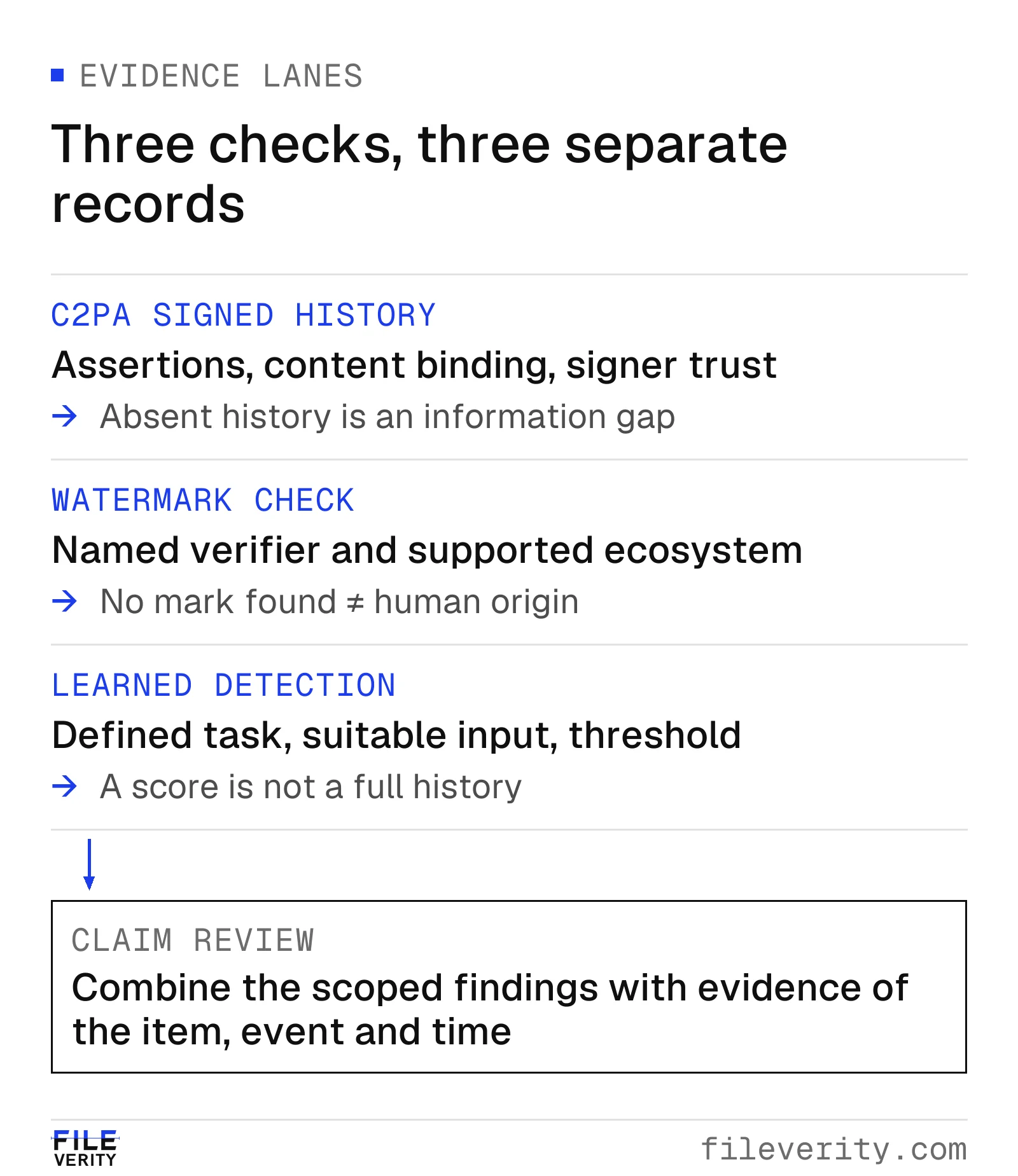
Signed history, watermark verification and image analysis supply different evidence for the same review.
C2PA verification: separate presence, validity and trust
As checked on October 28, 2026, the C2PA specifications site points to version 2.5, whose technical specification lists an October 2026 release. Record each verifier's implemented version and capabilities; a published standard does not establish a product's support. C2PA 2.5 index
The 2.5 trust model distinguishes well-formed, valid and trusted manifests, and separately addresses the asset's content binding. A manifest being present is therefore only the start. Record the returned validation state, whether the covered content validates, and the signer trust result. C2PA 2.5 technical specification, sections 13–14
For procurement, ask the provider to demonstrate these distinctions using permitted sample files. Can a reviewer tell “no credential found” from “credential present but not validated”? Can the tool explain an unsupported format or a signer outside its trust configuration? Can reviewers inspect the relevant action rather than relying on a green icon?
Read the history against your requirement. A record of generation may clearly establish disclosed AI involvement while leaving the asset perfectly acceptable for a conceptual advertisement. A valid camera history may still be insufficient for an inspection if the photograph cannot be tied to the required unit. A camera-origin entry followed by editing must be read as a sequence, not reduced to the first entry.
Absence is especially easy to misuse. A supplier who never used a signing workflow cannot provide its benefits retrospectively just by resending the same file. When signed capture is necessary for a future workflow, state that requirement before capture. For existing mixed archives, retain an alternative verification route rather than rejecting everything without credentials.
Watermark verification: name the exact service
“Supports SynthID” does not identify one fixed verification scope. On October 28, 2026, Google's DeepMind overview describes the standalone SynthID Detector as checking images, video and audio from Google and participating partners. That is broader than a Google-only description of the technology. Google DeepMind SynthID overview
At the same time, Gemini Apps Help says Gemini's SynthID recognition is currently for Google AI tools. It also documents a separate Content Credentials check: compatible versions 2.2 and later, products on the C2PA Conforming Products List, and no support for remotely stored metadata. These are product-specific limits, not universal limits of C2PA or all SynthID verification. Gemini verification help
Keep the verifier name and access surface in the review record. A negative Gemini watermark result should not be broadened into “all participating partners checked.” Equally, a partner appearing in an ecosystem announcement does not establish that every product, older export or editing mode from that partner is covered. Confirm the input and product scope for the service used.
Google also notes that repeated alterations can prevent detection, and that small edits or sparse content may produce unclear results. Preserve “unclear” as its own outcome. Gemini watermark limitations
For operational use, require reviewers to retain the actual verification result. A chatbot's visual opinion that an image “looks AI-generated” should not be entered as a successful watermark finding. The record needs to identify the mechanism that supplied the evidence.
Learned detection: cover the unknown-source lane
A general image-analysis service can be useful when suppliers do not participate in a provenance ecosystem or when a received copy has lost its history. Its value depends on the task: whole-image generation, local manipulation and attribution to an AI system are different requirements.
Specify which requirement matters in the evaluation. A tool that classifies fully generated images may not establish whether a small inspection label was replaced. A manipulation signal may warrant review without identifying generative AI as the cause. For that distinction, see how to detect AI-edited photos.
Ask for evaluation on the actual source mix: direct camera uploads, agency exports, edited photographs and images received through messaging or screenshots. NIST's evaluation discussion emphasizes false positives and performance at defined thresholds. A score therefore needs an output definition and relevant validation before it can guide an operational decision. NIST AI 100-4, section 4.2.2
For example, suppose a supported local check raises a concern around a product feature in an agency export with no usable history. That finding can focus the request on the pre-edit source and the treatment of that feature, instead of a generic demand to prove the entire file “real.” If the input is unsuitable or the result inconclusive, the source request remains unresolved.
Keep the result in the provider's terms. Do not convert it into the probability that a sender lied or average it with a watermark status. Those operations hide differences in what the checks measured.
How a signed credential binds to the image it describes
Fileverity's image analysis includes reading available Content Credentials through a C2PA reader and retaining provenance information separately from learned pixel evidence. One principle underlying that provenance examination is cryptographic content binding. A credential copied beside an unrelated image is not enough: the recorded claim must be connected to the content being reviewed.
There are two links to understand. A hash binding connects covered asset data to a digest recorded in an assertion. The signed claim references assertions through their hashes, connecting that record to a signing key. Verification of the signature alone cannot establish that the current image matches the covered asset; content-binding verification addresses that additional link. Trust in the signer is a further question. C2PA 2.5, sections 12–14
The binding does not always mean “hash every byte of the final file.” For a C2PA data-hash assertion, specified byte ranges are excluded, including the embedded manifest store where applicable. Otherwise, placing a manifest containing a digest inside the very data being digested would create a self-reference problem. The standard constrains and validates exclusions; they are not permission to leave arbitrary meaningful content unprotected. Other formats can use different binding structures. C2PA data-hash assertions and validation
Consider a simplified byte-accounting example. A 1,000-byte asset has an allowed 200-byte manifest range beginning at offset 300. Using zero-based, end-exclusive ranges:
covered bytes = file[0:300] || file[500:1000]
The hash input contains 300 + 500 = 800 bytes. The symbol || means concatenation. Merely finding the same credential text in two files says nothing about whether those 800 covered bytes validate. A verifier must also check that the exclusions comply with the file format.
For procurement, turn this mechanism into a demonstration: retain the original credential-bearing sample, a copy with covered image data changed, and the verifier's supported diagnostics for each. Ask what it checked about the asset binding, signature and signer trust. Do not infer full standard conformance from a product's ability to display a manifest.
Fileverity reads and validates Content Credentials against the C2PA specification, including the manifest's signature and integrity. A correctly bound, trusted record still cannot establish that the photographed item belongs to the shipment.
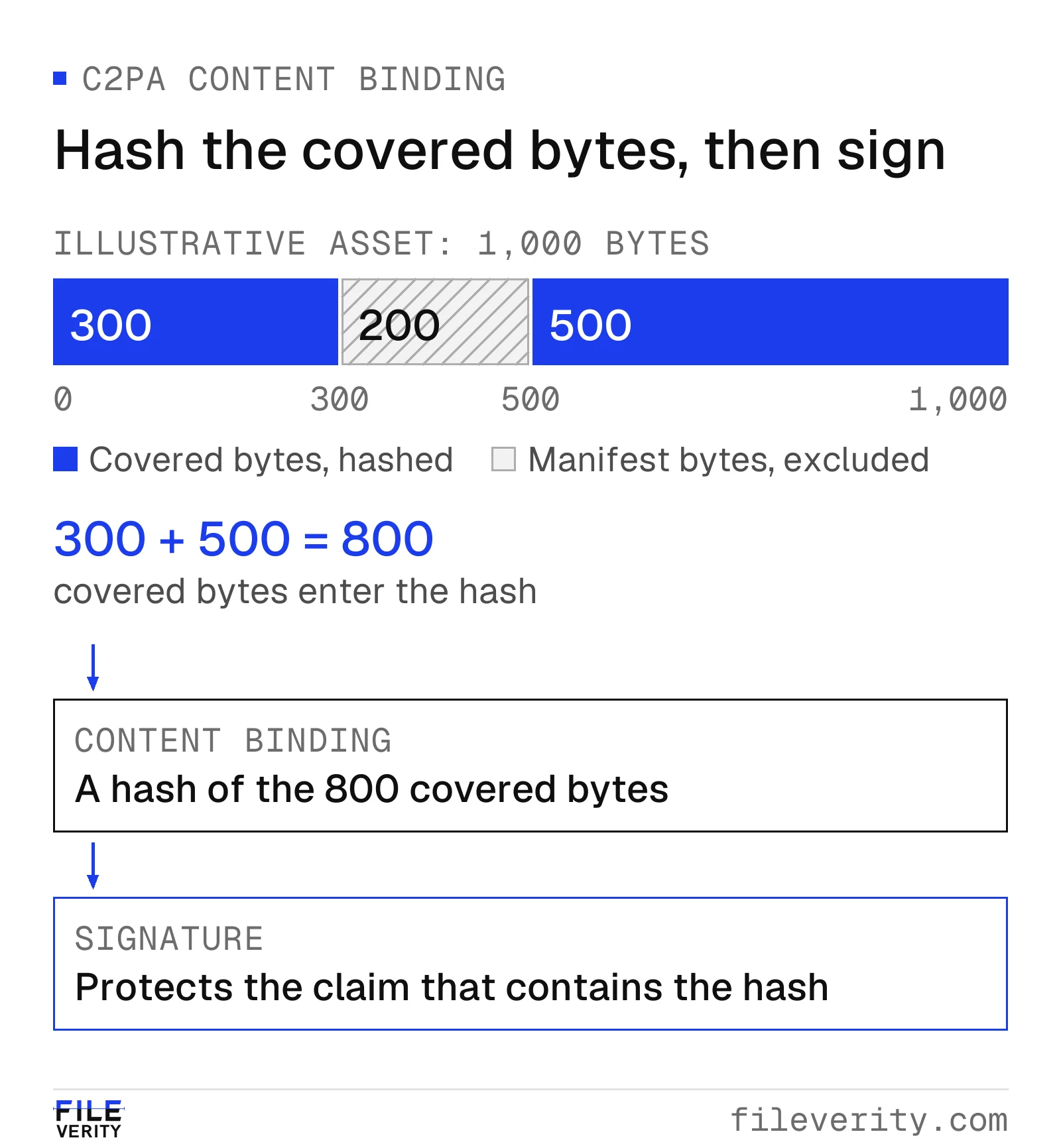
In this simplified layout, excluding the 200-byte manifest range leaves 800 bytes in the hash input.
A workflow for conflicting results
First determine whether there is a real contradiction. “No supported watermark detected” and “image-analysis review flag” can both be correct: they ask different questions. Two outputs concerning different copies are not competing analyses of the same evidence.
Use this sequence whenever the findings appear inconsistent:
- Match the inputs. Compare file identifiers, dimensions and received versions. Preserve the source and label any crop, conversion or screenshot used for analysis.
- Translate the outputs. Write one sentence per check stating its mechanism, scope and actual result. Keep unsupported and inconclusive states visible.
- Locate the disagreement. Is it about a signer, a recorded action, a particular region, or the real-world claim? Assign the discrepancy to that question.
- Request discriminating evidence. Choose something that could change the decision: a validator diagnostic, an earlier export, a documented editing explanation or a separately obtained inspection.
- Close the decision at the supported level. Record what was resolved, any remaining uncertainty, the reviewer and the reason for the disposition.
The next-action matrix below prevents repeated checks from becoming an endless search for a preferred answer.
| Observed combination | What to investigate | Decision-oriented next step |
|---|---|---|
| Validated, asset-linked credentials record AI use; detector does not flag | Signer trust under the review policy, detector scope and whether the action matters | Apply the disclosure policy when its trust requirements are met; a negative classifier does not erase a supported recorded action |
| Camera history present; detector flags | Credential validation, asset binding, signer trust, later actions and detector limitations | Compare the full history with the disputed feature; seek independent evidence if material |
| Watermark found; no credentials | Which watermark was found and what its result covers | Preserve the positive finding; request source history if the decision needs details |
| Watermark absent; detector flags | Watermark coverage and classifier task | Review the relevant feature; do not treat the absent mark as a veto |
| Two validators disagree | Versions, external-data support and trust configuration | Retain both diagnostics and resolve the capability difference |
| Every check is absent, negative or unsupported | Whether enough evidence remains for the claim | Use the normal corroboration route or request better evidence |
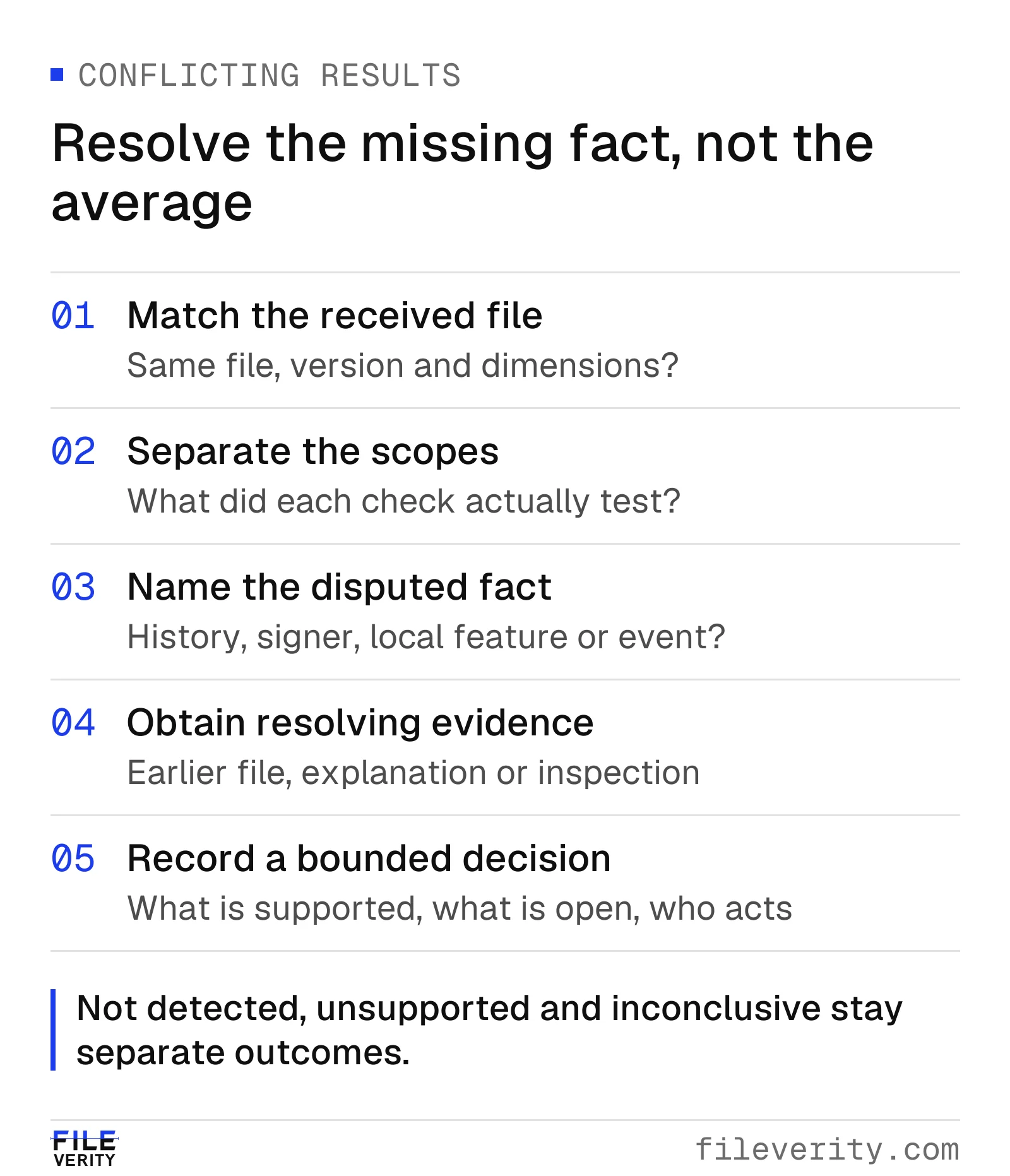
Resolve apparent conflicts by matching the input and identifying which question each check answers.
Worked example: a supplier's inspection photograph
In this hypothetical case, a manufacturer requires a photograph showing a specific valve assembly and its serial plate before shipment. The supplier sends a JPEG as proof of completion. AI assistance is allowed for marketing materials, but inspection evidence must show the relevant condition without generative replacement.
The reviewer records three fictional findings. A C2PA validator reports trusted provenance with a camera-origin ingredient and a later generative editing action, without sufficient detail to locate that action. A supported watermark verifier reports no watermark detected. A learned whole-image classifier does not raise its review flag.
Calling the file “verified real” would discard the most relevant finding. The absent watermark and unflagged classifier do not resolve what the recorded edit changed. Calling the shipment fraudulent would also outrun the evidence: the action might concern an irrelevant background, and nothing yet establishes deception or a defective assembly.
The reviewer places acceptance of this photograph on hold and asks the supplier for the pre-edit file and an explanation of the changed area. The supplier provides an earlier image and says a background pallet was removed. The files appear consistent with that account, but the serial plate remains unreadable in both. The provenance question is now better understood; the required link to the unit is still missing.
The reviewer requests a new inspection through the established supplier process, showing the assembly and legible serial plate in connected views, with the inspection record identifying the production unit. A qualified inspector confirms the unit and required condition. The manufacturer accepts that inspection evidence and records the first photograph as insufficient for the original requirement.
The final note reads: “Submitted image includes a recorded generative action with initially unresolved scope. Subsequent source comparison supports the supplier's background-edit explanation. Original views do not establish the unit identifier. Acceptance is based on the replacement inspection and linked unit record.”
Where a Fileverity report helps: it reads available Content Credentials and keeps provenance separate from pixel evidence. When local findings can be supported, the report marks suspicious regions so the reviewer can see whether the finding concerns the valve assembly or the background pallet.
This outcome preserves the difference between explaining an image's history and proving the shipment condition. It also avoids requiring a second detector to adjudicate a fact that an inspection can establish directly.
Turn the architecture into a buying requirement
Ask prospective providers to complete a capability sheet with these fields: verification mechanism, supported inputs, supported ecosystems or standard versions, negative and unsupported outcomes, retained diagnostics, and the reviewer action each finding enables. Include a named owner for updating changing compatibility information.
Run a small authorized exercise containing at least one missing-history file, one signed file, one known AI-assisted file and one transformed copy. The initial objective is to see whether reviewers can keep the mechanisms separate and reach useful next actions. It is not an accuracy benchmark. A larger performance evaluation needs a defined sample and reference labels; the software selection guide explains that stage.
For mixed-source intake, Fileverity image verification brings the three approaches into one report: validation of available Content Credentials, checks for supported invisible watermarks, and learned analysis for AI-generation and local-edit signals. List any proprietary watermark verifier you also require separately in the capability sheet, and confirm its support and access with that provider.
Send us your source mix and a recurring decision for which signed history or a supported watermark is unavailable, and we will walk your team through real cases; talk to sales. Fileverity analyzes files on servers operated by Entogo in Toronto, Canada and deletes them once the analysis is complete. The Trust & security page sets out data handling, including private deployment for Enterprise on request.
By Yang Zheng · Reviewed by Bill Liu