Documents
Transcript Verification: How Universities Detect Fake Admissions Documents
A verification workflow for admissions offices: official channels first, then file checks for uploaded transcripts, test reports, letters and bank statements.
Published · 8 min read
On this page
To verify a transcript, get it from the institution that issued it, or from a verification service that institution uses, instead of trusting the copy an applicant uploads. When your process has to accept uploaded files, examine each file for signs of editing and confirm anything flagged with the issuer before you decide. The document never verifies itself; the issuer's record does.
This guide is for admissions, international, registrar and graduate offices at universities, colleges and schools, with examples from the United States and Canada. It covers the official channels for each admissions document, the forms of fraud offices see, what file analysis can and cannot show, AI-written letters and statements, a fair process and a checklist. It is not legal advice.
Transcript verification: official channels first
Transcript verification starts with the channel the document came through. A record that the issuing school sends to you directly, or that you confirm in an official service, is evidence in itself. A file the applicant sends is only a claim until it matches the issuer's record.
| Document | Official route | Practical notes |
|---|---|---|
| Transcript | Sent by the issuing institution to your office, as a secure electronic transcript or in a sealed envelope | Credential evaluators work the same way: WES asks for documents sent by the institution in a sealed envelope or transmitted securely in electronic form. WES, sealed envelopes |
| Degree or diploma | The registrar, reached through contact details you find yourself, or a service the school uses | In the United States, the National Student Clearinghouse confirms degrees and enrollment for participating schools. National Student Clearinghouse, DegreeVerify |
| Language test report | The test provider's own score delivery or verification service | Recognizing organizations can check an IELTS Test Report Form online against the IELTS record. IELTS, verifying results |
| Recommendation letter | Submitted by the referee through your application system, from an institutional address | Contact the referee through the institution's published directory, not the details on the letter |
| Bank statement or proof of funds | A confirmation that the bank sends, or that you request from the bank | Treat a downloaded PDF as a claim; banks confirm accounts and balances on request with the holder's consent |
| Your own letter of acceptance | Your admissions records | In Canada, post-secondary designated learning institutions have confirmed every study permit applicant's letter of acceptance directly with IRCC since December 1, 2023. IRCC, October 2023 |
The flow below puts this into one rule for intake: check where the file came from, and only analyze files that came from the applicant.
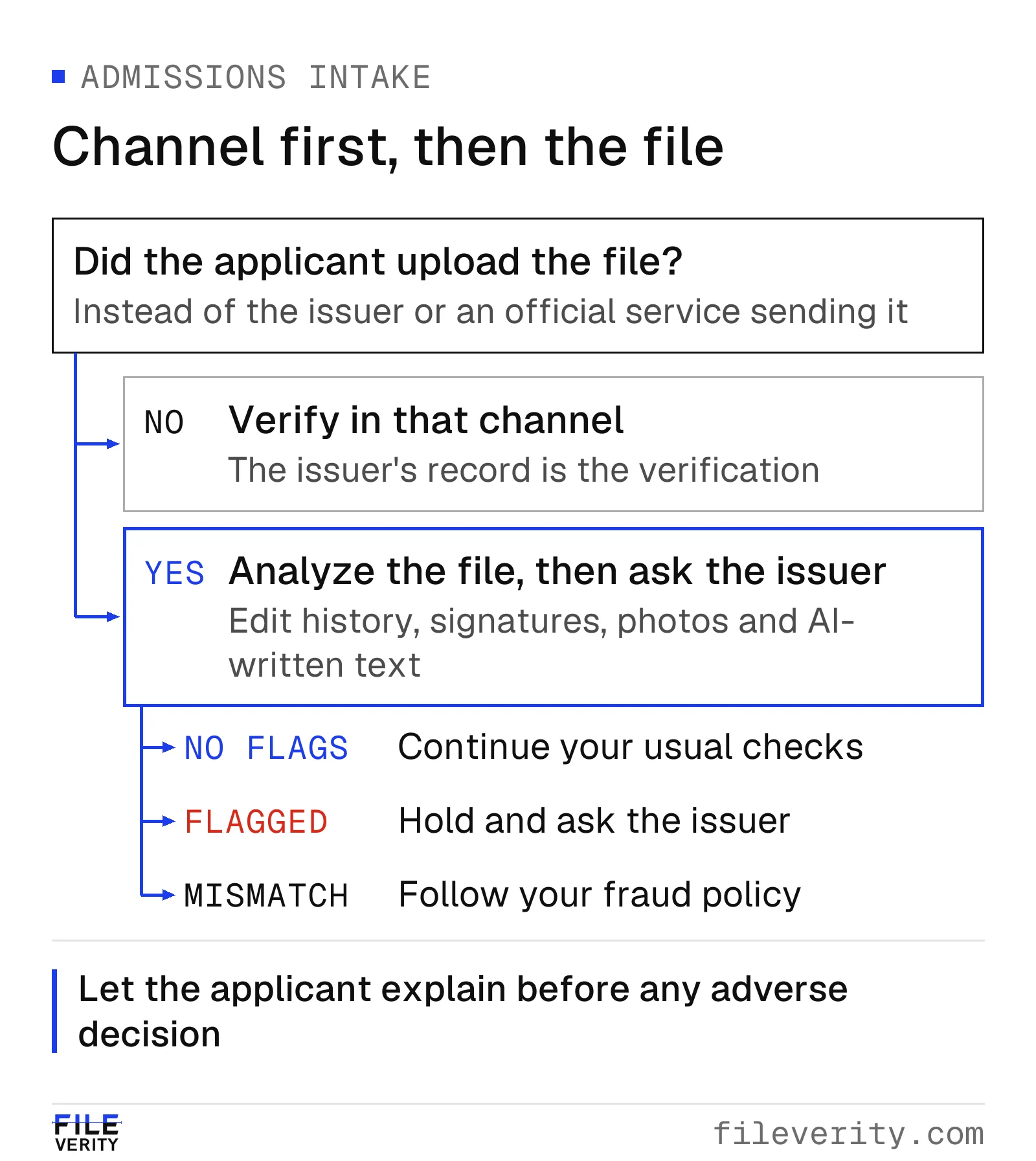
Issuer-sent records are the verification; uploaded files tell you what to ask the issuer.
Where admissions document fraud happens
Admissions document fraud rarely means an invented document from nowhere. Most cases change a real record, borrow a real institution's name or supply a document from a provider that sells credentials.
| Document | Typical manipulation | First check |
|---|---|---|
| Transcript | Grades, credits or graduation date edited in a PDF or image editor | Request the official transcript from the issuer |
| Degree certificate | A real school's design reproduced, or a degree from a diploma mill | Confirm the school is recognized, then the degree with the registrar |
| Language test report | Scores changed on a scan or PDF, or a fabricated report | Verify the report number in the provider's service |
| Recommendation letter | Written by the applicant, an agent or an AI tool and attributed to a referee | Confirm with the referee through the institution |
| Bank statement | Balances or account holder edited, or a template filled in | Ask the bank to confirm, or request a bank-issued letter |
| Letter of acceptance | A forged letter in your institution's name, used for a visa or permit | Match it against your admissions records |
The diploma-mill problem has its own checks, such as recognition lists and accreditation mills; the fake diploma guide covers them for the United States and Canada. The rest of this guide focuses on the files themselves.
What an uploaded file can reveal
When an applicant uploads a PDF, Word file or photo, the file carries traces of how it was made. File analysis reads those traces and turns them into findings a reviewer can check. Fileverity's document verification reports them with page references and the strength of each finding.
| Trace | What it can show | Limit |
|---|---|---|
| Producer and creator software | That a transcript was last saved by a consumer editor, not the issuer's records system | Many schools export through ordinary software too |
| Creation and modification dates | A file modified after the issue date or shortly before upload | Dates can be wrong or reset |
| Revision history | Text that was changed after the document was first created | Printing to PDF or rescanning removes history |
| Digital signature | A signed e-transcript that still validates, or a signature broken by later edits | Many genuine records are not signed |
| Embedded and attached photos | An ID photo or portrait that appears AI-generated or locally edited | Small, compressed photos give weaker evidence |
| Written passages | Letters and statements with passages that read as AI-written | Five languages, about 100 words or more |
How to use each check depends on the document. The matrix shows which checks matter for each common admissions file, and that only the issuer or its official service can actually verify one.
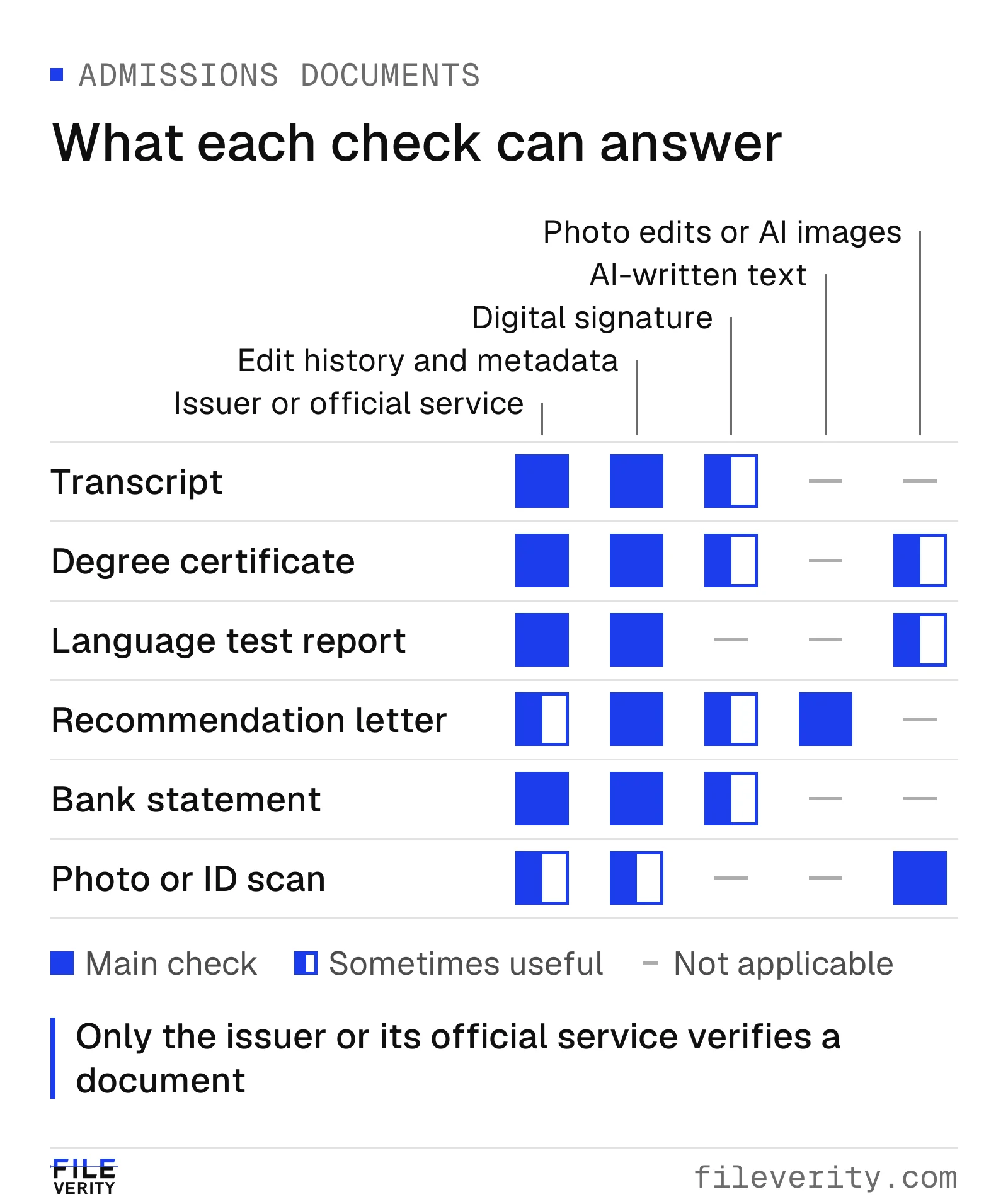
File analysis narrows the question; the issuer's record answers it.
Two limits matter in practice. A file that was printed, scanned or re-saved by a converter loses most of its history, so a short report is not a clean bill of health. And a report with no findings never proves a document genuine; it only means the file shows no sign of the edits these checks look for. The guide to checking whether a PDF has been edited explains each file trace in more depth.
A worked example from an admissions office
Fictitious example. An international applicant uploads a transcript PDF, a bank statement and two recommendation letters to a graduate program.
- Channel. All four files came from the applicant, so the office runs them through file analysis before relying on any of them.
- Transcript. The report shows that a consumer PDF editor saved the file two days before upload and that an incremental revision replaced text on page 1. The issuing university's e-transcripts normally carry a digital signature; this file has none.
- Bank statement. No findings. The office still asks for the bank-issued confirmation its policy requires.
- Letters. One letter reads as AI-written throughout. The office does not treat that as misconduct; it emails the referee at the address in the university's staff directory to confirm the letter.
- Outcome. The office requests the official transcript directly from the issuing university. The university's record shows different grades, so the file is a mismatch and goes to the institution's misconduct procedure, where the applicant can respond. The referee confirms the letter, which stays in the file.
The report did not decide anything. It told the office which two questions to ask, and the issuer and the referee answered them.
AI-written letters and personal statements
AI-written text in an application is not automatically misconduct. Many institutions allow some AI assistance and differ on what they require applicants to disclose, so start from your own policy. Detection is useful for two things: finding letters that may not come from the named referee, and showing where an applicant's statement may conflict with a rule your program has published.
Treat a detection result as one piece of evidence. Fileverity detects AI-written text in English, French, German, Spanish and Chinese texts of about 100 words or more and shows the passages behind each finding; it publishes its measured false-positive rates by language. No detector can tell you who wrote a text or whether the use broke a rule, so confirm with the referee, talk with the applicant and record how you reached the decision.
A fair and private review process
Fraud checks touch personal records, so the process around them matters as much as the tools.
- Tell applicants. State in your application instructions that documents may be verified with issuers and examined for alterations.
- Decide on evidence from the issuer. Use file findings to decide what to confirm, and confirmation to decide outcomes.
- Let applicants respond. Share the discrepancy and allow an explanation or an official record before an adverse decision.
- Limit what you share. Send vendors only the files they need and prefer tools that do not keep them. Fileverity deletes uploaded files after analysis, never uses them to train models and seals each report so that its findings can be verified later.
- Keep sensitive records on campus when required. Enterprise agreements include on-premises deployment that runs fully offline.
- Follow applicable law. Privacy and records law differs by country, state and province; ask your privacy office or counsel how it applies to admissions files.
Checklist for admissions offices
- Ask for transcripts, degrees and test reports through official channels wherever your process allows.
- Record the channel each document came through.
- Analyze every file the applicant supplied before relying on it.
- Confirm any flagged file with the issuer, using contact details you find yourself.
- Confirm recommendation letters with referees at institutional addresses.
- Check your own letters of acceptance against your admissions records.
- Give applicants a chance to explain before any adverse decision.
- Keep the report, the confirmation and the decision together in the file.
Education pricing
Fileverity offers special pricing to universities, colleges, schools and research institutes. Institutions can get a dedicated API that connects admissions and records systems to these checks; its pricing is not published, so contact us for a quote. Education pricing also covers website credits and Enterprise agreements. Request education pricing and we reply within 24 hours.
Frequently asked questions
How do universities verify transcripts?
Universities ask the issuing institution to send the transcript directly, as a secure electronic transcript or in a sealed envelope, or they rely on a credential evaluation service that does the same. When an applicant uploads a copy, the office treats it as provisional until it matches the official record.
Can a fake transcript be detected from the PDF alone?
Sometimes. File analysis can show that a PDF was edited, re-saved by consumer software or stripped of a signature the issuer normally applies. It cannot prove a transcript genuine, and a scan or a re-printed PDF carries little history, so the issuer's confirmation decides.
How can we check an IELTS score?
Organizations that recognize IELTS can check a Test Report Form number in the IELTS online verification service, which shows the result held on record. IELTS, verifying results
Should we reject an applicant because a letter reads as AI-written?
No, not on that basis alone. Check your policy, confirm the letter with the referee and talk with the applicant. Detection results are evidence for review, not proof of who wrote a text.
By Yang Zheng