Images
AI Labels Explained: EU AI Act Article 50, Platform Labels and What They Prove
What EU AI Act Article 50 requires for AI content labels, how platform labels work, and why an absent label does not rule out AI generation.
Published · 15 min read



On this page
An AI label is a visible notice or a machine-readable marker saying that content was generated or substantially altered by artificial intelligence. Some labels are required by law: Article 50 of the EU AI Act imposes specific labeling and marking duties from 2 August 2026, with a transition to 2 December 2026 for certain existing systems' machine-readable marking. Others are platform features, such as Meta's "AI info" label or the Content Credentials icon on LinkedIn.
Whatever its source, a label is evidence about origin, not proof of what a picture shows. A tool, platform or uploader may add a label. Screenshots and later exports can lose embedded markers or omit visible notices, so the absence of a label does not establish human origin. This guide covers who must label what under Article 50, how platform labels work and how to check a file yourself. Legal status is stated as of November 2, 2026.
What counts as an AI label: visible notices and machine-readable signals
An AI label is any signal that discloses AI involvement in content, and it comes in two forms. A visible label is something a person sees, such as a badge or caption reading "AI info" or "AI generated". The EU's voluntary Code of Practice includes a common icon built around the letters "AI", with "generated" and "modified" variants (Code of Practice, Annex 1). A machine-readable label is data in or about the file that software can read, whether or not a person ever sees it.
| Signal | Where it lives | What it says | Typical weakness |
|---|---|---|---|
| Visible label or badge | On the post, image or video | A disclosure by the creator, tool or platform | Cropped out, absent from screenshots |
| Content Credentials (C2PA) | A signed manifest attached to the file | Recorded creation and editing actions, including declared AI use and signer information | Optional; lost in many re-exports |
| IPTC Digital Source Type | An XMP metadata field | A standard term such as trainedAlgorithmicMedia | Plain metadata; easy to edit or delete |
| Invisible watermark | Embedded in the pixels or audio | A signal only a compatible detector reads | Needs the right detector; may not survive heavy edits |
The C2PA explainer says an action performed by an AI system is identified through the digitalSourceType field (C2PA 2.2 explainer, section 7.4.4). IPTC's vocabulary separates "Created using Generative AI" (trainedAlgorithmicMedia) from "Edited using Generative AI" (compositeWithTrainedAlgorithmicMedia) (IPTC Digital Source Type). For how these layers fit together, see C2PA, watermarks and AI image detection.
EU AI Act Article 50: who must label what
EU AI Act Article 50 sets transparency duties for providers and deployers of certain AI systems, and it is the main source of mandatory AI labeling rules in the EU (official text). A provider develops an AI system, or has one developed, and places it on the market or puts it into service under its own name. A deployer uses an AI system under its own authority, which means deciding whether and how it is used. A company that merely commissions an agency, without deciding whether and how the agency uses AI, is not a deployer, and neither is a platform that only hosts or distributes content made by others (Commission guidelines, section 2.3). Natural persons using AI in a purely personal, non-professional activity are outside the deployer duties (Commission guidelines, section 2.4.1).
The Article 50 duties at a glance
| Provision | Who | What | From |
|---|---|---|---|
| 50(1) | Providers of systems that interact with people | Tell people they are dealing with AI, unless obvious | 2 Aug 2026 |
| 50(2) | Providers of systems generating synthetic audio, image, video or text | Mark outputs in a machine-readable format and make them detectable, using solutions that are effective, interoperable, robust and reliable as far as technically feasible | 2 Aug 2026; systems already on the market: 2 Dec 2026 |
| 50(3) | Deployers of emotion recognition or biometric categorization systems | Inform the people exposed | 2 Aug 2026 |
| 50(4), deepfakes | Deployers | Disclose that deepfake image, audio or video is AI-generated or manipulated | 2 Aug 2026 |
| 50(4), text | Deployers | Disclose AI-generated text published to inform the public on matters of public interest, unless it had human review or editorial control and someone holds editorial responsibility | 2 Aug 2026 |
| 50(5) | Providers and deployers | Give the information clearly and distinguishably, at the latest at first interaction or exposure | With the duty it supports |
The marking duty in 50(2) does not apply to the extent a system performs an assistive function for standard editing or does not substantially alter the input data or its meaning. The Commission's guidelines list minor cropping, minor color correction and noise reduction as standard editing (guidelines, section 4.3). The figure below sums up the duties by role, with the key dates and the maximum fine.
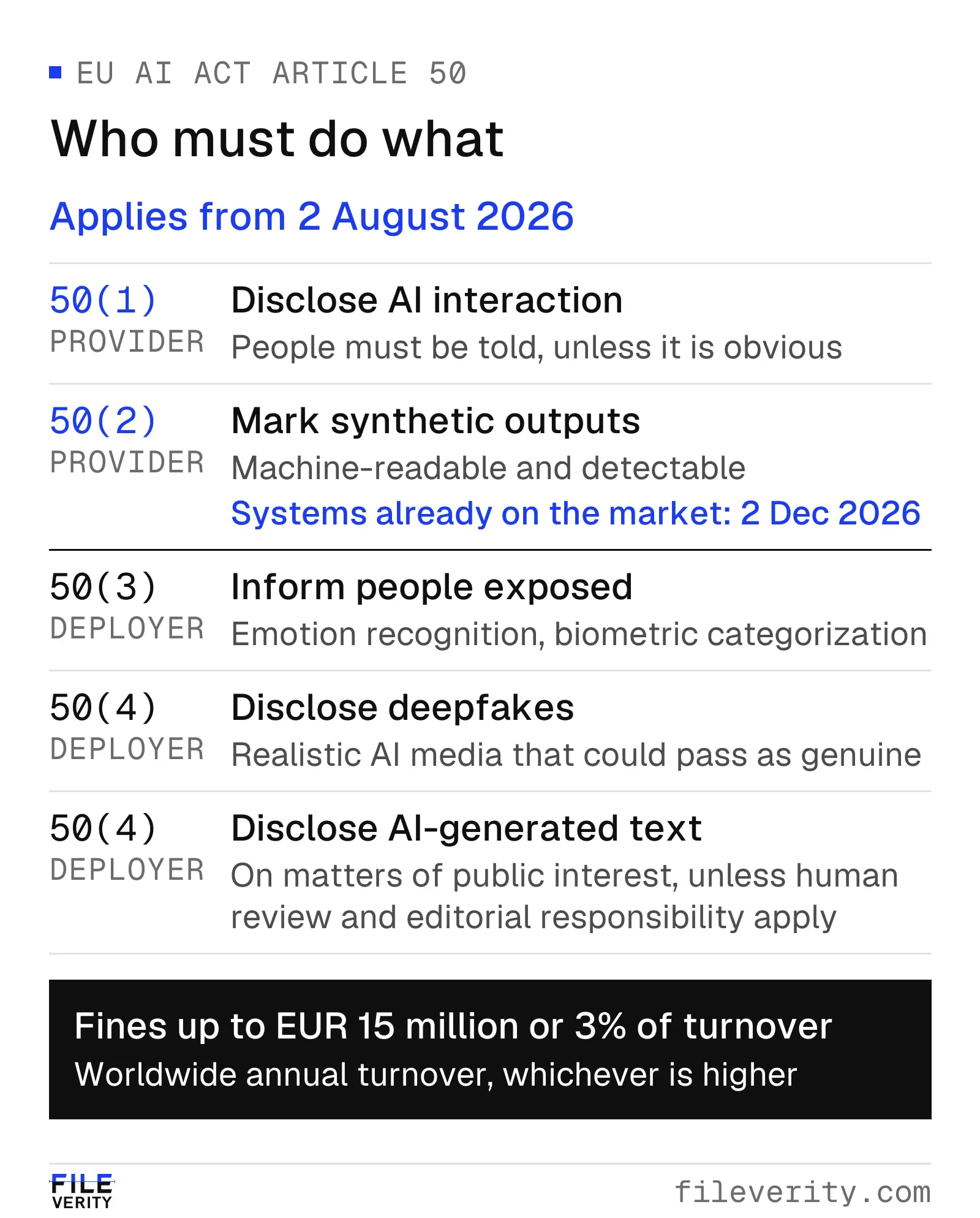
Providers of systems placed on the market before 2 August 2026 have until 2 December 2026 to meet the marking duty; the deployer disclosure duties have no equivalent transition.
Dates and the transitional period
Article 50 applies from 2 August 2026 under Article 113. Regulation (EU) 2026/1744, the AI Omnibus, entered into force on 27 July 2026 (Commission; Official Journal). It added a paragraph 4 to Article 111: providers of systems generating synthetic audio, image, video or text that were placed on the market before 2 August 2026 must take the necessary steps to comply with Article 50(2) by 2 December 2026. As of November 2, 2026, this adopted transition period is still running.
The relief is narrow. It covers machine-readable marking by providers of existing systems and does not delay the deployer disclosures in Article 50(4). The guidelines add that outputs and deepfakes generated or manipulated before 2 August 2026 need no retroactive marking or labeling, but text generated earlier and published on or after that date must be labeled if the Article 50(4) text duty otherwise applies (guidelines, section 8.4).
Labels for deepfakes and published text
For organizations that use AI to create or edit images, the duty most likely to apply is Article 50(4). The AI Act defines a deepfake as AI-generated or manipulated image, audio or video content that resembles existing persons, objects, places, entities or events and would falsely appear to a person to be authentic or truthful. The guidelines call this test objective, so intent to deceive is not required, and a picture of a sphinx flying over the Eiffel Tower is not a deepfake (guidelines, section 6.1).
The disclosure must be perceivable without special tools, such as a visible or audible label, so a provider's embedded marking does not satisfy it. Evidently artistic, creative, satirical or fictional works get a lighter regime: the deployer still discloses, in a way that does not hamper enjoyment of the work. For text, the guidelines say spell-checking or cursory approval is not human review, and substantive AI changes after sign-off void the exception (guidelines, section 6.2).
Code of Practice, guidelines and penalties
The Code of Practice on transparency of AI-generated content was published in final form on 10 June 2026. On 8 July the Commission concluded that it covers Article 50(2), (4) and (5), and the AI Board adopted its adequacy assessment the next day. Adherence is voluntary and "does not constitute conclusive evidence of compliance" (Commission opinion). For providers that sign it, the Code calls, for most content, for at least two layers of machine-readable marking: digitally signed metadata plus an imperceptible watermark (Code of Practice).
The Commission published its Article 50 guidelines on 20 July 2026. They are non-binding, and only the Court of Justice can interpret the Act authoritatively (guidelines, paragraph 5). Breaching Article 50 can be fined up to EUR 15 million or 3% of worldwide annual turnover, whichever is higher; for SMEs, including start-ups, and for small mid-cap companies the lower amount applies (Article 99).
Platform AI labels: what Meta, YouTube, TikTok, LinkedIn and Google show
Platform AI labels are notices that platforms attach to content they detect, or are told, involved AI. Platform policy sets them. Under the Commission's guidelines, a platform that only hosts or distributes content made by others is not a deployer under Article 50, although a platform's own generative AI tools carry provider duties (guidelines, section 2.3).
Meta: "AI info"
Meta shows "AI info" across Facebook, Instagram and Threads. It labels content when it detects industry-standard AI image indicators or when the poster discloses AI use, and it has said it builds detection for C2PA and IPTC metadata from other companies' tools (Meta, February 2024). Meta renamed the label from "Made with AI" on July 1, 2024 because indicator-based labels did not always match expectations, for example on minor retouching. From September 2024, Meta moved the label into the post's menu for content it detects was only edited by AI tools, while content detected as AI-generated keeps it on the post (Meta).
YouTube: altered or synthetic content
YouTube asks creators to disclose realistic content that is AI-generated or meaningfully altered, such as a real person appearing to say something they did not. A label may appear in the video player or the expanded description. YouTube may also label content automatically when it was made with its generative tools, carries C2PA metadata or is detected as AI-generated. Unrealistic content and minor edits such as beauty filters need no disclosure (YouTube Help).
TikTok: AI-generated content labels
TikTok requires people to label realistic AI-generated content. It combines creator labels, its own detection and Content Credentials, and its labels show whether they came from detection, a creator or a TikTok AI tool. It says labels can be lost when content is re-uploaded or edited elsewhere, and in March 2026 it said it was testing invisible watermarks that only TikTok can read (TikTok newsroom, March 2026).
LinkedIn: the Content Credentials icon
LinkedIn shows a C2PA icon on images and videos that carry cryptographically signed Content Credentials. Clicking it shows the credential and available metadata, including whether AI was used to generate or edit the content. LinkedIn states that it is not yet possible to identify and label all AI-generated and modified content (LinkedIn Help).
Google: "About this image" and SynthID
In Google Search, "About this image" can show whether an image carrying C2PA metadata was created or edited with AI tools (Google, September 2024). SynthID is an imperceptible watermark that Google DeepMind embeds in AI-generated images, audio, text and video, and Google describes a SynthID Detector for checking whether a file was made with AI from Google or its partners (Google DeepMind). In the Gemini app, SynthID recognition currently covers only content created with Google AI tools (Gemini Help).
Each label reflects what the platform could read or what the poster said, so one image can be labeled on one platform and unlabeled on another.
Other AI labeling rules: China and the United States
China requires both visible and embedded labels. The Measures for Labeling AI-Generated Synthetic Content, issued by the Cyberspace Administration of China with three other agencies, took effect on September 1, 2025. Service providers add explicit labels users can see and implicit labels embedded in file data, platforms check file metadata, and users must declare AI-generated content they publish (CAC, Measures). The mandatory national standard GB 45438-2025 on labeling methods took effect the same day (CAC, Q&A; national standards platform).
The United States has no general federal law requiring AI labels. The AI Labeling Act of 2026 (S. 4915) was introduced in the Senate on June 24, 2026 and referred to committee (GovInfo). One state-level example is California's AI Transparency Act (SB 942), as amended by AB 853 and SB 1000, which has been operative since August 2, 2026 (Business and Professions Code, chapter 25). Providers of generative AI systems publicly accessible in California must offer a free disclosure verification tool and, where technically feasible, embed a latent disclosure in AI-generated or altered image, video and audio content, apart from minor modifications. SB 1000, effective September 30, 2026, removed the earlier 1,000,000-user threshold (SB 1000). Large online platforms must surface provenance data from January 1, 2027, and penalties are $5,000 per violation, counted per day.
What an AI label proves, and what it does not
An AI label proves less than it seems, in both directions. A label is a claim about origin, and its strength depends on who made it: a validated, signed Content Credential documents recorded history, while a disclosure selected by the poster or an unsigned metadata field is only a declaration. No label shows that the depicted event happened: the C2PA explainer notes that provenance information alone cannot tell you whether content is true, accurate or factual (C2PA 2.2 explainer, section 7.2.2).
A missing label proves nothing. The explainer confirms that provenance metadata can be removed (section 7.2.3), and a screenshot carries none of the original file's metadata. The Content Authenticity Initiative says missing Content Credentials do not, by themselves, indicate that content is false (guidance). An unlabeled image is therefore not necessarily human-made. Article 50 does not close the gap: marking duties fall on providers, with exceptions for standard editing, a transition to 2 December 2026 and a "technically feasible" limit on how robust the marking must be, so some AI images will arrive unmarked.
Labels can also be too broad: Meta's switch from "Made with AI" to "AI info" followed labels on real photos with minor edits. A label says AI was involved, not how much of the image is synthetic. To read detection results next to labels, see how to read AI image detector accuracy.
How to check an image for AI labels yourself
To check an image for AI labels yourself, work from the visible to the technical and keep the original file. Each step answers a different question, so record each result separately. The figure shows the order and what each result means; the numbered steps explain how to run each check.
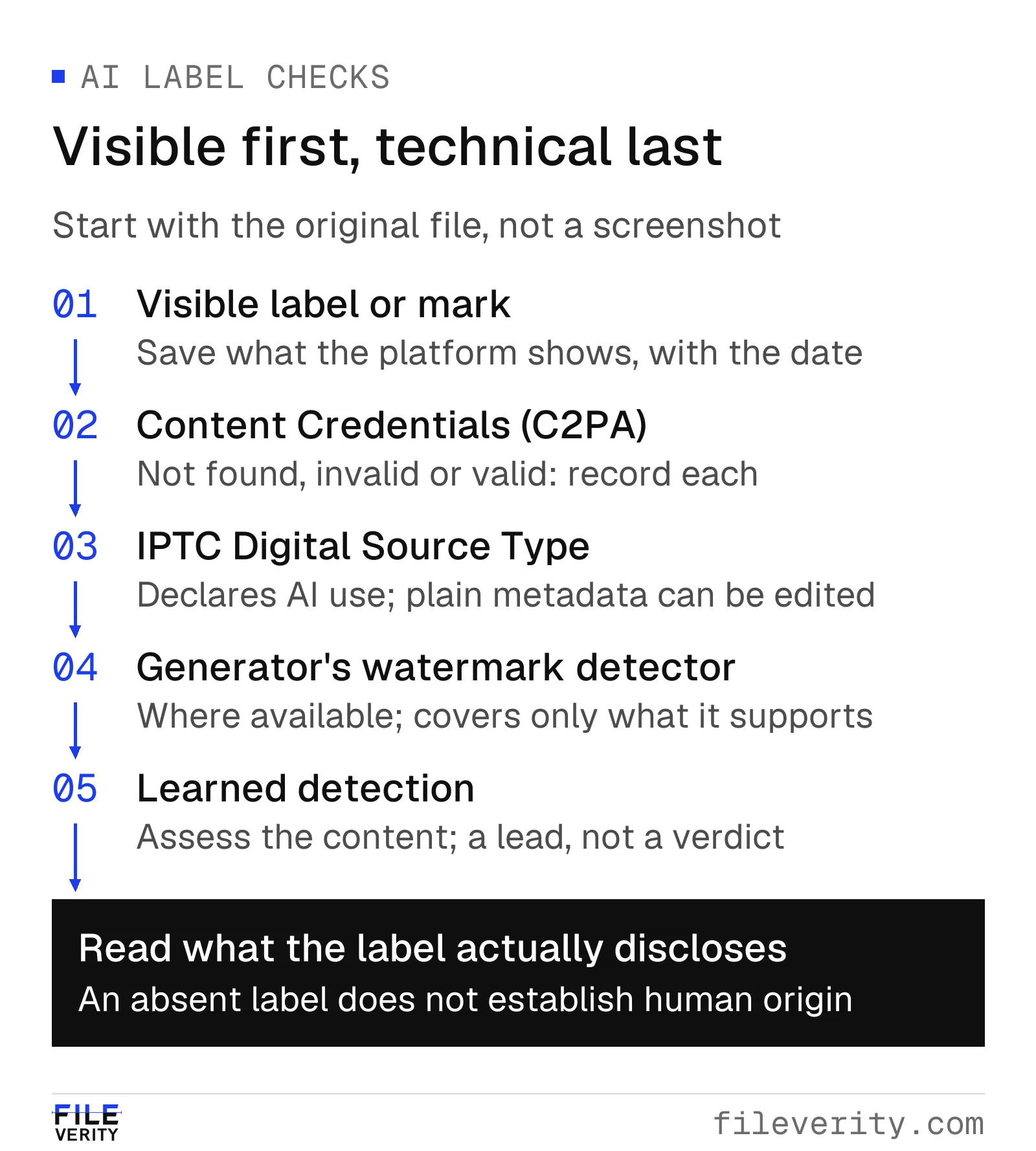
Interpret a label according to what it discloses and who supplied it. Its absence does not establish human origin.
- Read the context. Note any visible badge, such as "AI info" on the post or its menu, a YouTube disclosure or the LinkedIn icon. Save what the platform shows, with the date.
- Get the original file. Ask the sender for the original attachment. A screenshot or messaging preview may lack the source metadata you need.
- Inspect Content Credentials. Open the file in the Content Credentials Verify website, which the Content Authenticity Initiative describes as an inspection tool (how it works). Look for the Content Credentials pin, often called the "cr" icon, and separate "no credentials found" from "present but invalid" and "valid, with these recorded actions".
- Read the metadata. The command
exiftool -XMP-iptcExt:DigitalSourceType image.jpgprints the IPTC Digital Source Type, a tag ExifTool lists in its IPTC Extension table. A value ending intrainedAlgorithmicMediaorcompositeWithTrainedAlgorithmicMediadeclares generative AI use, but plain metadata can be edited. Fileverity's free photo metadata viewer reads basic EXIF only; it does not read C2PA, XMP or AI labels. - Try the generator's watermark check. Google's SynthID Detector covers content from Google and its partners, and the Gemini app covers Google AI tools. A negative result applies only to what that checker supports.
- Use learned detection to investigate the content. Fileverity's image analysis (model VerEye) validates available Content Credentials, reads EXIF, XMP and machine-readable AI labels, checks for supported invisible watermarks, and detects AI-generated images and locally edited regions. It reports available Content Credentials and supported watermark findings alongside a risk level. A watermark without a credential does not, by itself, establish that a credential was removed. The report records the file's SHA-256 hash and, when validation succeeds, an RFC 3161 trusted timestamp, and you can check it at Verify a report. Sign in to run it at the AI image detection; a free account includes 5 AI image detections a month. A negative result never proves content is human-made.
For the full workflow, see how to tell if an image is AI-generated.
For teams that publish or receive content: a checklist
- Know your role. Decide whether you are a provider, a deployer, both or neither for each AI tool.
- Label your own AI outputs. Add a visible label to realistic AI images, audio and video that could pass as authentic, and keep embedded Content Credentials by not stripping metadata on export.
- Keep provenance. Store the original file, its SHA-256 hash, the sender and the receipt date, as described in SHA-256 checksums and trusted timestamps.
- Document editorial review for text. For AI-assisted text on matters of public interest, record who reviewed it, when, what they checked and who holds editorial responsibility, including any AI changes after sign-off.
- Ask suppliers to disclose. Require agencies and freelancers to state whether AI tools were used and to deliver originals.
Fileverity's AI text detection flags AI-written passages with Veread, its own text model, in plain text, and the document analysis includes the same check for files, which can support an editorial review of incoming text. It does not decide whether a labeling obligation applies, and a report does not replace human review or editorial responsibility.
Worked example: an agency image with no label
This example is fictitious. A marketing team at a regional outdoor retailer in the EU receives a campaign image from an agency: a hiker in the retailer's new jacket on a mountain trail. The file carries no label and no Content Credentials.
The team saves the original and records its hash. There is no visible badge, no Content Credentials and no Digital Source Type value. A Fileverity report returns an elevated risk level for AI generation, with no supported watermark found. The team treats that as a lead, not a verdict.
The team asks the agency for a written statement of the tools used, the layered working file and the original export. The agency replies that the trail and the model were generated and only the jacket was photographed. The Commission's guidelines count realistic AI-generated human avatars as persons for the deepfake definition (guidelines, section 6.1), so the team's counsel treats the image as a likely deepfake under Article 50(4). Who holds the Article 50(4) duty depends on who used the AI system: the guidelines say a company that merely commissions an agency, without deciding whether and how the agency uses AI, is not a deployer, so the duty may sit with the agency (guidelines, section 2.3). The team documents the applicable responsibilities with the agency, adds a visible disclosure wherever the retailer publishes the image and uses each platform's AI disclosure setting.
The team files the hash, the report, the agency's statement, the label wording and the publication date. The agency's statement and the legal assessment decided the outcome, not the detection result.
Common questions about AI labels
What does "AI info" mean on Instagram or Facebook?
"AI info" is Meta's label for content it detected as AI-generated or modified through industry-standard indicators, or that the poster said involved AI. Where content was only edited with AI tools, the label sits in the post's menu. It does not mean the whole image is synthetic.
When does Article 50 of the EU AI Act apply?
Article 50 applies from 2 August 2026. Providers of generative AI systems placed on the market before that date have until 2 December 2026 to meet the machine-readable marking duty in Article 50(2), under Article 111(4) as added by Regulation (EU) 2026/1744. The Article 50(4) disclosure duties for deployers have no transitional period.
Does the EU AI Act require labeling all AI-generated images?
No. Providers of image generators must mark outputs in a machine-readable format, with exceptions for standard editing and non-substantial alteration. Deployers must visibly disclose deepfakes, meaning realistic content resembling existing persons, objects, places or events that would falsely appear authentic. Clearly fantastical images fall outside that definition.
Can AI labels be removed?
Yes. Screenshots, re-encoding and metadata stripping can remove embedded labels, and invisible watermarks are designed to survive some edits but are not guaranteed to. China's measures prohibit maliciously deleting or altering labels, and from January 1, 2027 California will require large online platforms not to knowingly strip provenance data where technically feasible.
Is AI labeling required in the United States?
There is no general federal labeling law. California's AI Transparency Act, operative since August 2, 2026, requires providers of generative AI systems to offer a verification tool and, where technically feasible, embed latent disclosures in AI-generated image, video and audio content. Platforms such as Meta, YouTube and TikTok also apply their own labeling policies.
By Yang Zheng · Reviewed by Bill Liu