Model release
Veread 1.1: fewer false positives, sharper passage marking
Veread 1.1 detects 98.6% of fully AI-written text with 0.28% false positives, and finds 92.2% of mixed human and AI documents. Live from 18 November 2026.
Published · 6 min read
Key facts
- Version
- Veread 1.1
- Released
- 18 November 2026
- False positives on human writing
- 0.28% (from 0.45%)
- Fully AI-written texts detected
- 98.6%
- Mixed human and AI documents detected
- 92.2% (from 87.3%)
- Texts from unseen AI models detected
- 94.9%
Veread 1.1, released on 18 November 2026, detects 98.6% of fully AI-written text and wrongly flags only 0.28% of human writing, down from 0.45% in Veread 1.0, measured across seven languages on held-out data. It detects 92.2% of documents that mix human and AI writing (from 87.3%) and marks the AI-written passages with 97.2% precision.
Veread is Fileverity's own AI-text detection model, and every Fileverity text and document check now runs on version 1.1.
What's new in Veread 1.1
- Training focused on English, Spanish and French. All seven languages stay in one model: English, French, German, Spanish, Chinese, Vietnamese and Arabic.
- Much broader human writing. Student essays and coursework, full academic papers, letters and complaints, film and product reviews, forum discussions, fiction and literary prose, legal and administrative text, news and encyclopedic articles.
- Deliberate hard human cases. Formal, formulaic or polished human writing, the kind detectors most often mistake for AI, is now a core part of training.
- The newest AI writing from nine model families: OpenAI, Anthropic, Google, DeepSeek, Alibaba, Meta, Mistral, xAI and Zhipu, including AI text paraphrased or "humanized" to evade detection and AI rewrites of human text.
- Sentence-level labels. Every AI-written sentence in a mixed document is labelled, so the model learns exactly where human writing stops and AI writing starts.
- Cleaner training text. Bylines, credits, cookie and subscription notices, markup, footnote markers and word counts were removed by deletion only. The writing itself is never altered, so Veread judges the writing, not the formatting.
- Exact and near-duplicate screening across training and evaluation.
- New decision thresholds calibrated on held-out human writing, with passage marking and writing-style resemblance, which now appears more often and is right more often, recalibrated for the new model.
Results: Veread 1.1 against Veread 1.0
Both versions ran through the same evaluation: held-out texts of about 100 words or more in seven languages.
| Measure | Veread 1.0 | Veread 1.1 |
|---|---|---|
| Human writing wrongly flagged as AI | 0.45% | 0.28% |
| Fully AI-written texts detected | 98.3% | 98.6% |
| AI-written and AI-assisted texts of every kind detected | 95.4% | 95.9% |
| Human texts continued by AI detected | 91.7% | 94.3% |
| Documents that mix human and AI writing detected | 87.3% | 92.2% |
| Short excerpts of about 100 words detected | 92.9% | 94.1% |
| Full documents detected | 96.6% | 96.8% |
| Texts rewritten by AI detected | 92.5% | 92.8% |
| Passage marking F1 | 90.3 | 92.9 |
| AUROC, short excerpts | 0.995 | 0.996 |
Veread 1.1 also detects 100% of AI passages inserted into human text, 97.6% of texts polished by AI and 94.9% of texts from AI models never used in development. AUROC on full documents is 0.999.
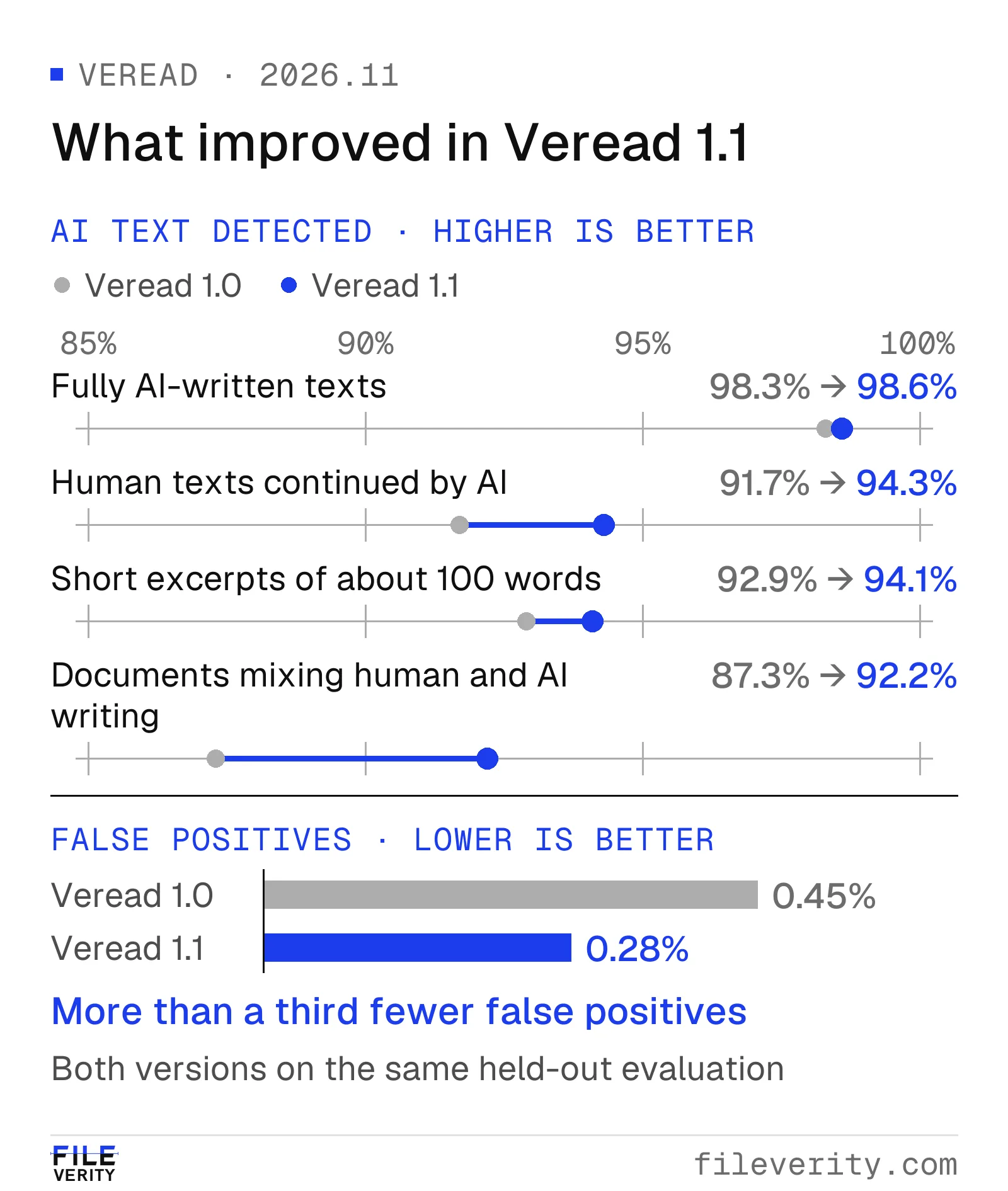
False positives fall by more than a third while detection rises on every headline measure.
The measures in plain words
- False positive rate: the share of human-written texts that receive an AI finding. Lower is better.
- Detection rate: the share of AI-written or AI-assisted texts that Veread identifies. Higher is better.
- AI-assisted: a text counts only when the AI genuinely changed the wording, whether it continued, rewrote, polished or was inserted into human text.
- AUROC: how cleanly Veread's scores separate human and AI writing, whatever decision point you choose. A score of 1 is perfect separation.
- Passage marking F1: one score combining how many AI-written passages Veread finds with how many of the passages it marks are truly AI-written.
- Precision of marked passages: the share of marked text that is truly AI-written.
Fewer false positives on human writing
A false positive is a person's own work flagged as machine-written. For a teacher, an admissions office or an editor, it decides whether a detector can be used on real people's work.
Veread 1.1 flags 0.28% of human writing, more than a third fewer false positives than Veread 1.0. The figure covers all held-out human writing, including independent human panels from sources never used in training. Full documents reach 0.23%.
Every language is below 0.5%. English fell from 0.43% to 0.18%, Spanish from 0.77% to 0.41% and French from 0.76% to 0.45%, and the full list is in the language table below. Every genre is below 1%. Literature and literary prose fell from 0.62% to 0.08%, reviews and forums from 0.84% to 0.38%, learner and student writing from 0.51% to 0.30%, and academic and scientific prose from 1.08% to 0.77%.
Sharper passage marking in mixed documents
Real submissions are rarely pure machine output. Veread 1.1 learns from sentence-level labels, so it detects 92.2% of documents that mix human and AI writing (from 87.3%), marks passages with 97.2% precision, and reaches a passage marking F1 of 92.9 (from 90.3). These results are measured end to end through the production engine.
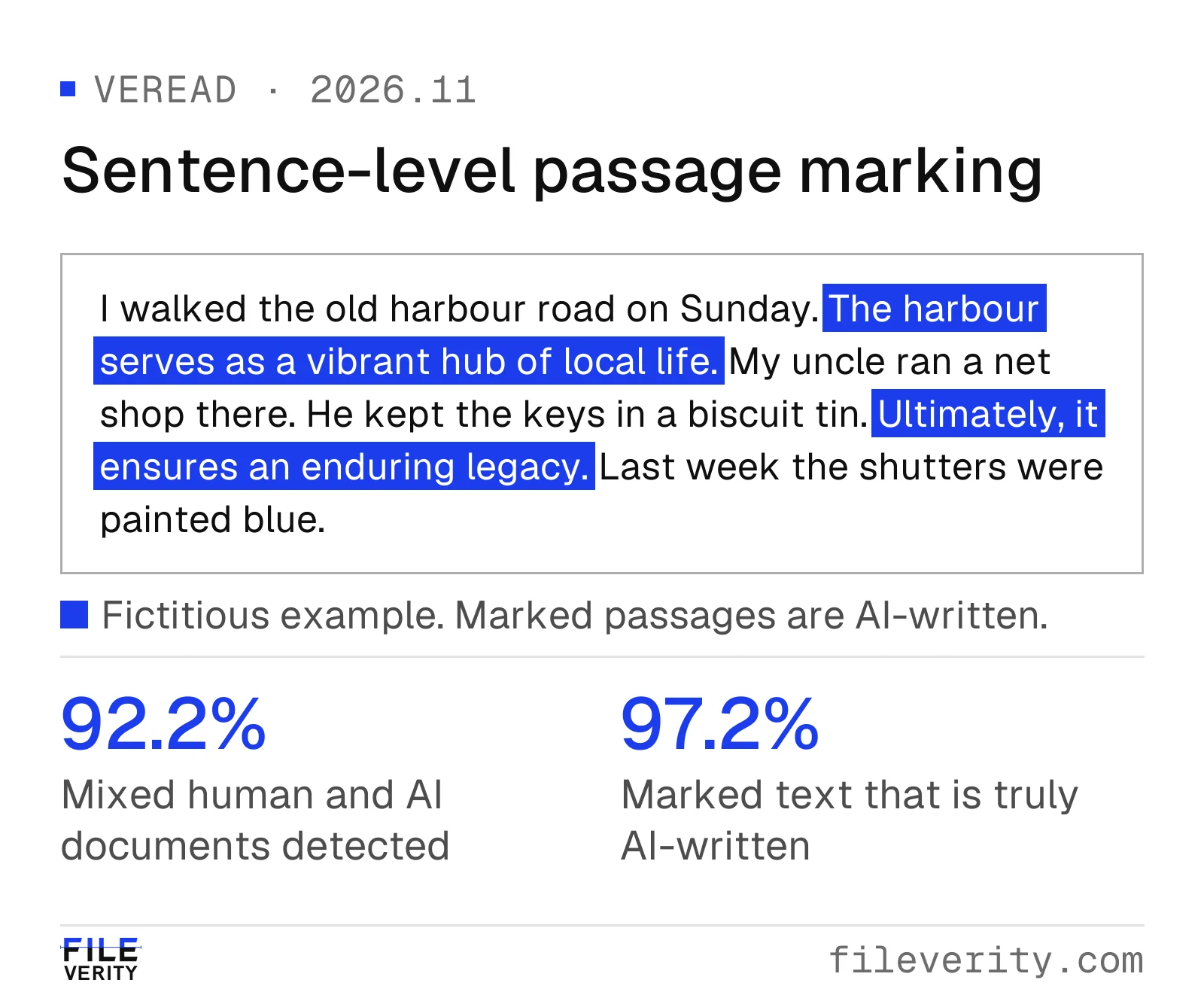
Fictitious example. Veread 1.1 marks the AI-written sentences inside a document that also contains human writing.
Strong results in all seven languages
One model serves all seven languages, and each is measured separately.
| Language | Human text wrongly flagged | AI-written and AI-assisted detected | Fully AI-written detected |
|---|---|---|---|
| English | 0.18% | 94.5% | 95.1% |
| French | 0.45% | 96.8% | 99.1% |
| German | 0.27% | 94.1% | 100% |
| Spanish | 0.41% | 96.0% | 100% |
| Chinese | 0.03% | 98.8% | 100% |
| Vietnamese | 0.48% | 92.8% | 95.5% |
| Arabic | 0.13% | 97.5% | 98.5% |
Detection of AI-written and AI-assisted text rose in English (from 93.3%), German (from 93.2%), Vietnamese (from 90.7%) and Arabic (from 97.2%). Fully AI-written German text moved from 99.1% to 100%.
By model family, fully AI-written text from OpenAI, Alibaba, Mistral, xAI and Meta is detected at 100% (Meta from 96.8%), DeepSeek at 96.3% (from 95.1%) and Google at 95.9% (from 93.9%).
By genre, AI-written and AI-assisted academic and scientific prose and letters, emails and complaints are detected at 100%, and learner and student writing at 99.1% (from 98.1%).
How we test Veread
A detector is only as credible as its evaluation. Veread is built and validated on massive, exclusive, proprietary, professionally curated data, and every result in this post comes from the evaluation below.
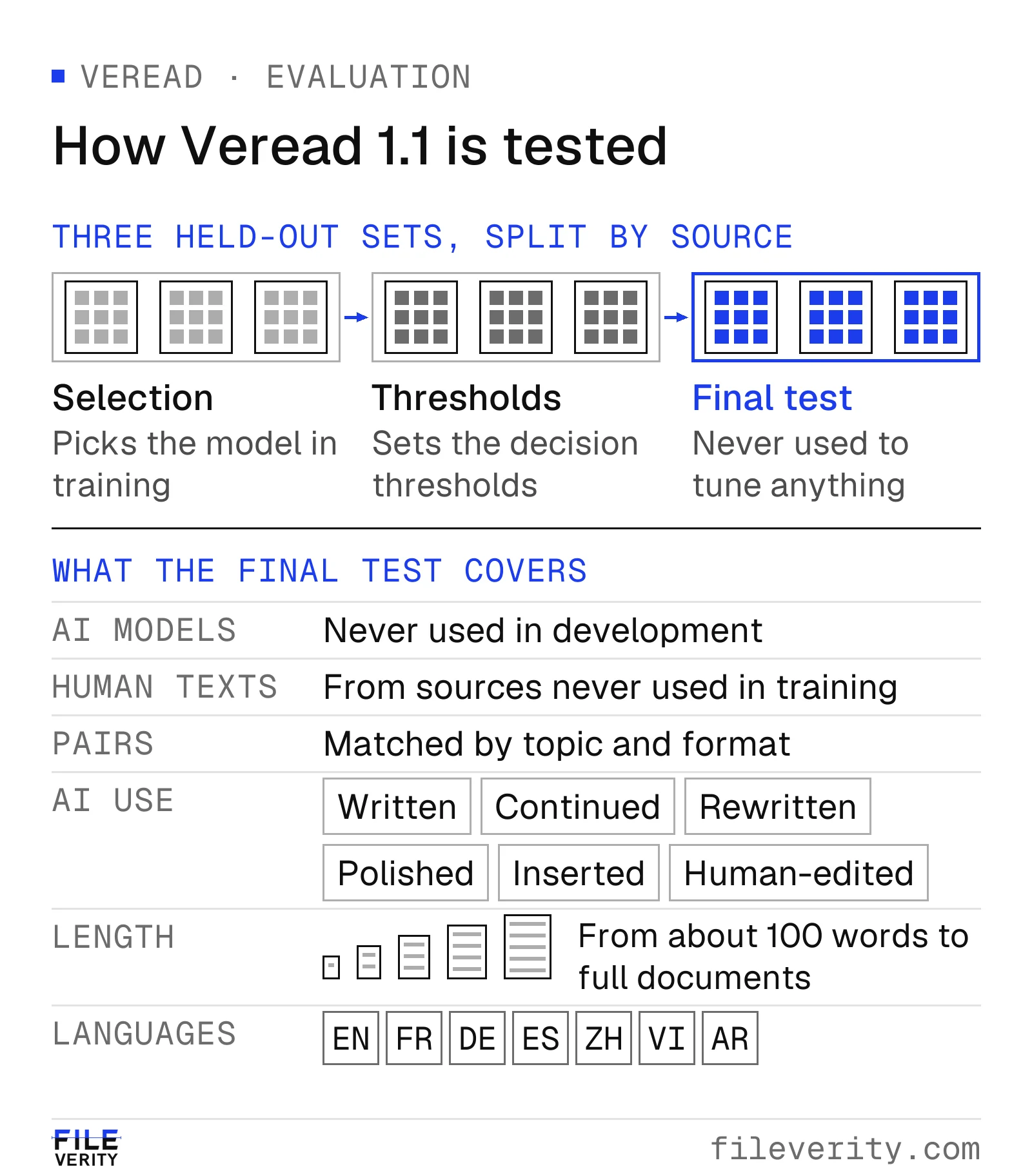
The evaluation separates choosing the model, setting thresholds and the final test, and measures the engine customers use.
- Three held-out sets with three jobs. One chooses the model during training, one sets the decision thresholds, and one is the final test. The final test set is never used to tune anything.
- Held out by source. Documents that share a source or author group stay on the same side of the split, so the test measures generalization, not memory.
- Unseen AI models. The test includes text from models that were never used anywhere in development.
- Unseen human sources. Human panels from sources never used in training measure false positives the way customers meet them.
- Matched pairs. AI texts are written on the same topics and in the same formats as their human counterparts, so a detector cannot succeed on topic or format alone.
- Every kind of AI involvement. Written from scratch, a human start continued by AI, rewritten, polished, AI passages inserted into human text, and humans editing AI drafts.
- Real AI writing only. An edited text counts as AI-assisted only when the AI genuinely changed the wording. Light touch-ups that leave the human wording intact are excluded.
- Full range of inputs. Excerpts of about 100 words up to full documents, in seven languages, across legal and administrative text, literary prose, student writing, academic papers, news, web content, reviews and forums, practical documents, and letters and complaints.
- The production engine. Results are measured end to end through the same engine that serves customers, not on a lab copy.
Available now
Veread 1.1 has been live since 18 November 2026, with no action needed:
- The web AI text detector and the Console.
- The API, with model IDs unchanged (
veread-1-textfor text,veread-1for documents) and a new snapshot dated 2026-11-18. See the text detection API documentation. - Document reports, where Veread checks the text inside documents. The accuracy page lists the headline measurements.
- The Chrome extension and bulk class checks for teachers.
The complete Veread 1.1 scorecard, by language, genre and model family, is in the Veread benchmark guide.
By Yang Zheng