Evaluating detection
Veread 1.1 detects 98.6% of fully AI-written text with 0.28% false positives
Veread 1.1 detected 98.6% of fully AI-written text and 95.9% of AI-assisted text, with 0.28% false positives across seven languages. See every result.
Published · Updated · 8 min read
On this page
Veread 1.1 detected 98.6% of fully AI-written text in our evaluation, with just 0.28% of human-written text receiving an AI finding across seven languages. Every language stays below 0.5% false positives, and every kind of writing stays below 1%. Across every kind of AI involvement, from fully written to continued, rewritten and edited, Veread detected 95.9%, and its AUROC is 0.999 on full documents.
For teams comparing AI text detectors, this report gives the complete scorecard: false positives by language and by kind of writing, detection by language, kind of writing and model family, results for mixed and rewritten documents, and results for short excerpts. Detection is measured on a held-out test set, and false positives on all held-out human writing, including independent panels from sources never used in training.
Model version: Veread 1.1, release 2026.11. Veread is the text detection model developed by Fileverity. It is developed and validated on massive, exclusive, professionally curated proprietary data, and one model serves all seven languages. Veread 1.1 has been live since 18 November 2026, and the results below stay attributed to Veread 1.1 as new versions ship. What the release brings is described in the Veread 1.1 release post.
AI text detector accuracy: the complete scorecard
| Measure | Result | What it tells you |
|---|---|---|
| Human-written text receiving an AI finding | 0.28% | The false-positive rate across all seven languages |
| Fully AI-written text detected | 98.6% | Share of texts written entirely by an AI model that Veread identified |
| All AI-written and AI-assisted text detected | 95.9% | Fully written, continued, rewritten and edited texts together |
| Human documents rewritten by AI | 92.8% | Detection when an AI model rewrites a human-written document |
| Text from AI models never used in development | 94.9% | Detection on models Veread had not seen |
| AUROC, full documents | 0.999 | How cleanly human and AI text separate across all decision points |
| AUROC, short excerpts | 0.996 | The same separation for excerpts of about 100 words |
Detection was measured on a held-out test set that was never used for training, model selection or decision settings. False positives were measured on all held-out human writing: the test set together with independent human panels from sources never used in training. The texts run from about 100 words upward, and Veread was run at its production settings. AUROC is a different metric from the share of texts classified correctly: it measures how well the scores separate human and AI writing, whatever decision point a reader picks.
Every language below 0.5% false positives
A false positive is a human-written text that receives an AI finding. For a school, a publisher or a claims team, it is the number that decides whether a detector can be used on real people's work. Veread keeps it at 0.28% overall, and all seven languages stay below 0.5%.
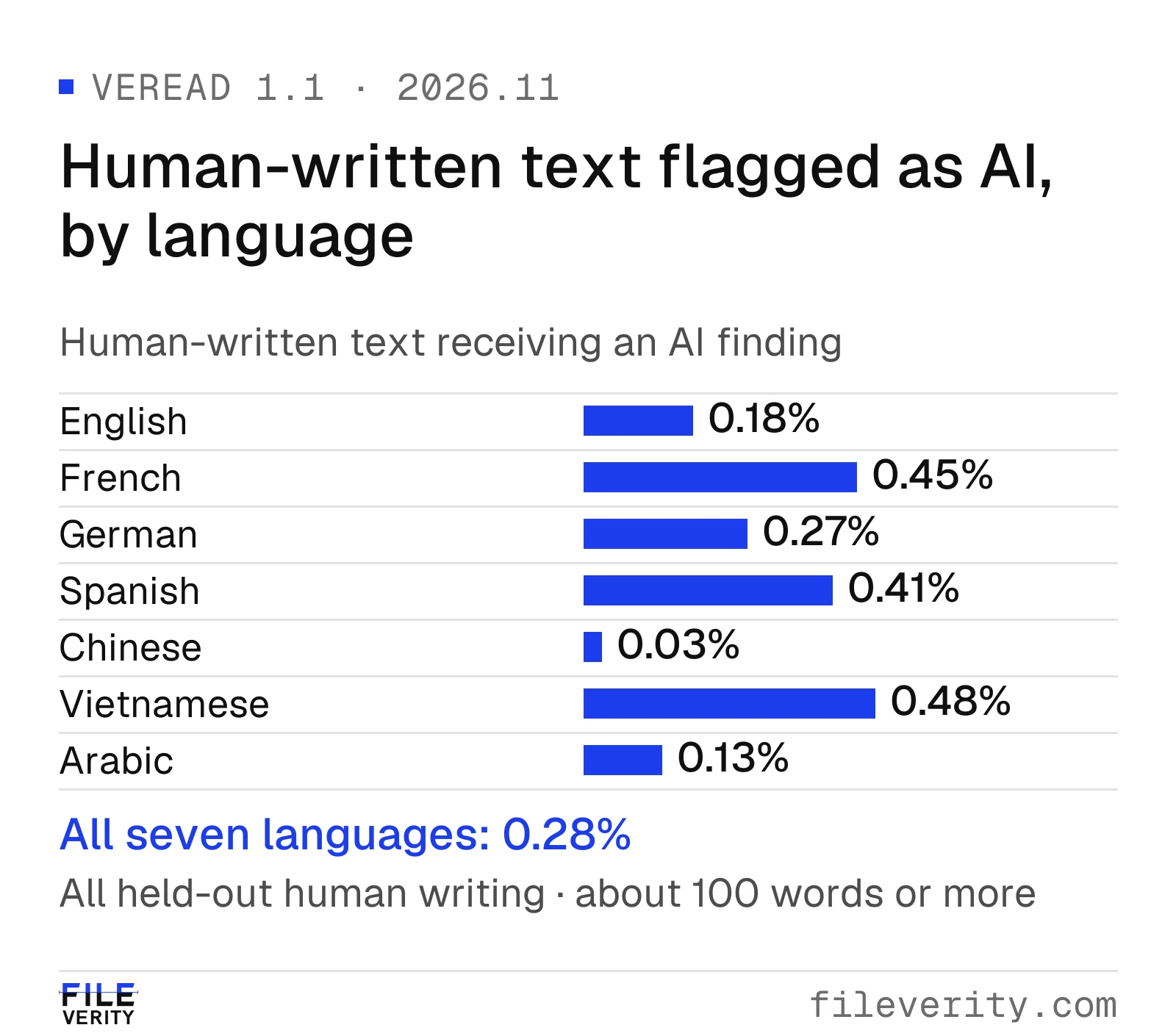
Human-written texts of about 100 words or more. All held-out human writing, including independent panels from unseen sources. Fileverity evaluation · Veread 1.1 · 2026.11.
| Language | Human text receiving an AI finding | Fully AI-written text detected | All AI-written and AI-assisted text detected | AUROC |
|---|---|---|---|---|
| English | 0.18% | 95.1% | 94.5% | 0.9998 |
| French | 0.45% | 99.1% | 96.8% | 0.9991 |
| German | 0.27% | 100% | 94.1% | 0.9995 |
| Spanish | 0.41% | 100% | 96% | 0.9995 |
| Chinese | 0.03% | 100% | 98.8% | 1.000 |
| Vietnamese | 0.48% | 95.5% | 92.8% | 0.9919 |
| Arabic | 0.13% | 98.5% | 97.5% | 0.9999 |
False positives range from 0.03% to 0.48% by language. AUROC is 0.9991 or higher in six languages and above 0.99 in all seven. Vietnamese and Arabic are measured exactly like the other five languages. If your team reviews text in several languages, you get one model and one set of measured results instead of a separate tool per market.
Fully AI-written text detected in every language
Veread detects fully AI-written text at 100% in German, Spanish and Chinese, 99.1% in French, and 98.5% in Arabic. Every language is measured separately, and all seven are at 95.1% or above.
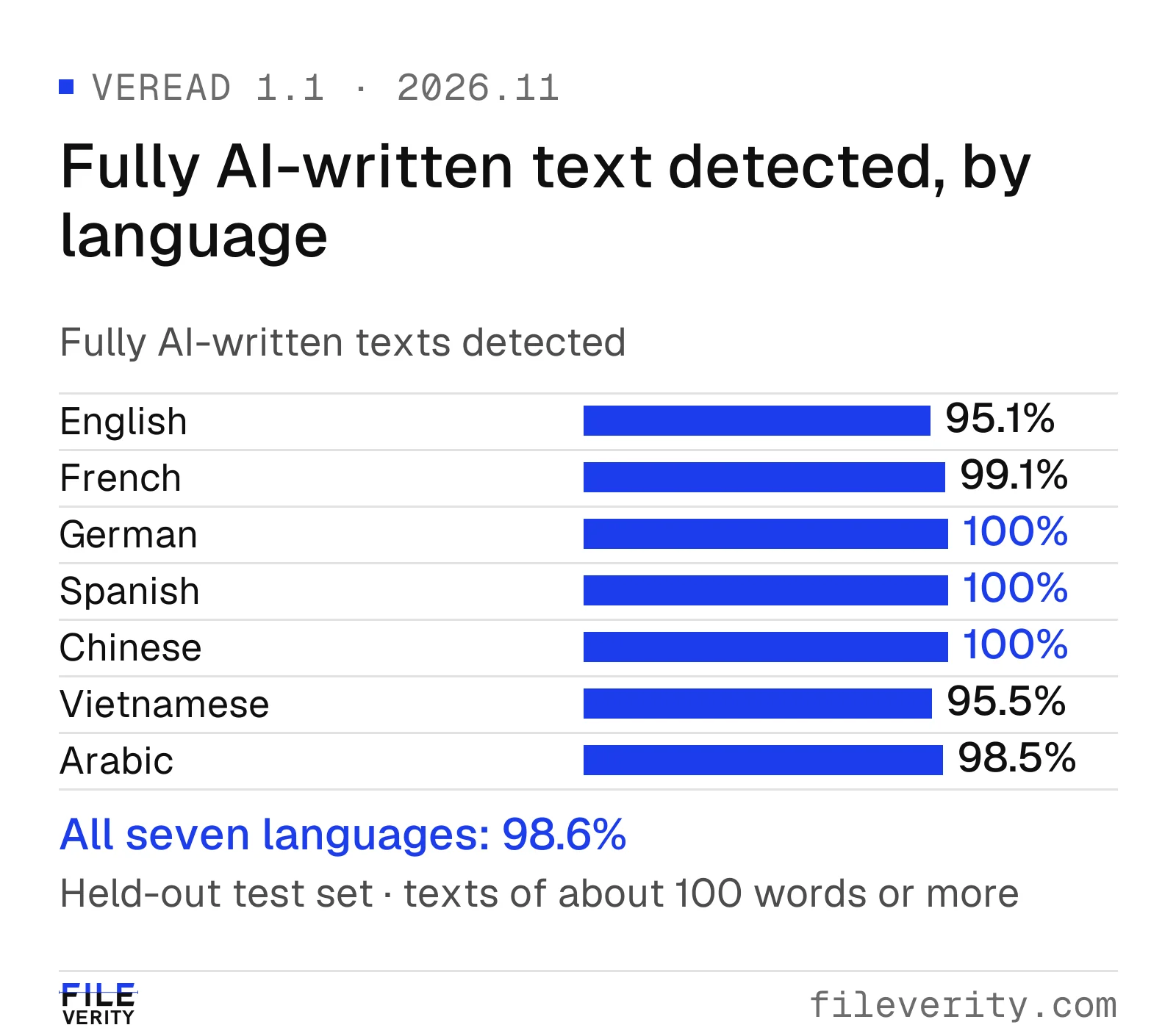
Fully AI-written texts. All seven languages together: 98.6%. Fileverity evaluation · held-out test set · Veread 1.1 · 2026.11.
When AI involvement is partial, the picture stays strong: all AI-written and AI-assisted text together is detected at 98.8% in Chinese, 97.5% in Arabic and 96.8% in French, and at 92.8% or above in every language.
False positives by kind of writing
Writing style changes how detectors behave, so we measured each kind of writing separately. Every kind of writing stays below 1% false positives. Encyclopedic text measured 0.04%, literature and creative writing 0.08%, and essays by students and language learners 0.30%.
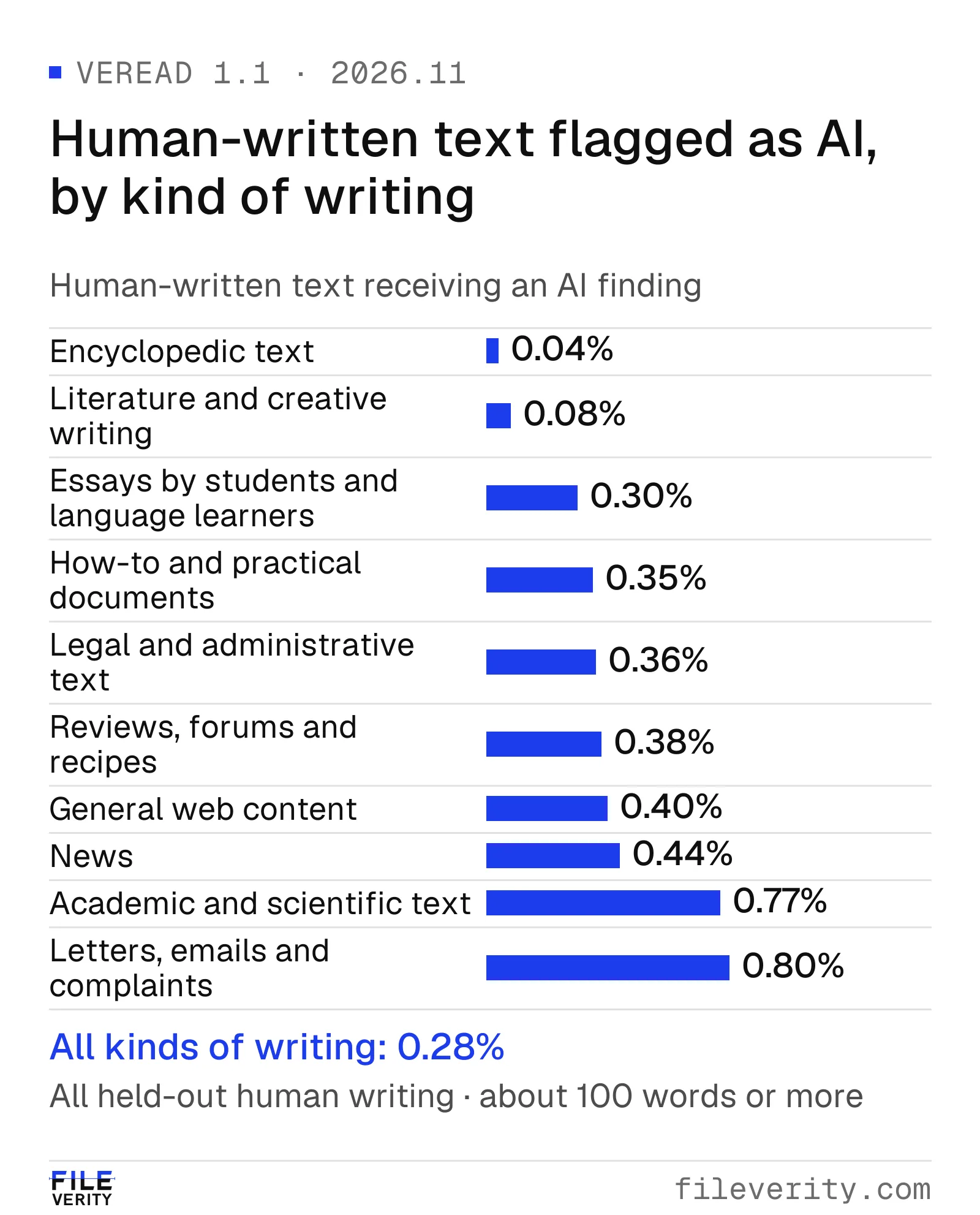
Overall across all kinds of writing: 0.28%. All held-out human writing, including independent panels from unseen sources. Fileverity evaluation · Veread 1.1 · 2026.11.
| Genre | Human text receiving an AI finding | All AI-written and AI-assisted text detected |
|---|---|---|
| Encyclopedic text | 0.04% | 95.3% |
| Literature and creative writing | 0.08% | 93.9% |
| Essays by students and language learners | 0.30% | 99.1% |
| How-to and practical documents | 0.35% | 97.3% |
| Legal and administrative text | 0.36% | 92.3% |
| Reviews, forums and recipes | 0.38% | 95.1% |
| General web content | 0.40% | 97.4% |
| News | 0.44% | 94.9% |
| Academic and scientific text | 0.77% | 100% |
| Letters, emails and complaints | 0.80% | 100% |
Student and language-learner writing
Fairness to students and non-native writers matters to every school, university and employer that screens submissions. In this evaluation, essays by students and language learners received 0.30% false positives, while 99.1% of AI-written and AI-assisted essays were detected.
AI-written and AI-assisted text detected, by kind of writing
Every kind of writing is detected at 92.3% or above. Academic and scientific text and letters, emails and complaints reach 100%, and essays by students and language learners follow at 99.1%.
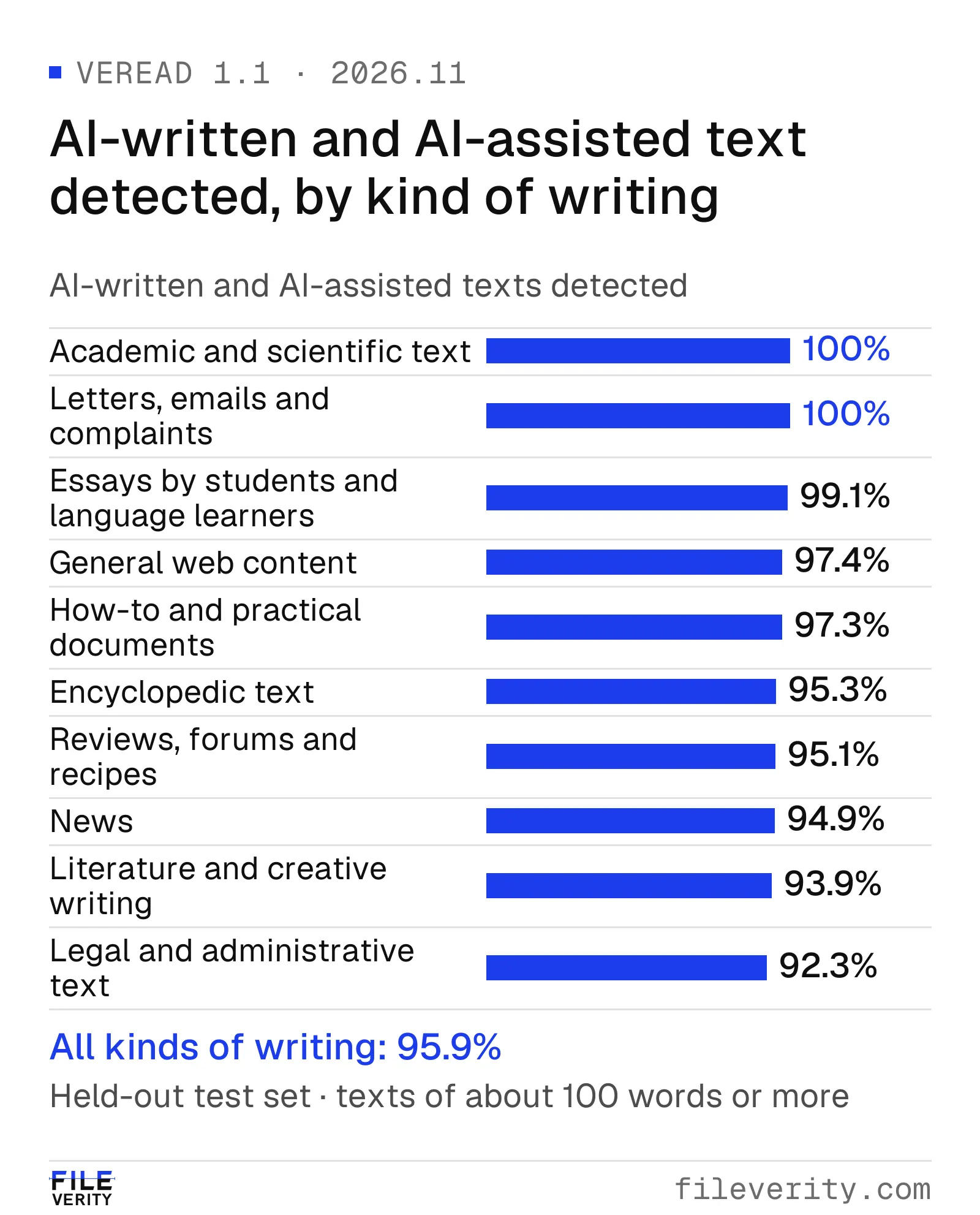
Fully written, continued, rewritten and edited texts. All kinds of writing together: 95.9%. Fileverity evaluation · held-out test set · Veread 1.1 · 2026.11.
Detection by model family
Veread was evaluated on text from the major AI developers, including current models. OpenAI, Alibaba, Meta, Mistral and xAI models are detected at 100%, and Anthropic models at 97.9%.
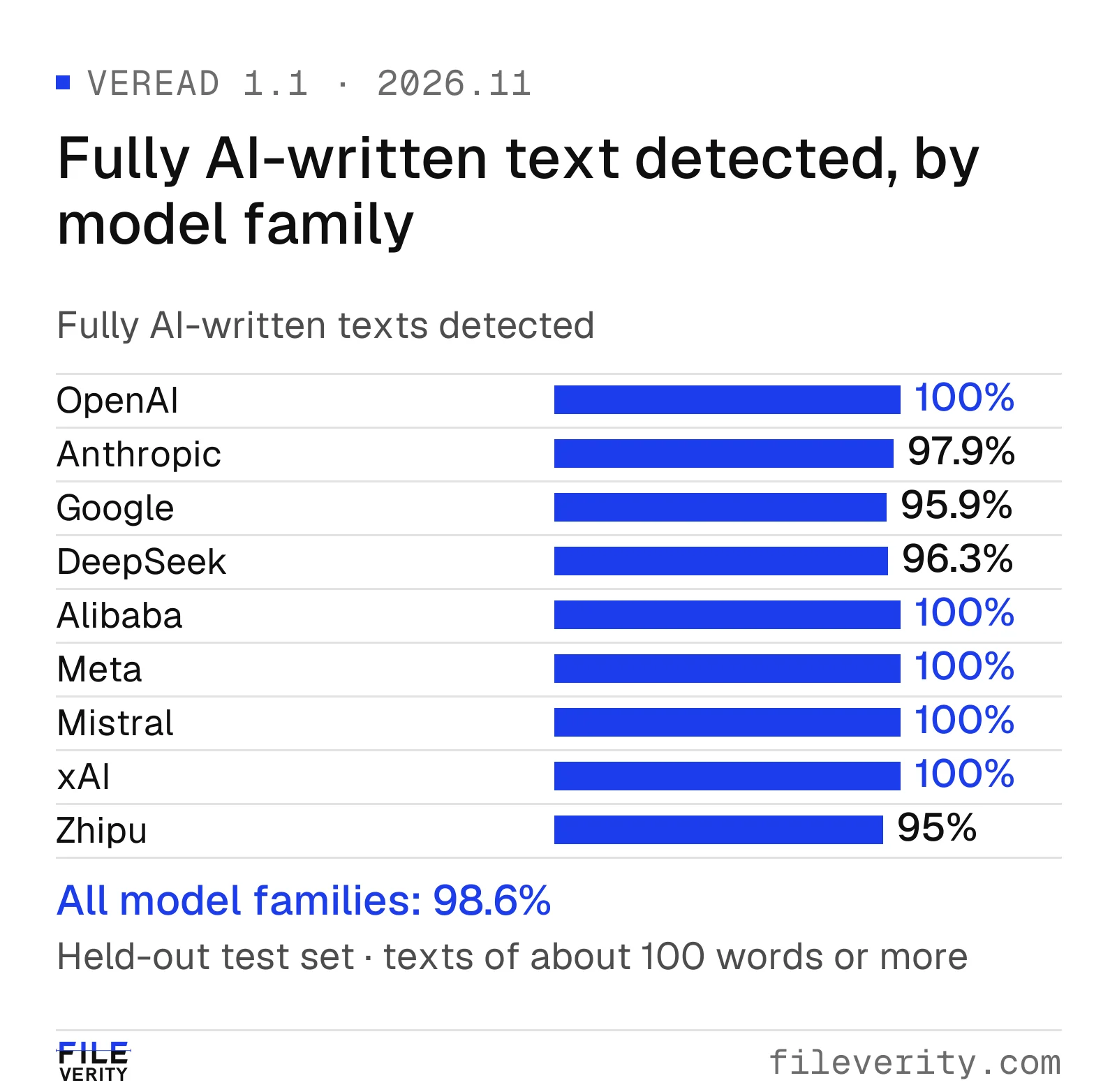
Fully AI-written texts. All model families together: 98.6%. Fileverity evaluation · held-out test set · Veread 1.1 · 2026.11.
| Model family | Fully AI-written text detected |
|---|---|
| OpenAI (GPT) | 100% |
| Anthropic (Claude) | 97.9% |
| Google (Gemini) | 95.9% |
| DeepSeek | 96.3% |
| Alibaba | 100% |
| Meta | 100% |
| Mistral | 100% |
| xAI (Grok) | 100% |
| Zhipu (GLM) | 95% |
Newer developers such as Moonshot (Kimi), ByteDance, Tencent and MiniMax are also part of Fileverity's ongoing coverage. The broad result holds on models Veread never saw during development: 94.9% of their text was detected, which is the measure to look at when new models appear faster than detectors are updated.
Mixed and rewritten documents
Real submissions are rarely pure machine output. A writer may let an AI continue a draft, or ask it to rewrite a human paragraph.
| Document type | Detected |
|---|---|
| Human documents continued by AI | 94.3% |
| Human documents rewritten by AI | 92.8% |
| All AI-written and AI-assisted text: fully written, continued, rewritten and edited | 95.9% |
Veread detects AI involvement across this whole range, not only text generated in a single pass, and its document report marks which passages carry the finding.
Short excerpts and full documents
Veread reads texts from about 100 words and answers in seconds.
| Input | Human text receiving an AI finding | AI-written and AI-assisted text detected | AUROC |
|---|---|---|---|
| Full documents | 0.23% | 96.8% | 0.999 |
| Short excerpts of about 100 words | 1.4% | 94.1% | 0.996 |
Full documents bring false positives down to 0.23% with 96.8% detected. Short excerpts hold up too: from about 100 words, 94.1% of AI-written and AI-assisted text is detected, with an AUROC of 0.996, so a pasted paragraph or a single answer already gives a strong signal.
What was tested
- A held-out test set that was never used for training, model selection or decision settings, for detection.
- All held-out human writing for false positives: the test set together with independent human panels from sources never used in training.
- Seven languages: English, French, German, Spanish, Chinese, Vietnamese and Arabic.
- Many kinds of writing, from letters and legal text to news, academic writing and general web content.
- Fully AI-written, continued, rewritten and edited texts from the major AI developers, including current models and models never used in development.
- Veread's production decision settings, the same ones a customer uses, fixed before the evaluation.
Veread is developed on massive, exclusive, professionally curated proprietary data.
How to use these results
Start with the figure that matches your risk. A school or HR team should look first at false positives on human writing and on learner essays. A publisher or a trust-and-safety team should look at detection by model family and on unseen models. A team with mixed documents should look at the continued and rewritten results.
A Veread result is evidence for review, not proof of authorship, and decisions about people need human review. Use the AI text detector to check a text, or run a full document report when you also need metadata, revisions and signatures. The accuracy page for document analysis lists the headline measurements, and how to choose an AI detection API covers integration.
Questions about the results
How accurate is the Veread AI text detector?
On a held-out test set, Veread 1.1 detected 98.6% of fully AI-written text and 95.9% of all AI-written and AI-assisted text, while 0.28% of human-written text received an AI finding. AUROC was 0.999 on full documents and 0.996 on short excerpts.
What is the AI detector false-positive rate?
Across seven languages, 0.28% of human-written text received an AI finding. By language the rate ranged from 0.03% to 0.48%, and every kind of writing stayed below 1%.
Does Veread work for multilingual AI text detection?
Yes. One model covers English, French, German, Spanish, Chinese, Vietnamese and Arabic, and every language was measured separately. Detection of fully AI-written text was 100% in German, Spanish and Chinese, 99.1% in French, and 98.5% in Arabic.
Does it detect text from newer AI models?
Veread detected 94.9% of text from AI models that were never used in its development, and its coverage includes OpenAI, Anthropic, Google, DeepSeek, Alibaba, Meta, Mistral, xAI and Zhipu models.
Does it detect text that an AI rewrote or continued?
Yes. Veread detected 92.8% of human documents rewritten by AI and 94.3% of human documents continued by AI, and 95.9% of all AI-written and AI-assisted text together.
Does it flag students and non-native writers?
In this evaluation, essays by students and language learners received 0.30% false positives, and 99.1% of AI-written and AI-assisted essays were detected.
By Yang Zheng