Evaluating detection
What to Do When an AI Detector Flags a Student's Essay
How teachers can review a flagged essay: read passages in context, examine the writing process, talk with the student and document a fair decision.
Published · 11 min read

On this page
When an AI detector flags a student's essay, begin with a careful reading of the work. Review the highlighted passages, compare relevant earlier writing, examine any drafts or version history, and invite the student to explain their process. Record what you learn and assess the evidence under your institution's procedures. A detector result alone should never determine a misconduct decision.
This guide offers teachers, lecturers and heads of department a practical approach to reviewing a flagged submission. It covers school coursework, college assignments and university essays, starting from a result produced by a detector such as Veread, Fileverity's text model.
What a flag means, and what it does not
A detector assesses patterns associated with AI writing and identifies passages that may warrant review. It does not establish who composed the text, which tools they used or what they understood. Those questions require evidence about the student's work and writing process.
Official guidance in England says the same about detection in qualifications. Ofqual's advice note for awarding organisations, published on 27 April 2026, says that statistical or technological tools can help identify potential cases for investigation, that "such tools should be used as sources of evidence rather than as sole determinants", and that organisations should consider the risk of false positives and false negatives. The note is advice and creates no new regulatory requirement, and it speaks to awarding organisations rather than to individual classrooms, but the logic carries over to any marking decision.
An unflagged result also needs careful interpretation: it does not establish that the work was produced without AI assistance. In either case, the result is one source of information within a broader review. The figure below sets out the process, from an initial concern to a decision informed by the student's work and explanation.
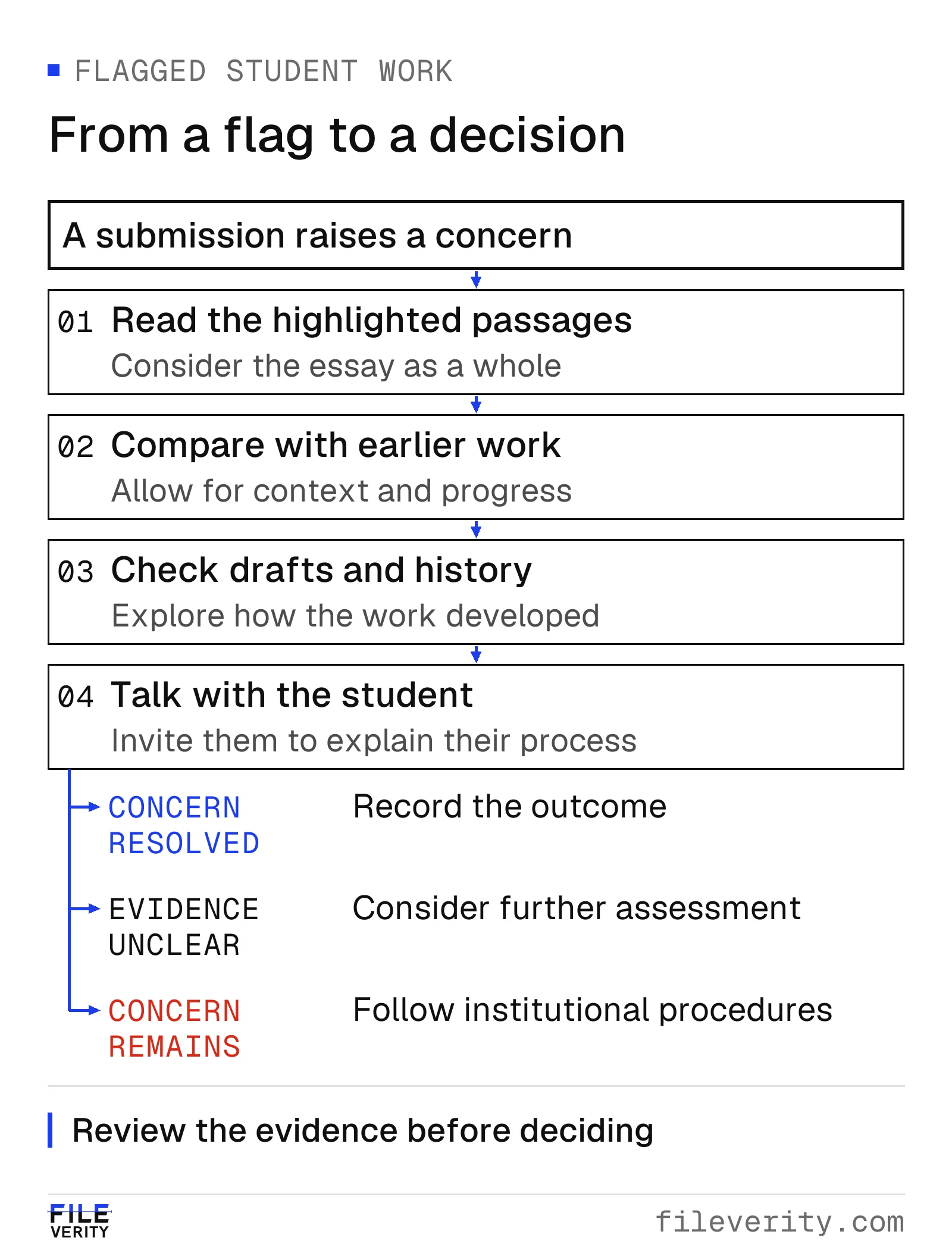
Each route ends with a decision made under the institution's procedures, informed by the available evidence.
Read the highlighted passages in context
If your tool highlights passages, as Veread does, begin by reading them within the essay as a whole. Consider how they address the task, engage with the material taught and develop the student's argument. Familiarity with the student's writing can inform questions, but an impression of style is not enough to establish authorship. When the essay is a Google Doc, the Fileverity Chrome extension lists the flagged passages in a side panel next to the document, which stays unchanged.
Record specific observations: a passage that overlooks the assigned reading, an unsupported claim, an abrupt change in register or a reference you cannot locate. These may have explanations unrelated to AI use. Notes tied to particular passages provide a clearer basis for discussion than a general impression that the essay sounds unfamiliar.
For context on patterns associated with different model families, see how each AI model writes. The patterns described are tendencies rather than unique identifiers; the same expressions also occur in human writing.
Compare the essay with the student's earlier work
Compare the submission with relevant earlier drafts, classroom writing and previous assignments. Consider sentence structure, recurring language patterns, the development of arguments and the use of sources. A change may be worth discussing, but its significance depends on the task, the student's progress and the conditions in which the work was produced.
Choose comparisons carefully. A timed classroom paragraph and a researched report place different demands on a writer. Feedback, additional reading, editing support or a new interest in the subject may also produce substantial improvement. Use differences to frame questions that the student has an opportunity to answer.
Check the process: drafts, notes and version history
Plans, reading notes, outlines and drafts can help explain how an essay developed. Where available, version history in tools such as Google Docs or Microsoft Word can show additions and revisions over time. Review that history with the student: a large pasted section may have been drafted elsewhere, while gradual typing does not establish where the wording originated.
Process records add context that a detector score cannot provide. Education Week's report from 27 February 2025 notes that editing-history tools offer a more nuanced picture, while cautioning against treating them as a final determination of plagiarism. A student may type text produced elsewhere, or compose their own work in a notebook before entering a complete draft into a document.
Which evidence tells you what
Different sources illuminate different aspects of the work. A detector identifies patterns associated with AI writing. Earlier assignments provide context for changes in style. Drafts and version history offer a partial account of the writing process. Sources and notes can demonstrate engagement with the material, while a conversation allows the student to explain their reasoning. A supervised task provides a further writing sample under known conditions. Interpret each in light of what it can and cannot establish.
The figure compares six sources of evidence and offers indicative weights for planning a review. These are practical guides, not validated scores or a fixed hierarchy for every case.
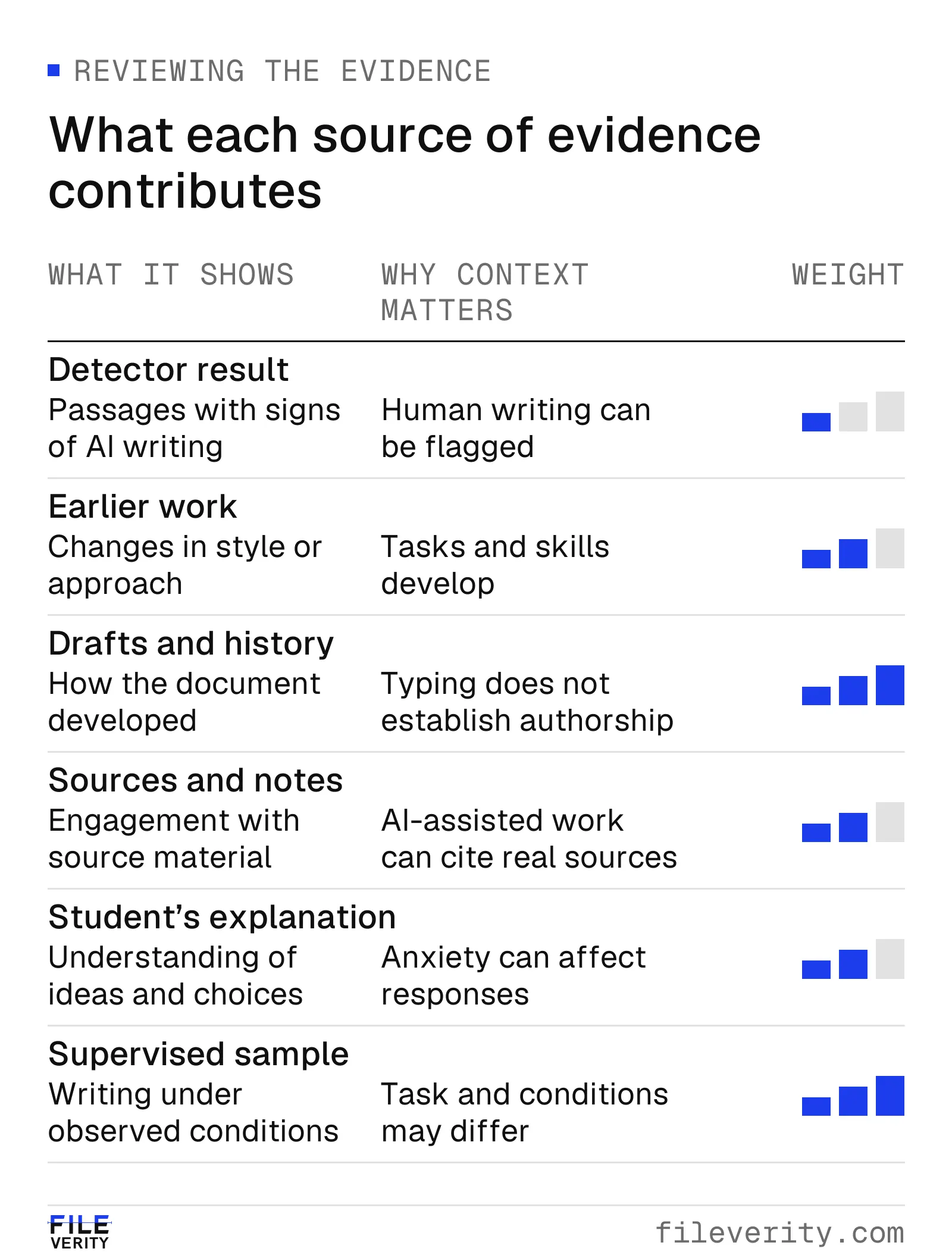
The weights are illustrative. The relevance, quality and independence of the evidence matter more than its position in the table.
No single item settles a case. Agreement between two or three independent sources may strengthen a concern, while conflicting evidence may weaken it or suggest a different explanation. For example, a detailed draft history and a persuasive account of the argument may help explain a flagged passage without supporting an allegation of misconduct.
Hold the conversation
Arrange a private conversation before reaching a conclusion. Describe the specific passages or process questions you want to understand, and invite the student to explain how they approached the assignment. Education Week's report describes a school that treats suspected AI use as an opportunity for learning and, in some cases, allows the student to redo the work.
Useful questions include:
- Can you tell me how you started this essay, and what you did first?
- Can you explain this paragraph in your own words, and why you chose this example?
- Which sources did you use, and where did this claim come from?
- Did you use any tool to plan, draft or edit, and how?
- Can you show me your notes or drafts?
Some institutions routinely combine written assignments with oral discussion. Careers360 reported on 13 April 2026 that teachers at Delhi University and NLSIU Bengaluru had introduced viva voce alongside written work, with one professor describing an assignment as "always accompanied by a conversation with the student". Where appropriate, a five-minute discussion of the argument can provide useful context without becoming a formal viva.
If the student says they did not use AI and has no drafts to share, record their explanation without treating the absence of drafts as proof. Consider a supervised task where policy allows, and follow the institution's procedure for any further review.
Interpreting results for language learners
Human-written work can be flagged, and published evaluations have identified differences in false-positive rates across writing populations. Reporting by The Markup on 14 August 2023 described a Stanford study in which seven detectors labelled essays by non-native English speakers as machine-written about 61 percent of the time, and the study did not test Turnitin. The report explains that detectors tend to flag predictable word choice and simple sentences, a pattern that learner writing often fits.
Turnitin disputed the reach of that study in a post of 26 October 2023, saying that for documents of 300 words or more it found no statistically significant bias against English-language learners, and that its error rate was larger for shorter texts, so it raised its minimum length to 300 words. These findings concern particular products and evaluation conditions; they should not be treated as a single estimate for all detectors. They underscore the need to consider text length and evaluate performance on writing by language learners.
Interpret short answers, conventional genres such as lab reports and summaries, language-learner writing, and heavily edited text with particular care. For detection and false-positive rates, including an evaluation of essays by students and language learners, see the Veread benchmark.
Partly AI-written work
A submission may involve several kinds of assistance. A student might develop an outline and use a model to expand it, or write a complete draft and ask a model to revise one section. Passage-level analysis complements the overall assessment by identifying sections that merit closer review; it does not reconstruct the writing process on its own.
When only part of an essay is highlighted, focus the discussion on how those passages developed. Whether assistance was permitted depends on the assignment rules, which should be clear in the brief. England's Department for Education, in guidance updated on 12 August 2025, suggests that schools may want to review homework policies and other types of unsupervised study, and to develop guidance on when AI use is acceptable for students.
A practical review procedure
- Read the highlighted passages in context and record specific observations.
- Check the analysis requirements: Fileverity requires at least 100 words. Note relevant context, including translation, substantial editing or language learning.
- Compare the essay with at least two relevant earlier pieces by the same student, allowing for differences in task and conditions.
- Ask for available plans, notes, drafts and version history to understand how the text developed.
- Meet the student privately, explain your observations and invite them to discuss their reasoning and writing process.
- Weigh the evidence together and acknowledge any inconsistencies. Consider a short supervised task or revised draft where your institution's policy permits.
- Keep a concise factual record of the review and the student's response, then follow your institution's procedure.
The purpose of this process is a reasoned, documented decision that the student and a reviewing colleague can understand.
If the evidence is still unclear
| What you have | What it suggests | A reasonable next step |
|---|---|---|
| Flag, alongside detailed drafts and a clear explanation of the argument | Evidence that may resolve the concern | Record the explanation and close the review if the evidence supports doing so |
| Flag, with no drafts or clear explanation available | Questions remain about the process | Consider a supervised task where permitted and follow the review procedure |
| Flag, a marked difference from earlier work and disclosed AI use | AI assistance that needs to be assessed against the assignment rules | Apply the relevant policy and give the student an opportunity to respond |
| No flag, but an unexplained change in style and no drafts | An unflagged result does not resolve other concerns | Discuss the writing process and request any available supporting material |
| Flag on a short text or language-learner writing | The result needs particularly careful interpretation | Check the tool's scope and evaluation, and review other evidence |
Record the case and follow your school's procedure
Keep a concise factual record of the assignment, date, highlighted passages, comparisons, process evidence and the student's explanation. Store your review notes separately from the detector report, with enough detail for a colleague to follow the reasoning and distinguish observations from conclusions.
Misconduct decisions must follow the institution's or awarding body's procedures, including its evidence standards and opportunities for response or appeal. Include the detector result as one source within that process.
Check the rest of the class the same way
A consistent review process can help a teaching team apply the same criteria across an assignment, while still considering each student's circumstances. Batch check accepts the ZIP file downloaded from your learning platform and produces individual results for supported submissions. Verified teachers can apply for the Pro plan, free for 12 months, on the teachers page. See checking a whole class set of essays for download instructions for Google Classroom, Moodle, Canvas, Microsoft Teams, Blackboard and Brightspace.
Common questions
Does an AI detector score prove that a student cheated?
No. A score or highlighted passage indicates patterns associated with AI writing; it does not establish authorship or misconduct. Ofqual's advice note treats these tools as sources of evidence rather than sole determinants. Review the work, examine any process evidence and give the student an opportunity to explain.
What should I do first when an AI detector flags a student's essay?
Read the highlighted passages in context and record specific observations. Compare relevant earlier work and review any available drafts or version history. Frame the subsequent conversation as an enquiry into the work, without reaching a conclusion in advance.
What if my student denies using ChatGPT?
Invite the student to explain their process and share any notes, drafts, sources or version history. Discuss a passage and the reasoning behind it. If questions remain, consider a supervised task or revised draft where policy allows, and continue under your institution's procedure rather than drawing a conclusion from the flag alone.
Can an AI detector wrongly flag students who write English as a second language?
Yes. Human-written text can be flagged, and some published research found higher false-positive rates for non-native writers in the detectors it evaluated. Check the tool's evaluation and text-length requirements, read passages in context, and consider drafts and the student's explanation alongside the result.
How long does a text need to be for a reliable result?
Fileverity requires at least 100 words. Other vendors set their own minimums; Turnitin raised its minimum to 300 words after finding higher error rates on shorter texts. Meeting a minimum length does not guarantee a correct result, so interpret short answers with particular care.
Should I run the student's older work through the detector to test it?
A known human-written sample, such as work completed under supervision, can help you understand how the tool behaves on that student's writing. Follow institutional rules for using student work and protect its privacy. A flag on such a sample is a reason to investigate the tool's behaviour and interpret the current result cautiously.
Sources
- Ofqual, Artificial intelligence malpractice and assessment advice note, published 27 April 2026.
- Department for Education (England), Generative artificial intelligence (AI) in education, updated 12 August 2025.
- Education Week, Why teachers should talk to students before accusing them of using AI to cheat, 27 February 2025.
- Careers360, No UGC framework, no scope of AI-free assignments; teachers rethink class assessment with viva voce, 13 April 2026.
- The Markup, AI detection tools falsely accuse international students of cheating, 14 August 2023.
- Turnitin, New research: Turnitin's AI detector shows no statistically significant bias against English language learners, 26 October 2023.
By Yang Zheng