Evaluating detection
AI Text Watermarks in 2026: Who Marks ChatGPT, Claude, Gemini and Grok Text
Which AI vendors watermark text in 2026, from OpenAI textGrain to SynthID, who can verify it, what the EU AI Act requires and what a mark proves.
Published · Updated · 7 min read
On this page
Who is watermarking AI text in 2026, and can you check it? OpenAI, Anthropic, Google and xAI have each described a statistical watermark for at least some of their text, and none of them gives the public a checker. DeepSeek, Qwen and GLM label output visibly under China's rules but have published no hidden text watermark. This tracker is current as of 10 November 2026, with each fact dated to the vendor page it comes from, and it explains what a watermark can and cannot prove.
The practical answer for a teacher, editor or compliance reviewer is short. A text watermark is a private test run by the vendor or by organizations the vendor approves. For everyone else, the only check left is the style of the writing, which is a signal and not proof.
Who marks AI text in 2026: the vendor matrix
The matrix below compares the vendors on four questions: which watermark, where it is on by default, who can verify it and whether a public text checker exists. Every row is true as of 10 November 2026, and the sections that follow give the dates and sources.
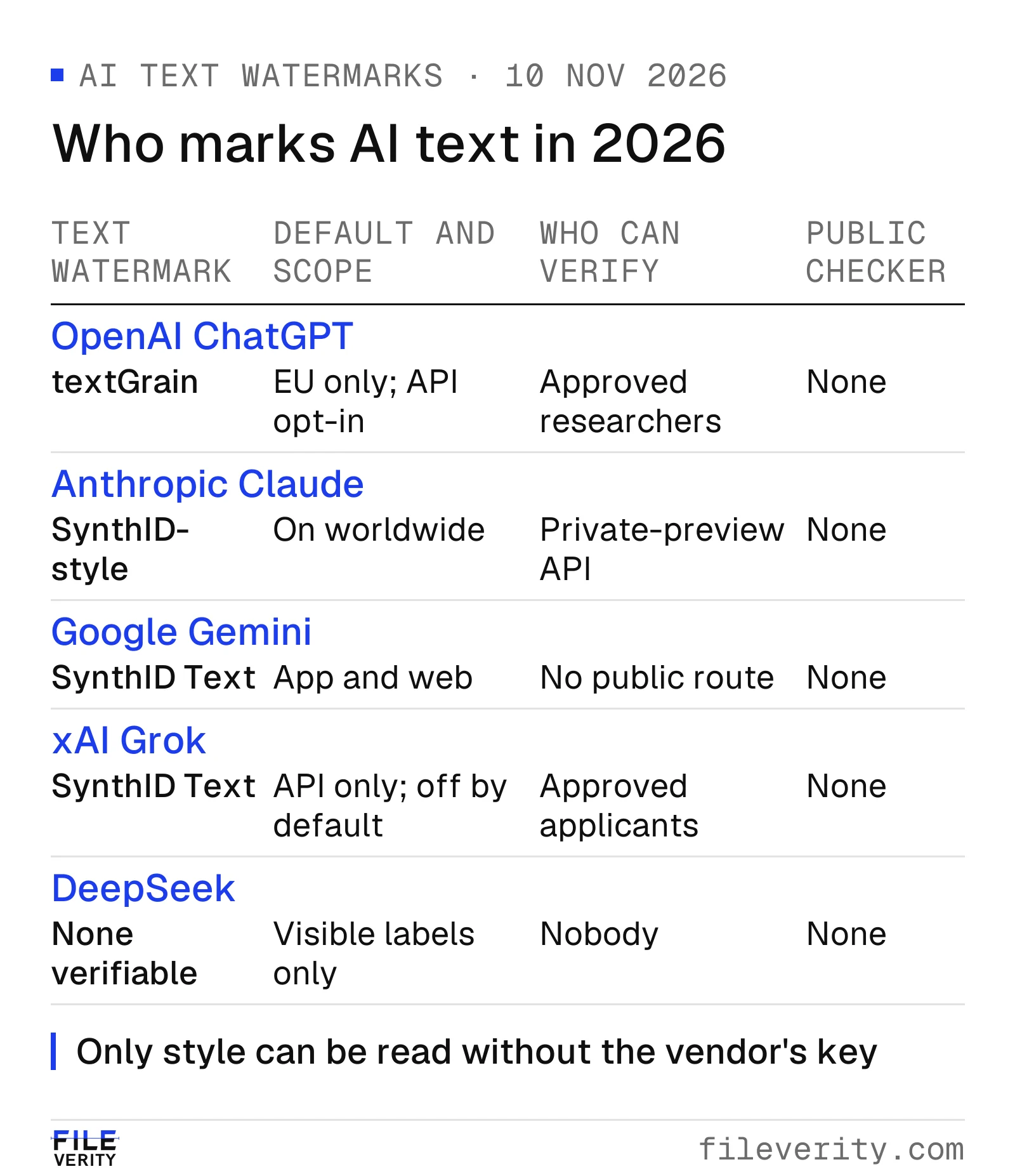
Only style can be read without the vendor's key: not one of the five vendors offers a public checker for text.
OpenAI: textGrain in the EU
On 5 October 2026 OpenAI announced textGrain, an invisible statistical signal in word choices (OpenAI). OpenAI said it would add the watermark to eligible ChatGPT and Codex text in the EU only, across all plans, and that it was "not making text watermarking a global default at launch". API customers worldwide can opt in for select models, and the watermark stays off by default there. OpenAI's help article, checked on 10 November 2026, lists text as "textGrain watermarks (EU only)" and ties it to the EU AI Act and the EU Code of Practice on Transparency of AI-Generated Content.
OpenAI's text detector is not public. Access is by application and, initially, goes to approved researchers and expert organizations. OpenAI also states that the absence of a detected watermark does not prove human authorship. For the full status and how to check ChatGPT text without the key, see ChatGPTDetect's watermark page.
Anthropic: a SynthID-style watermark on Claude
On 14 August 2026, updated on 1 September, Anthropic published how Claude's text watermarking works (Anthropic). It is a version of the SynthID-Text approach from Google DeepMind. Nothing is added to the text: no hidden characters and no extra tokens. Anthropic applies it worldwide rather than by region, and it signed the EU Code of Practice in July 2026.
Detection is a private-preview API for eligible organizations, such as regulators, media, fact-checkers, researchers and educational organizations, and for enterprises that must check their own Claude outputs. Individuals cannot check text themselves. Anthropic says a mark cannot tell "Claude wrote this" from "Claude heavily edited this", that detection works poorly on short samples and that a full rewrite removes the signal. See ClaudeDetect's watermark page for the model coverage and what you can check without the key.
Google: SynthID Text in Gemini, but the public detector skips text
Google announced on 14 May 2024 that SynthID would watermark text from the Gemini app and web experience. Its own pages say the watermark is less effective on factual prompts and that confidence can be greatly reduced after heavy rewriting or translation. SynthID Text is open source, and its detection is probabilistic: watermarked, not watermarked or uncertain. The owner of the model chooses whether a detector is private, semi-private or public.
On 7 October 2026 Google opened the public SynthID Detector to everyone, but only for images, video and audio from Google and its partners. Text is not mentioned, and we found no Google page that lets a third party verify Gemini text. A search-result summary saying the portal accepts text draws on Google's 2025 announcement, which listed text as planned; the 2026 pages list none. GeminiDetect's watermark page keeps the two lists apart.
xAI: the Grok API watermark is off by default
xAI's watermarking page, last updated on 9 November 2026, says text watermarking is off by default and that team admins can turn it on per model in the Console (xAI docs). It applies to text from the Responses and Chat Completions APIs for the models a team switches on, and the technique is SynthID Text. An x-watermark: true header on the response says that request was watermarked.
Earlier coverage said the watermark would be on by default from 7 November, so the page is worth re-reading before you rely on this row. Detection is statistical and reports watermarked, not watermarked or uncertain, with stronger signals on longer text. Access is granted by application, and we found no public checker. Text from the Grok app, from teams that left the setting off and from models not on the list carries nothing to find. More in GrokDetect's watermark page.
DeepSeek, Qwen and GLM: labels under China's rules
China's Measures for Labeling AI-Generated Synthetic Content were issued on 7 March 2025 and have been in force since 1 September 2025. They require explicit labels visible to users and implicit labels in file metadata. DeepSeek's terms of use, dated 5 September 2025, say it has added labels inside its platform that remind users that content is AI-generated and forbid removing or hiding them.
We found no DeepSeek source describing a hidden statistical text watermark, and no public tool that verifies one. Absence from the sources we read is not proof that none exists, so we word it as no public verification tool published. For Qwen and GLM we found no vendor watermark statement at all. Plain-text copy and paste also drops file metadata, so a metadata label does not travel with pasted text. Details are on DeepSeekDetect's watermark page.
The EU AI Act marking duty and the Code of Practice
The EU is the reason most of these watermarks exist. Article 50(2) of the AI Act requires providers of systems that generate synthetic text to mark outputs in a machine-readable format and make them detectable, using solutions that are effective, interoperable, robust and reliable as far as technically feasible. It applies from 2 August 2026, and providers of systems already on the market before that date have until 2 December 2026. The voluntary Code of Practice on transparency of AI-generated content, published in final form on 10 June 2026, describes how providers can meet the duty. Adherence does not constitute conclusive evidence of compliance.
The duty is about marking and detectability, not about handing every reader a checker. That explains how vendors can mark text and still leave the public without a way to read the mark. Our guide to AI labels and EU AI Act Article 50 covers the duties, dates and penalties.
How a statistical text watermark works
A statistical watermark is applied while the model writes. A secret key and the words before the next position seed a score for every possible next word. The model then slightly favors higher-scored words, so the choice tilts without changing what the sentence says. The text reads normally, with nothing added to it.
A detector holding the same key recomputes those scores over the text. If the words land on high scores more often than chance allows, it reports watermarked. If they do not, it reports not watermarked, and when the evidence is thin it reports uncertain. The result is a likelihood, not a verdict. The figure shows the five steps and the three things that weaken the signal.
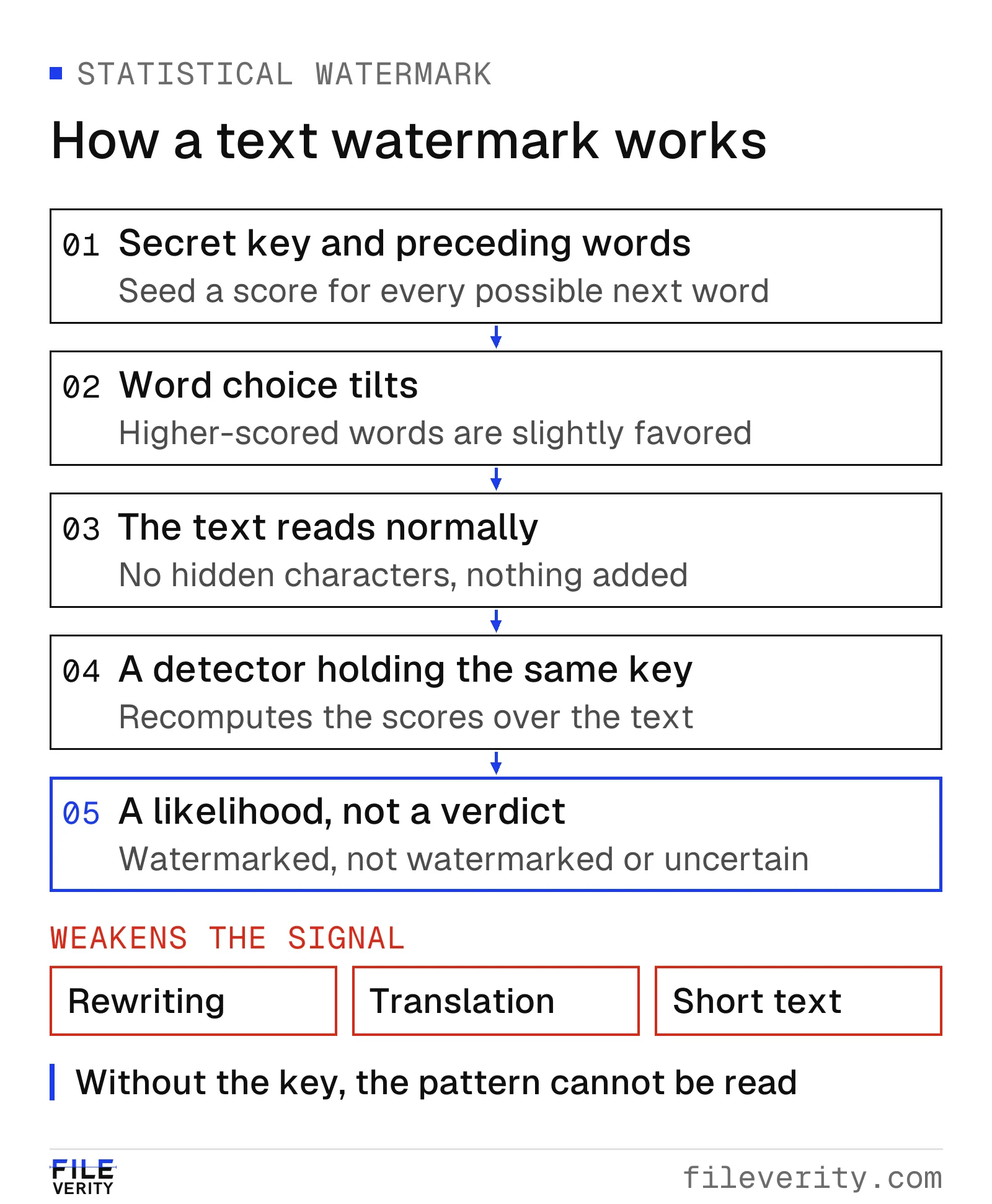
Without the key, the pattern cannot be read: the watermark lives in word choice, and only the key shows which choices were tilted.
What a text watermark can and cannot prove
A detected mark is a signal that a vendor's model processed the text. It is not conclusive, because the model may not be the original author: it may have proofread, translated or summarized a human draft. Anthropic says a mark cannot separate writing from heavy editing, and OpenAI says a watermark does not identify the user, measure human contribution, establish ownership or verify accuracy.
A missing mark proves even less. The text may come from a model or setting that is not marked, from outside the EU, from a vendor with no watermark, or it may have been rewritten or translated until the signal faded. Short passages carry little signal to begin with. Vendors say this themselves, so nobody should treat "not watermarked" as "human".
Why style-based detection is the check open to the public
Without the key, a watermark cannot be read, and the vendors have kept detection to approved organizations. What every reader can still see is the writing itself. Style-based detection compares a text with how AI models and people write, needs no cooperation from the vendor and works on text from any model, marked or not.
Veread is Fileverity's text model. It reads a whole passage and reports writing-style similarity to the major model families. Veread 1.1 detected 98.6% of fully AI-written text, 94.9% of text from models it had never seen, and gave 0.28% false positives on human text across seven languages; the full accuracy report shows every result. Treat a Veread result as evidence for review, together with the context and the document history, and not as proof of authorship. To see which phrases and habits separate the families, read how each AI model writes.
By Yang Zheng