Evaluating detection
Which AI Wrote This? How ChatGPT, Claude, Gemini, Grok, DeepSeek, Qwen and GLM Write
The phrases, punctuation and structure that set seven AI model families apart from human writers, with multipliers, the method and why they are not proof.
Published · Updated · 6 min read
On this page
Can you tell which AI wrote a text? Sometimes you can lean one way. Each model family has habits: phrases it reaches for far more often than a human writer, punctuation it avoids and structures it repeats. This guide lists those habits for ChatGPT (OpenAI), Claude (Anthropic), Gemini (Google), Grok (xAI), DeepSeek, Qwen (Alibaba) and GLM (Zhipu) in English, with the multiples we measured against human writers.
None of it is proof. People use these phrases too, and a prompt can change a model's style. A tell is a reason to look harder, and a family result is writing-style similarity, not a statement about who typed the words. The numbers below come from Fileverity's own corpus of fully AI-written and human-written English documents.
The phrases that give each family away
The figure shows two characteristic phrases per family and how many times more often each appears than in human writing. The scale is shared, so a very large value such as 25× shortens the others. Phrases that read as ordinary wording and can be searched for in a text were chosen over stray fragments.
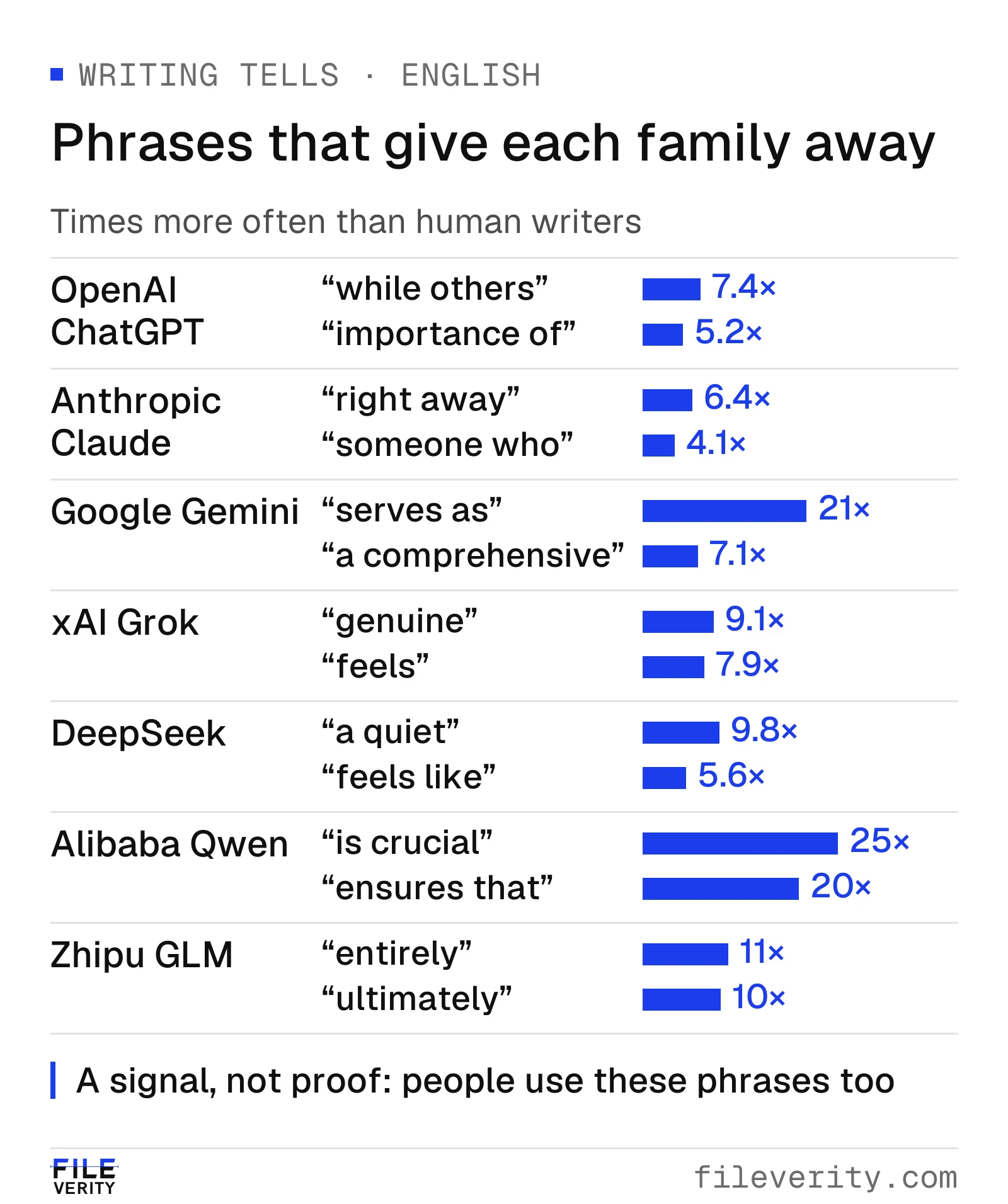
A signal, not proof: people use these phrases too, and none of them identifies a model on its own.
Some phrases are shared. "Rather than" appears 4.6 to 7.3 times more often than in human writing in every family we measured, so it says "AI" but not which one. The sections below use the phrases that also set a family apart.
ChatGPT (OpenAI): the connective, advisory voice
ChatGPT text leans on "while others" (7.4× the human rate), "importance of" (5.2×), "is essential" (5.8×), "this approach" (5.8×) and "offers a" (5.9×). Against the other AI families it stands out for "intended to", "and whether", "easier to" and "can help", an explanatory, advice-giving register.
Structurally it uses em dashes at 8.2 times the human rate and three-item lists at twice the human rate, with fewer parentheses (3.2× less often) and ellipses (3.5× less often). Its sentences are also more uniform in length. More on the tells at ChatGPTDetect.
Claude (Anthropic): plain, hedged, few flourishes
Claude favors "right away" (6.4×), "someone who" (4.1×), "far more" (11×), "yet the" (10×), "tends to" (4.2×) and "practical" (6.5×). Against other AI families it is more likely to say "depends on", "the whole", "a little" and "I think".
Its punctuation is restrained: ellipses appear 13 times less often than in human text, and em dashes are 3.7 times less common than in the other AI families, so the em-dash tell does not apply to Claude. Three-item lists run 1.6 times the human rate. See ClaudeDetect's tells page.
Gemini (Google): formal and emphatic
Gemini's strongest tell is "serves as" at 21 times the human rate, with "furthermore the" (14×), "the primary" (8.3×), "a comprehensive" (7.1×), "the digital" (8.9×) and "ensuring that" (9.4×). It also leans on intensifiers such as "truly", "entirely" and "completely" more than other AI families.
Em dashes appear at 5 times the human rate. Ellipses are 7.2 times less common than in human writing. See GeminiDetect's tells page.
Grok (xAI): a narrative, reflective register
Grok text uses "genuine" (9.1×), "feels" (7.9×), "quiet" (8.2×), "remains" (6.8×) and "far more" (12×). Against other AI families, "had never", "almost" and "continued" stand out, which gives it a storytelling tone.
Its punctuation is the plainest of the group: no clear em-dash excess, exclamation marks 7.5 times less often than human writers and ellipses 8.8 times less often. See GrokDetect's tells page.
DeepSeek: quiet, figurative and heavy on dashes
DeepSeek shares part of Grok's register with "a quiet" (9.8×), "feels like" (5.6×), "a moment" (5.2×) and "the kind" (5.1×), alongside "practical" (6.6×) and "yet the" (8.5×). It sets itself apart with "a short", "kind of" and "the problem".
Its em dashes run at 11 times the human rate, second only to GLM. It also opens a list with a colon in 15% of texts against 11% for human writers. See DeepSeekDetect's tells page, which also covers Qwen and GLM.
Qwen (Alibaba): the most formal, with the largest multipliers
Qwen has the most extreme phrase multipliers: "is crucial" (25×), "serves as" (26×), "ensures that" (20×), "furthermore the" (17×), "ensuring that" (16×) and "is essential" (11×). Against other AI families, "ensures that", "not merely", "merely a" and "allows for" mark it out.
Em dashes run at 5.3 times the human rate, and its paragraphs average 75 words against 53 for human writers. Qwen is covered on DeepSeekDetect's tells page.
GLM (Zhipu): few stable phrases, many intensifiers
GLM is close to the other families in English, and only five phrases passed every stability check when compared with them: "completely", "highly", "entirely", "absolutely" and "furthermore". Against human writers it leans on "entirely" (11×), "ultimately" (10×), "deeply" (9.4×), "furthermore" (8×) and "typically" (6.2×). Treat any GLM call with extra caution.
Its em dashes are the most frequent of all, at 12 times the human rate, and ellipses are 3.5 times more common than in the other AI families. GLM has a section on the same DeepSeekDetect tells page.
Punctuation and structure: what the families share and where they differ
Structure is a steadier signal than single phrases, because it is counted across the whole text. The matrix shows four markers, each as a multiple of the human rate per 1,000 words. Three patterns are shared by every family: fewer parentheses, fewer ellipses and more three-item lists. Em dashes are the marker that separates them, from no clear difference in Claude and Grok to 12 times the human rate in GLM.
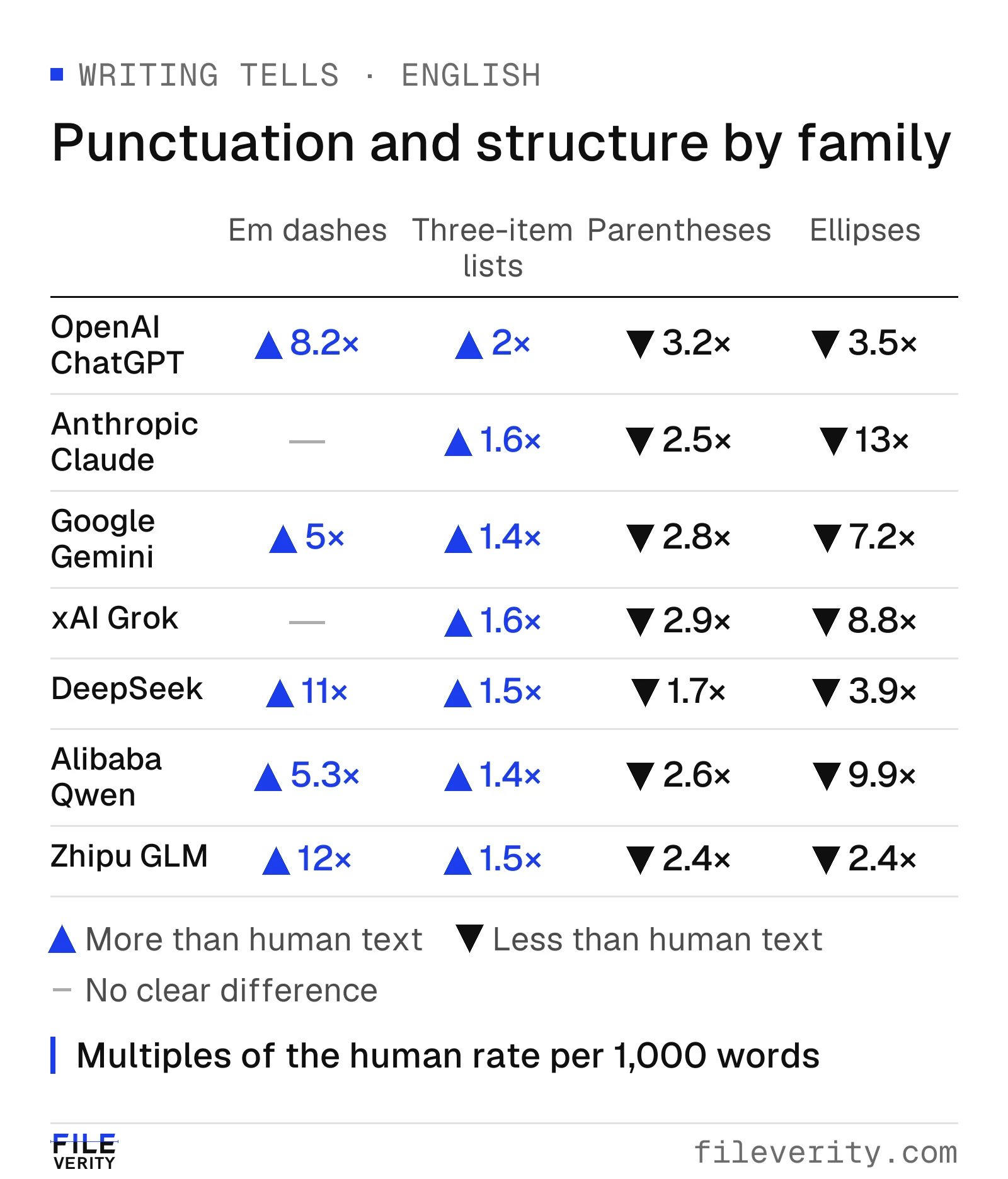
Multiples of the human rate per 1,000 words: the triangle shows whether a family writes more or less of it than people do.
How we measured these tells
For each family we compared fully AI-written documents with human documents in the same language. The human documents were re-weighted to the same mix of sources and genres as the AI documents, so topic and genre do not drive the result. Phrases are runs of one to three words, scored by how much more likely they are in one group than the other.
We kept only phrases that appear in many documents across several sources and genres, that are not names, numbers or topic words, and that point the same way in two random halves of the data. Structural markers come from the raw text and were kept only when the direction agreed in both halves and for both writing and rewriting tasks. The AI texts were generated as plain prose, so list and heading markup say little about real chat output.
Caveats: people use these phrases too
These are statistical tendencies of a family, not fingerprints. A human writer in a formal register uses "serves as" and "furthermore the" too. Prompting changes style, so a model asked to write casually drops many of these habits. A model that edits a human draft carries little of its own style at all. Newer versions drift, and the multipliers apply to the corpus we measured, not to every text.
For that reason a phrase list is a weak detector on its own. It misses text that avoids the tells and flags honest writers who share them. Use the tells to know where to look and decide with the evidence around the text. Text marked with a vendor watermark is a separate question, covered in our AI text watermark tracker.
How Veread reads far more than phrase lists
Veread, Fileverity's text model, does not look up a list. It is trained on massive proprietary data and reads whole passages, weighing vocabulary, rhythm, structure and punctuation together in each of seven languages. A text with no famous phrase can still read as AI-written, and a human text that happens to contain one is not flagged for it alone.
Veread reports writing-style similarity to the model families, so you see which style a passage resembles, and marks the passages that carry the finding. In our evaluation Veread 1.1 detected 98.6% of fully AI-written text and 94.9% of text from models it had never seen, with 0.28% false positives on human text across seven languages. The accuracy report has the full results. To run the same model on a page you are reading or on an open Google Doc, without pasting the text, use the Fileverity Chrome extension.
By Yang Zheng