Evaluating detection
How a Plagiarism Checker Works, What It Finds and What It Misses
How a web plagiarism check finds matching text, what it cannot see and how to read the share, sources and exact versus close matches in a result.
Published · 9 min read
On this page
A web plagiarism check finds passages in your text that also appear, word for word or nearly so, on public web pages and in Wikipedia, and shows you where. It answers one narrow question: does this text contain runs of words that someone has already published online? It does not say whether the author copied, whether a quotation was cited properly or whether the ideas are original. Those judgments need a reader. This guide explains how a plagiarism checker works, what it finds, what it cannot see and how to read the result, using the check in Fileverity's text tool as the example.
It is written for students checking an essay before handing it in, teachers who must decide what a result means, and editors who need to know whether a submission reuses published text.
What a web plagiarism check does
The check takes your text, picks out distinctive phrases, looks for them on the public web and in Wikipedia, reads the pages it finds and compares them with your text word by word. The result is your text with the matching passages marked, a numbered list of the sources they match and a share: the part of your text that matches.
Each marked passage can be verified by opening the source and reading both versions side by side. That makes the result a starting point, not a verdict.
The pipeline, step by step
Fileverity's plagiarism check takes plain text of at least 50 words and up to 30,000 characters. It searches in the language of the text: English, Spanish, French or Arabic. Typical duration is ten to sixty seconds. The check runs in five steps.
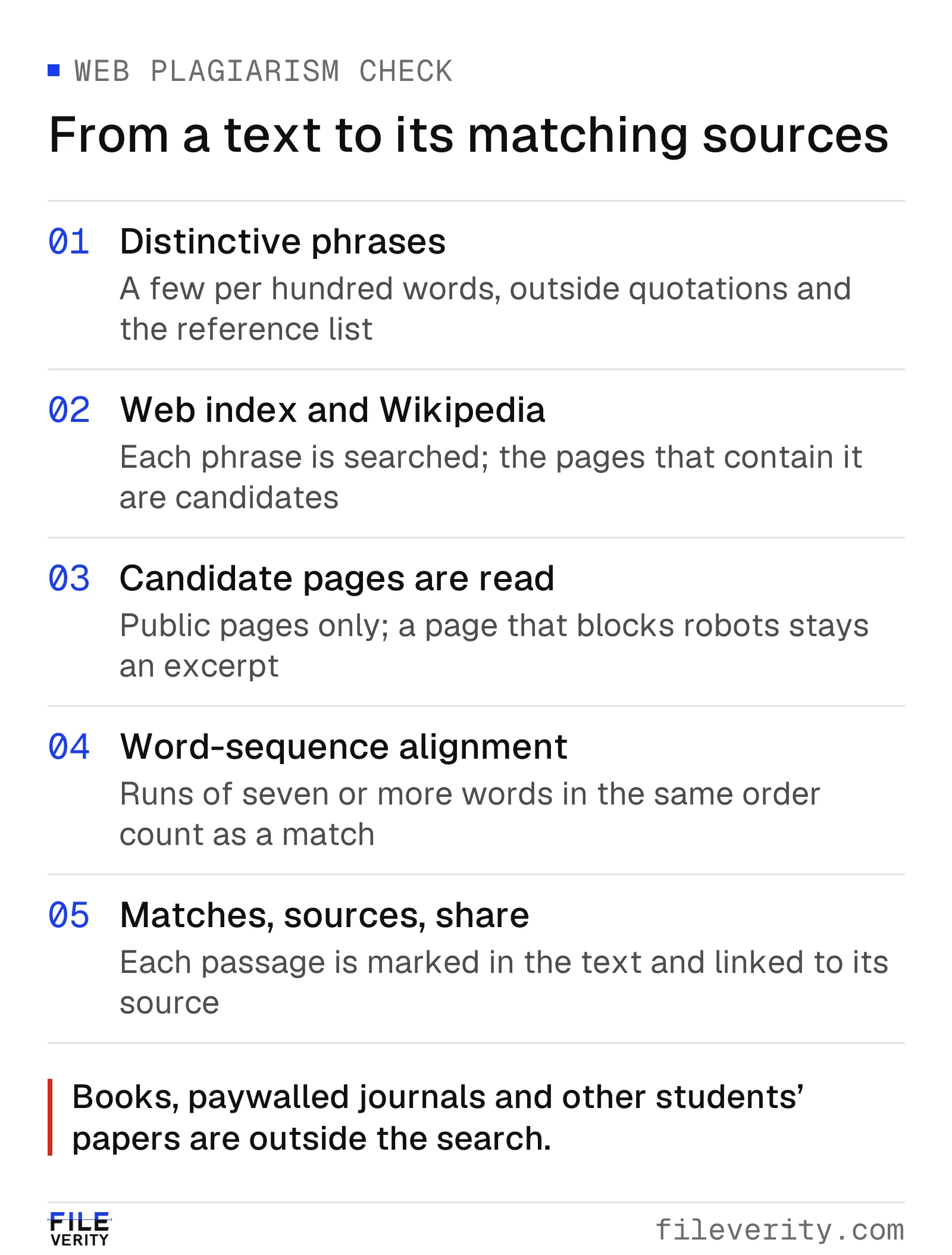
Books, paywalled journals and other students' papers are outside the search.
1. Distinctive phrases. The check picks about one phrase for every seventy words, up to twenty-four, taken from outside quotation marks and the reference list. Distinctive means uncommon enough that a page containing it is likely a real source.
2. Search. Each phrase is searched in a public web search index and in Wikipedia in the text's language. The pages that contain a phrase become candidates.
3. Pages are read. Up to fifteen candidate pages are fetched and read. The check respects robots.txt, the file with which a website tells automated visitors what they may fetch; the standard is the Robots Exclusion Protocol, published as RFC 9309 in September 2022. When a page cannot be read, the check compares your text with the search excerpt only, and the source is tagged "Excerpt only".
4. Alignment. Your text and each page are aligned word by word. A run of seven or more words in the same order counts as a match. A run with small gaps, up to three words, is a "close match"; an unbroken run is an "exact match".
5. Result. Every matching passage is marked in the text and linked to a numbered source. The source list gives each source's title, host and the share of your text it accounts for.
The check does not guess or judge style. It finds sequences of words that are the same.
What counts in the share, and what does not
The share is matched words divided by the words that count, after the exclusions. Passages inside quotation marks and entries in the reference list are flagged and excluded from the share by default; two checkboxes include them if you want to see the figure with everything counted.
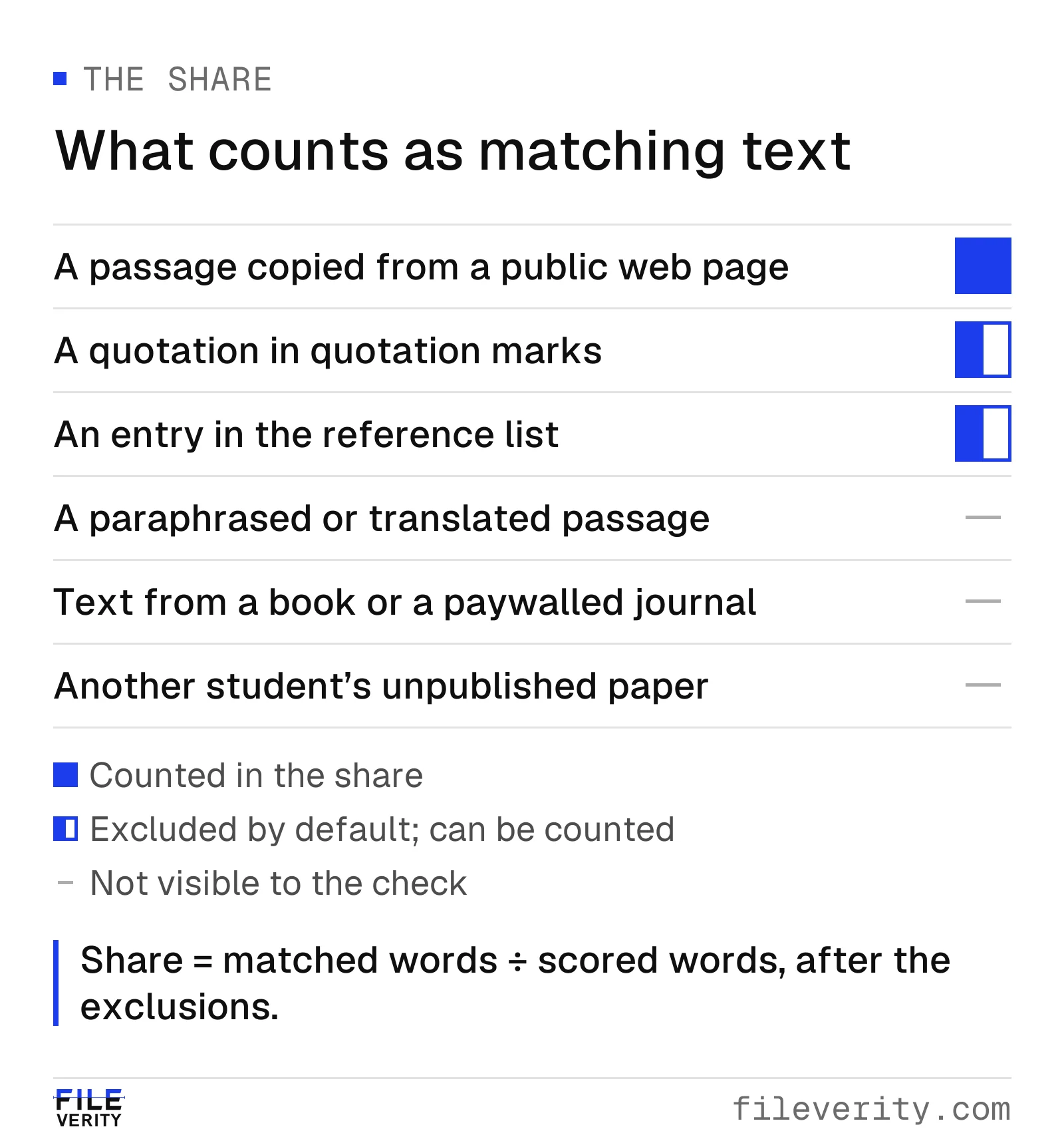
Share = matched words divided by scored words, after the exclusions.
Quotations are excluded because quoting with attribution is legitimate, and reference-list entries are supposed to match published titles and authors. Both stay flagged in the text.
Four kinds of text are outside what this check can see.
- Paraphrase. Only runs of words in the same order are found. A passage rewritten in different words has no run to find, however closely it follows the source.
- Translation. A passage translated from a source in another language shares no words with it.
- Books and paywalled journals. The check searches the open web and Wikipedia. It does not search books or articles behind a paywall.
- Other students' papers. Learning-platform submissions, other students' work and private databases are not searched.
A result with no matching text therefore means no match was found in the open web and Wikipedia. It does not mean the work is original.
How to read a result
Start with the headline band: no matching text, little, some or much. It orients you; it is not a threshold for action.
Read each marked passage in context. Common phrases and properly cited passages also match. A methods sentence such as "participants were randomly assigned to one of two groups" will match hundreds of pages, and nobody owns it. A sentence that expresses a distinctive idea in distinctive words, and that appears on one web page, deserves a closer look.
Look at the source. The source list shows a title, a host and the share each source accounts for. One source accounting for most of the matching text tells a different story from twenty sources that each match one stock phrase.
Separate exact from close matches. An exact match is an unbroken run of seven or more words. A close match has small gaps of up to three words, so it can mean a light edit of the original, or a coincidence of common phrasing.
Note the "Excerpt only" tag. It means the page could not be read in full, for instance because the site asked automated visitors not to fetch it, and the comparison rests on the search excerpt. Open the source yourself before you rely on it.
A short worked example
An invented essay excerpt, 600 words long, is checked. Sixty words sit inside quotation marks and the reference list; they are excluded, so 540 words count. The check marks 81 words in three passages. The share is 81 divided by 540, which is 15 percent, and the headline reads "some matching text".
The reader opens the three sources. Passage one is a sentence from a Wikipedia article on the topic, copied with two words changed and no quotation marks: a genuine concern, and a close match, not an exact one. Passage two is a standard definition from a textbook website that the essay cites in its first footnote; it is properly attributed, and the passage needs only quotation marks. Passage three is a stock phrase of eleven words found on many pages. Only one passage needs a conversation, and it is about quoting and paraphrasing, not an accusation. That is the sense in which matching text is not a verdict.
Plagiarism check or AI detection
Plagiarism checks and AI text detection ask different questions and use different evidence. A plagiarism check asks whether words appear elsewhere; its evidence is a source you can open. An AI text detector asks whether the writing shows patterns associated with a language model; its evidence is a set of passages and a probability, and it can only say something about the text itself.
The two are independent. A copied passage can be entirely human-written, and a passage generated by a model may match no page at all. Neither check substitutes for the other. In Fileverity's text tool both run on the same text in one window, along with the grammar check. For the AI side, see the AI text detector and, for a review procedure when a result is surprising, what to do when an AI detector flags a student's essay. The Veread benchmark shows how the detector performs.
Plagiarism check or institutional systems
Institutional systems cover more ground. Turnitin's own Similarity page says it compares a submission against a collection of student submissions, premium publications from top publishers and more than twenty years of internet content, including archived web pages. Compilatio describes its API as comparing documents with billions of online sources, academic databases and previously analyzed documents. Student-paper repositories and licensed publications are not public, which is why a web check cannot replace them.
A web check covers the open web and Wikipedia, which is often where copied text comes from, and is available to a student before submission and to a teacher or editor without an institutional licence. Use it as a first pass. Where your institution runs a system, its report is the one that carries weight in a procedure.
Institutional reports carry the same caution. The University of Nevada, Reno says the Similarity Report "does not automatically detect and report plagiarism" and leaves interpretation to the instructor and student; the University of Tennessee, Knoxville says that "a high similarity score does not always suggest that a piece of writing has been plagiarized." A percentage from any tool is a pointer.
Notes for English-language markets
In US institutions the rules usually sit in an academic integrity policy or an honor code. In UK, Canadian and Australian institutions they sit in a student handbook or assessment regulations. In either case, what counts as acceptable reuse, how much quotation is allowed and what happens after a match is for the institution, not for the checker.
Students get the most from the check before submission: read each marked passage, add quotation marks and a citation where you quoted, rewrite and cite where you followed a source too closely, and leave a stock phrase alone. For teachers, a result is a reason to read the source beside the passage and to ask the student about their process. For editors, a match shows previously published text; it does not show who published it first.
Privacy and cost
Only short phrases of your text are sent to the search services.
The plagiarism check is part of the Pro plan and uses 1 credit per 1,000 characters of text, or part thereof. Verified teachers receive the Pro plan free for 12 months. The same check is available through the API; see the plagiarism API documentation.
Common questions
How does a plagiarism checker work?
It picks distinctive phrases from your text, searches for them online, reads the pages that contain them and aligns your text with each page word by word. Runs of seven or more words in the same order count as matches, and the result lists each source and the share of your text it accounts for.
Does a plagiarism checker find paraphrased text?
No. This check finds runs of words in the same order, so a passage rewritten in different words, or translated, does not match. Reading the source beside your own text is the only way to judge a close paraphrase.
Is a high percentage always plagiarism?
No. Matching text includes common phrases, quotations and properly cited passages. Read each passage in context and judge it against your institution's rules. The percentage points you to passages; it does not decide anything.
Does no matching text mean my essay is original?
It means no match was found in the open web and Wikipedia. Books, paywalled journals and other students' papers are not searched, and paraphrased or translated passages are not found.
Is this a replacement for Turnitin or Compilatio?
No. Those services compare against databases of student papers and licensed publications that are not public. This check covers the open web and Wikipedia.
Sources
- Turnitin, Turnitin Similarity, accessed 16 November 2026.
- Compilatio, Plagiarism Detection API & AI Content Checker, accessed 16 November 2026.
- University of Nevada, Reno, Teaching & Learning Technologies, Introduction to Turnitin, accessed 16 November 2026.
- University of Tennessee, Knoxville, Office of Innovative Technologies, Turnitin Similarity, accessed 16 November 2026.
- Internet Engineering Task Force, RFC 9309: Robots Exclusion Protocol, September 2022.
By Yang Zheng · Reviewed by Bill Liu